Understanding the Compassion Focused Therapy Model:
Compassion Focused Therapy (CFT) is a psychological approach that helps people reduce self-criticism and improve emotional well-being. It teaches people to develop kindness and compassion toward themselves and others. Through practices such as compassionate imagery, mindfulness, and empathy, CFT can help people manage difficult emotions, build emotional resilience, and develop a more supportive inner voice. Compassion is valued in many religious and philosophical traditions because it can promote kindness, connection, and a more caring way of living. CFT applies these ideas in a practical way to support healthier and happier lives. In the rest of this article, we will explore understanding the Compassion Focused Therapy Model.
What Is Compassion Focused Therapy?
According to the Compassionate Mind Foundation, Compassion Focused Therapy (CFT) is “an evidence-based form of psychotherapy that draws upon our evolved capacity for compassion to facilitate the alleviation of human suffering” (CMF-USA).
CFT was developed by Dr. Paul Gilbert, a psychologist from England. He believed that compassion toward ourselves and others could help people manage difficult emotions, especially shame and self-criticism. The main goal of CFT is to help people develop a kinder and more supportive attitude toward themselves (Gilbert, 2009).
3 Distinctive Features of Compassion Focused Therapy:
CFT has some important features that make it different from many other types of therapy. Other therapies may also use compassion, mindfulness, or similar techniques. However, CFT brings these ideas together in a unique way. Three main features help explain what makes CFT distinctive.
- Combining Western and Eastern Ideas: CFT combines ideas from both Western and Eastern traditions. It draws knowledge from evolutionary psychology, biology, neuroscience, and Buddhist thought. These different areas help explain how the human mind works, how emotions develop, and how compassion can support psychological well-being.
This combination gives CFT a broad understanding of human behavior. It considers both scientific knowledge and practices that have been used in Eastern traditions for many years. The aim is to use these ideas together to help people understand their emotions and respond to themselves with greater compassion.
- An Interactional and Compensatory View of the Mind: Another important feature of CFT is its interactional and compensatory view of the mind (Gilbert, 2010a). This means that different parts or patterns of the mind can influence each other.
Some mental patterns may receive more attention and become stronger, while other important mental abilities may receive less attention. For example, a person may develop strong patterns of self-criticism, fear, or shame while having less developed abilities to comfort and support themselves.
CFT helps people understand these patterns and develop healthier ways of responding. When one part of a person’s mental system becomes stronger, it can also influence other parts. Developing compassion, for example, may help reduce self-criticism and create healthier emotional responses. In this way, positive changes in one area of the mind can have a wider effect on other areas (Gilbert, 2010a).
- The Idea of Social Mentalities: CFT also focuses on the idea of social mentalities (Gilbert, 2010a). Social mentalities are patterns in the mind that influence how people seek, understand, and develop relationships with others.
Paul Gilbert identified different types of social mentalities. These can influence relationships such as sexual relationships, group or tribal relationships, dominant and subordinate relationships, and caring relationships between people who give and receive care (Gilbert, 2010a).
Understanding these social mentalities can help people recognize how their relationships affect their thoughts, feelings, and behaviour. It can also help them develop healthier and more compassionate ways of relating to themselves and others.
Together, these three features make CFT a distinctive therapeutic approach. By combining Western and Eastern ideas, understanding how different parts of the mind interact, and exploring social relationships, CFT provides a broad framework for developing compassion and reducing psychological distress.
10 Compassion Focused Therapy Exercises:
CFT includes several exercises that can help people develop compassion, reduce self-criticism, and manage difficult emotions. The exercises below are based on the work of CFT founder Dr. Paul Gilbert (2010a). They use breathing, relaxation, imagination, mindfulness, and compassionate thinking to help people develop a kinder relationship with themselves and others.
- Soothing Rhythm Breathing: Soothing rhythm breathing is a simple exercise that helps create a calm and relaxed state. Begin by sitting comfortably. Keep both feet flat on the floor and place your hands gently on your legs. You can close your eyes or look down at the floor.
Try to keep a gentle and relaxed facial expression. You may use a small, natural smile. Now bring your attention to your breathing.
Breathe gently through your nose. Allow the breath to move naturally into your diaphragm. Notice how your body moves as you breathe in and out. Try different breathing speeds until you find a slow and comfortable rhythm.
For many people, a comfortable rhythm may be about three seconds for breathing in, a short pause, and about three seconds for breathing out. There is no need to force the breathing. The goal is to find a rhythm that feels calm and comfortable for you.
Next, bring your attention to your body. Notice the weight of your body on the chair and the feeling of your feet on the floor. Imagine that the chair and floor are supporting you.
Your mind may wander during the exercise. This is normal. When you notice that your attention has moved away, gently bring it back to your breathing and body. Notice the air moving through your nostrils and allow yourself to stay in the present moment.
If focusing on your breathing feels difficult, you can use an object instead. You might hold a smooth stone, a soft ball, or another comfortable object. Notice how the object feels in your hand while continuing to breathe calmly.
When you are ready to finish, slowly open your eyes. Take a deep breath and gently stretch your body. Then return your attention to the present moment.
- Simple Body Scan and Relaxation: This exercise builds on soothing rhythm breathing. Begin by sitting comfortably and bringing your attention to your breath. Allow your breathing to become calm and steady.
Start by focusing on your legs. Notice any tension you feel in them. As you breathe in, become aware of the tension. As you breathe out, imagine the tension moving down through your legs and into the floor.
You can gently tighten your leg muscles while breathing in and relax them while breathing out. Notice the feeling of relaxation as the tension leaves your body.
Next, bring your attention to your shoulders. Notice any tightness or tension. Breathe in and become aware of the tension. Then breathe out and imagine the tension flowing away.
Move your attention to your fingers and hands. Imagine the tension leaving your fingers and moving through your hands, wrists, arms, elbows, and shoulders. Then imagine it continuing through your body and into the floor.
Next, focus on your head, neck, and forehead. Allow these areas to relax with every breath. Imagine the tension moving down through your shoulders, stomach, back, legs, and finally into the floor.
Finally, focus on your whole body. With each breath, quietly think of the word “Relax.” Imagine your body becoming more relaxed with every breath. Continue this for a few minutes.
When you finish, take a deep breath and move your body gently. Notice how you feel now compared with how you felt at the beginning. Allow yourself to feel grateful for your body and the attention you have given it.
When you are ready, get up and continue with your day while carrying a sense of greater relaxation.
- Creating a Safe Place: Begin this exercise with soothing rhythm breathing. Allow yourself to become calm and peaceful. When you feel more relaxed, imagine a place where you feel completely safe and comfortable.
Your safe place can be anywhere. It might be a beautiful forest with trees and leaves moving in the wind. It could be a quiet beach where you can hear gentle waves. It might also be a familiar place from your childhood or a special place that brings back pleasant memories.
First, notice what you can see. Imagine the colors, shapes, light, and surroundings of your safe place.
Next, notice what you can feel. You might feel warm sunlight on your face, a gentle breeze on your skin, soft sand under your feet, or the warmth of a fire.
Now focus on what you can hear. You might hear ocean waves, birds, moving leaves, a crackling fire, or familiar sounds from a peaceful home.
Then notice the smells around you. You might smell trees, fresh air, the ocean, food being prepared, or a warm fire.
Allow your whole body to relax. Relax your face as well. Let your facial expression show that you feel comfortable and safe.
Finally, imagine that your safe place is also happy to have you there. Imagine that it welcomes you with warmth and kindness. Build an emotional connection with this place.
You can return to this safe place in your imagination whenever you need to feel calm, safe, loved, or peaceful.
- Compassionate Colors: Begin with soothing rhythmic breathing. Allow your body and mind to become calm. Focus on your breathing and give yourself permission to simply be present.
When you feel ready, imagine a color that represents compassion, kindness, warmth, or safety for you. There is no correct color. Choose a color that personally reminds you of compassion.
Imagine that this color is surrounding your body. Then imagine the color slowly entering through your chest, near your heart. See it spreading gently through your entire body.
If imagining a color feels difficult, you can imagine a soft light or gentle mist instead.
As the color moves through your body, connect it with qualities such as wisdom, strength, warmth, and kindness. Allow your facial expression to match these feelings.
Imagine that this compassionate color exists to support, strengthen, and help you. Allow yourself to experience the feeling of being cared for and supported.
- The Compassionate Self: Developing a compassionate self is an important part of CFT. It can help you become more compassionate toward yourself and others.
Begin with soothing rhythm breathing. Allow your body to become calm. Then imagine that you are a deeply compassionate person.
Think about the qualities you would like to have. Imagine yourself becoming wiser, stronger, warmer, and more responsible.
First, focus on wisdom. Imagine that you understand more about life and about how the human mind and body work. Remember that many things happen inside us that are not our fault. This understanding can help you become less judgmental toward yourself and others.
Next, focus on compassionate strength. Imagine yourself as a strong but caring person. Change your posture so that it reflects confidence and strength. Imagine that you can understand difficulties without judging yourself or other people.
Then focus on warmth. Imagine being warm and kind toward yourself and others. Use a gentle facial expression. Imagine speaking to another person with a calm and caring voice. Notice what it feels like to reach out to someone with warmth.
Finally, focus on responsibility. Imagine that you do not need to blame or condemn yourself or others. Instead, focus on doing what you can to help yourself and other people through difficult situations.
Remember that you do not need to actually feel that you have all these qualities. The exercise is about imagining them and practicing them. Wisdom, strength, warmth, and responsibility develop gradually through practice.
- Compassionate Flowing Out: Begin by sitting somewhere quiet where you will not be disturbed. Focus on your breathing and allow yourself to become calm.
Think about a time when you felt kind and caring toward someone you love or toward a beloved animal. Try to choose a memory in which the person or animal was not experiencing severe distress. This helps you focus on your feelings of kindness rather than their suffering.
Think about your desire to help that person or animal. Focus on the intention to be kind and helpful. Remember that your intention is more important than how the other person or animal responds.
Bring a specific memory of compassion to mind. Imagine yourself becoming calmer, wiser, stronger, warmer, and more responsible as you think about helping.
Notice how your body feels when you remember being kind. Feel warmth and openness in your body. Focus on your genuine wish for the other person or animal to be free from suffering and to live well.
Think about your voice. Remember the kind tone you used and the supportive things you said. Also think about the actions you took or wanted to take to help.
Spend some time noticing how good it felt to be kind and caring.
Finally, focus only on your desire to be helpful and compassionate. Notice the warmth in your body, your kind voice, your wisdom, and your wish to help.
After finishing the exercise, you may write down what you noticed and how the exercise made you feel.
- Focusing the Compassionate Self on Others: Find a quiet place where you can practice without being disturbed. Begin by developing a sense of yourself as a compassionate person. This may feel easy on some days and difficult on others. Even a small feeling of compassion is enough to begin.
Now think about someone you care about. This could be a partner, friend, parent, child, or beloved animal.
Bring that person to mind and focus on three simple wishes:
- May you be well.
- May you be happy.
- May you be free from suffering.
Focus on the genuine desire behind these words. Your intention and feelings are more important than how the other person responds.
Take your time and remain gentle with yourself. You may imagine the person smiling or experiencing happiness. Allow yourself to focus on your sincere wish for that person to be safe, healthy, and happy.
- Compassion Flowing Into Oneself (Using Memory): Memory can help us experience and practice compassion. Begin with soothing rhythm breathing for a minute or two.
As your body becomes calmer, adjust your posture and facial expression so they feel gentle and compassionate.
Now think of a time when someone showed genuine kindness toward you. Try to choose a memory where the main focus is the person’s kindness rather than a time when you were in severe distress.
Remember how it felt to receive that kindness. Keep your compassionate facial expression and posture as you remember the experience.
Try to remember the person’s facial expression. You might imagine them smiling gently or looking at you with care.
Then focus on the sensory details of the memory.
Step 1: Remember Their Words: Think about what the person said to you. Notice the words they used and the tone of their voice. Spend about a minute focusing on this.
Step 2: Remember Their Feelings: Think about what the person may have felt toward you. Focus on the warmth, kindness, care, or concern they showed. Spend another minute with this memory if it feels comfortable.
Step 3: Remember the Whole Experience: Think about the complete experience. Perhaps the person gave you a comforting touch, helped you with something, listened to you, or simply stayed with you.
Allow feelings of gratitude and happiness to develop. Continue to keep a gentle and compassionate expression.
When you are ready, allow the memory to slowly fade. Return your attention to the present moment. You may also write down how you felt before, during, and after the exercise.
- Focusing the Compassionate Self on Yourself: This exercise can focus on either your troubled self or your anxious self. You can practice both versions, but it is usually helpful to focus on one at a time.
Focusing on the Troubled Self:
Find a quiet place where you can relax. Notice your body and facial expression. Begin by developing your compassionate self, using qualities such as wisdom, strength, warmth, and responsibility.
Imagine that you are watching a video of yourself, like watching a movie. See yourself waking up, moving around your room, and preparing for your day.
As you watch yourself, notice any self-critical thoughts or difficult feelings. Try to understand the struggle without becoming overwhelmed by it.
Look at yourself through the eyes of compassion. Try to be warm, kind, and helpful toward the person you see.
If you lose your sense of compassion, return to soothing rhythm breathing. Calm yourself again and then return to the exercise.
This practice can help you observe yourself more objectively. It can also help you develop greater understanding, acceptance, and compassion toward your own struggles.
Focusing on the Anxious Self:
The second version focuses on your anxious self. Everyone experiences anxiety at times, even if they do not have an anxiety disorder.
Begin by developing your compassionate self. Slow down your breathing and adopt a gentle and caring facial expression.
Now imagine yourself in a situation that makes you anxious. Keep your compassionate posture and expression.
Look at your anxious self through the eyes of compassion. Try to understand what the anxious person is experiencing without judging them.
Imagine what you could say or do to help. You might say something that validates the person’s feelings. You could also remind them that they can get through the difficult moment.
Make sure your words are kind, supportive, and helpful.
Imagine time passing and the anxiety gradually becoming weaker. Notice what it feels like to come through the anxious experience. Offer yourself encouragement and understanding. Recognize the courage it took to manage the difficult moment.
When anxiety increases in daily life, you can return to soothing rhythm breathing. Slow yourself down, remember your compassionate self, and try to view yourself through compassionate eyes.
- Creating a Compassionate Ideal: Creating a compassionate ideal is the final exercise in this set. It may be helpful to practice some of the earlier exercises before trying this one, especially soothing rhythm breathing, compassionate expression, and creating a safe place.
Begin with soothing rhythm breathing. Adopt a gentle and compassionate facial expression.
Return to your safe place and imagine all the sights, sounds, smells, and feelings connected with it. Remind yourself that this is a special place where you feel welcomed and safe.
Now imagine meeting your compassionate self. Create an image of a deeply compassionate person or being. This image may appear from a mist, appear suddenly, or walk toward you with a gentle smile.
Think about the qualities of this compassionate image. Consider the following questions:
- How would you like your compassionate image to look?
- Would you imagine it as young or old?
- Would it be male, female, non-human, or something else?
- How would you like its voice to sound?
- What kind of tone would it use when speaking to you?
- Would there be special colors, sounds, or other sensory qualities?
- How would this compassionate image show care and commitment toward you?
- How would you like to respond to this compassionate image?
Remember that your compassionate image wants you to be free from suffering and to live well. It understands that people are often doing the best they can. It also understands that difficult emotions can appear in the mind without being our fault.
Imagine that this compassionate figure looks at you with warmth, kindness, and acceptance. Focus on the feeling that you are valued and cared for.
Imagine that your compassionate self has three important wishes for you:
- That you be well
- That you be happy
- That you be free from suffering
Practice this exercise regularly if it feels helpful. Over time, it may help you connect more easily with your compassionate self and develop greater kindness, acceptance, and compassion toward yourself and others (Gilbert, 2010a).
Understanding the Compassion Focused Therapy Model:
An evolutionary approach, Compassion Focused Therapy (CFT) attempts to functionally analyze our basic human social motivations and their relationship with our emotional regulation systems.
For example, social motivational systems include the basic drive to live together in communities or to protect loved ones from harm.
Some examples of functional emotional systems entail how we respond to threat, and the drive to seek out safety.
3 Emotion Regulation Systems:
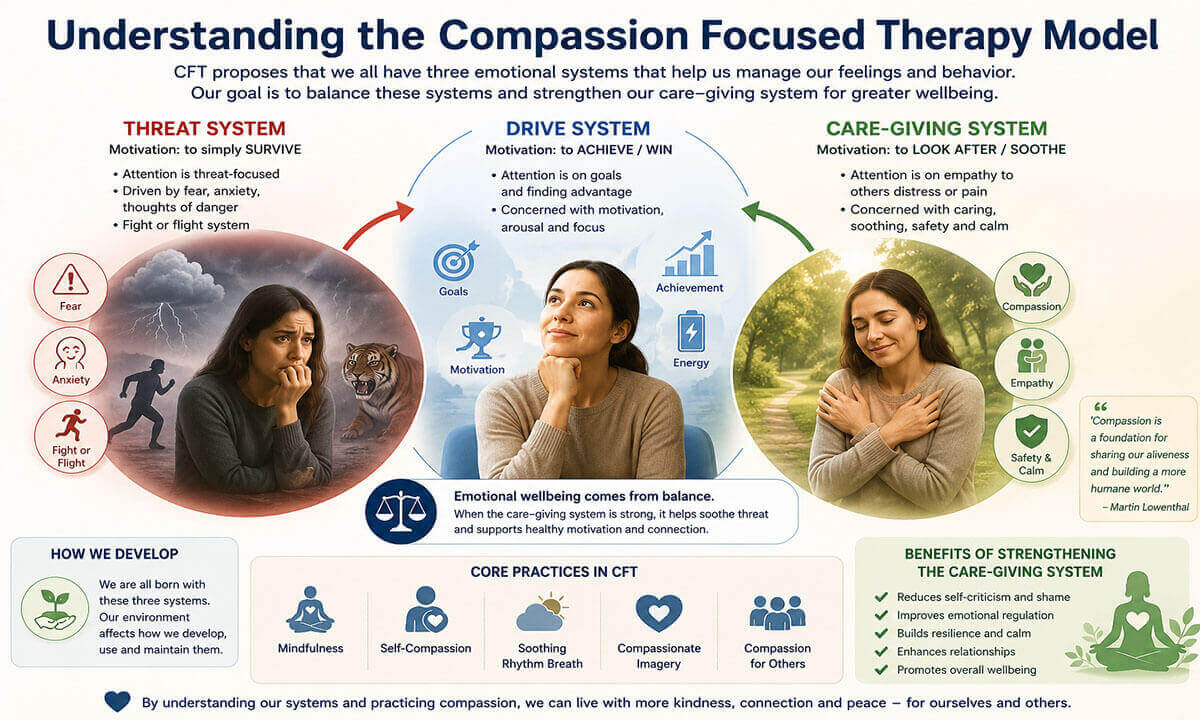
According to Gilbert (2009), the CFT model proposes that three systems are used to regulate emotional states: A Caregiving/Doing System, Threat System, and a Drive System.
- Threat System: The threat system helps us protect ourselves from danger. Its main purpose is survival. When we feel threatened, this system becomes active and prepares us to respond quickly.
The threat system focuses our attention on possible danger. It can produce emotions such as fear and anxiety. It may also make us think about what could go wrong.
This system is closely connected with the fight or flight response. For example, when a person feels that they are in danger, they may want to fight the threat or escape from it. The threat system can be very useful because it helps us recognize danger and protect ourselves.
However, this system can also become very active when there is no immediate physical danger. A person may experience fear, worry, or anxiety because of thoughts, memories, or stressful situations.
- Drive System: The drive system is related to motivation, achievement, and reaching goals. Its main purpose is to encourage us to move toward things that we want.
When the drive system is active, we may focus strongly on achieving success, gaining rewards, or finding advantages. It can encourage us to study for an examination, work toward a career goal, compete with others, or complete an important task.
This system is connected with motivation, arousal, and attention. It can give us energy and help us stay focused on our goals.
The drive system can therefore be helpful for achievement and personal growth. However, if it becomes too dominant, a person may feel that they always need to achieve more or prove themselves.
- Care Giving System: The care giving system is connected with caring, soothing, safety, and calmness. Its main purpose is to help us care for ourselves and others.
This system becomes important when we notice that someone is experiencing pain, distress, or difficulty. It encourages empathy and helps us respond with kindness and support.
For example, when a parent comforts a crying child, when a friend listens to someone who is struggling, or when a person treats themselves kindly during a difficult time, the care giving system is involved.
This system can help create feelings of safety, calmness, connection, and compassion. It is especially important in CFT because developing this system can help people respond to themselves with greater kindness instead of harsh self-criticism.
Each has a different function or objective and focus and is associated with different thoughts, feelings, physical states of arousal, and behaviors, as shown in the table below.
| Key points | Caregiving/Doing | Threat | Drive |
| Function/ Objective | Protecting | Survival | Reward/Accomplishment |
| Focus | Sensitivity to suffering/ distress | Perceived threat | Aims/Achievement/ Goals |
| Thoughts | Tending/Soothing | Risk | Achievement |
| Feelings | Safety | Stress/Disgust/Anxiety/ Fear | Excitement/Vitality |
| Physical State | Low arousal/Calm | High arousal | Arousal |
| Behaviors | Soothing/Protecting/
Caring |
Avoidance/Self-criticism/Safety-seeking | Focus |
Our Emotion Regulation systems are all innate, but our life experiences and environment determine which we use the most and whether we develop our non-survival-based Caregiving/Doing and Drive systems.
Developing Self-Compassion:
CFT is concerned with developing our Caregiving/Doing systems to help us better cope with distress and suffering.
This ‘compassionate’ system is distinguished by:
- Empathy
- Non-Judgment
- Distress Tolerance
- Sensitivity
- Care for Well-Being, and
- Sympathy
Helpful skills that facilitate its development include:
- Visualization
- Attention
- Reasoning
- Conscious Behaviors, and
- Practicing Caregiving Behaviors.
By focusing on our capacity for caregiving and compassion, CFT aims to help individuals manage their emotions more adaptively and introduce more balance to the emotional regulation system.
Compassion Formulation Worksheet:
Compassion-focused Therapy (CFT) is a form of psychotherapy commonly used to help individuals who are dealing with high levels of shame and self-criticism.
It aims to encourage psychological and emotional well-being by helping individuals cultivate higher levels of self-compassion, as well as more compassion towards others.
This Compassion Formulation Worksheet may guide you through the process of developing self-compassion by:
- Exploring the source of your self-blame, shame, or self-criticism (Past Influences)
- Reflecting on your key fears (Primary Fears)
- Considering your self-protective or safety coping mechanisms (Protective/Defensive Behaviors), and
- Examining their impact on your future behavior (Unintentional Outcomes), as well as on your self-relationship (Relationship With Self).
Utilizing this approach can frequently unveil self-perpetuating cycles of maladaptive coping strategies. When used regularly and with time to reflect, it is also designed to help you nurture more compassionate ways of self-motivating and tolerating distress (Gilbert & Procter, 2006).
Other Compassion Focused Therapy Techniques:
One of the main techniques used in Compassion Focused Therapy (CFT) is called Compassionate Mind Training (CMT). CMT helps people experience compassion and develop greater compassion toward themselves and others. The goal is to help clients build a kinder and more supportive way of thinking and responding (Gilbert & Procter, 2006).
CMT focuses on developing several important qualities. These include compassionate motivation, sympathy, sensitivity to suffering, and the ability to tolerate emotional distress. It also encourages people to become less judgmental and to develop a non-condemning attitude toward themselves and others. Instead of blaming or criticizing themselves for difficulties, people learn to respond with understanding and kindness.
Several exercises can be used to support Compassionate Mind Training. Some important techniques include appreciation exercises, mindfulness, and compassion focused imagery exercises (Kolts, Bennett-Levy, Bell, & Irons, 2018).
- Appreciation Exercises: Appreciation exercises help people notice and enjoy positive experiences in their daily lives. The purpose is to encourage people to slow down and pay attention to activities that they enjoy.
For example, a person may take time to appreciate a favorite meal, a walk outside, listening to music, spending time with a friend, or enjoying a peaceful moment. Instead of rushing through these experiences, the person learns to notice the positive feelings they create.
These exercises can help people become more aware of pleasant experiences and develop a greater sense of appreciation in everyday life.
- Mindfulness: Mindfulness involves paying attention to what is happening in the present moment. It means observing thoughts, feelings, physical sensations, and events around us without immediately judging them.
In CFT, mindfulness can help people notice difficult thoughts and emotions without becoming overwhelmed by them. For example, instead of thinking, “I should not feel this way,” a person can simply notice, “I am feeling worried right now.”
This approach creates some distance from difficult emotions. It allows people to observe their experiences with greater calmness and understanding. Mindfulness can therefore support the development of a more balanced and compassionate response.
- Compassion Focused Imagery Exercises: Compassion focused imagery exercises use guided imagination to help stimulate the mind’s soothing system. During these exercises, people create mental images that represent safety, kindness, warmth, and compassion.
For example, a person may imagine a compassionate person, a safe place, or a warm and supportive presence. They may also imagine themselves responding to difficult situations with wisdom, strength, kindness, and understanding.
These exercises can help people develop a stronger emotional experience of compassion. With regular practice, they may become more comfortable with showing compassion toward themselves and others.
Who Can Benefit From CMT?
Compassionate Mind Training can be particularly useful for people who struggle with shame and self-criticism. People who are very critical of themselves may find it difficult to treat themselves with kindness. CMT provides practical ways to develop a more supportive inner voice and a more accepting attitude.
However, compassion is not only useful for people experiencing these difficulties. Almost everyone can benefit from developing greater compassion toward themselves and others. Learning to respond to mistakes, difficulties, and emotional pain with understanding rather than harsh judgment can support healthier emotional wellbeing (Gilbert & Procter, 2006; Kolts, Bennett-Levy, Bell, & Irons, 2018).
Example of Application (Eating Disorders):
CFT can be used to support people experiencing different psychological difficulties, including depression, anxiety, and anger. Another important area where CFT may be helpful is the treatment of eating disorders.
Researchers Stanley Steindl, Kiera Buchanan, Kenneth Goss, and Steven Allan (2017) reviewed existing research on the use of CFT for eating disorders. They wanted to understand how compassion focused approaches could help people who struggle with eating, body image, and weight related concerns.
Their review showed that concerns about eating, body image, and weight are often connected with high levels of self-criticism and shame. These individuals may also experience lower levels of self-compassion. This can make their difficulties more challenging because they may respond to themselves with harsh judgment instead of understanding and kindness.
CFT can help address these problems by encouraging people to develop a more compassionate attitude toward themselves. In treatment, the usual CFT approach can be adapted to focus specifically on eating and body image concerns. Therapists can help clients understand the connection between their emotions, thoughts, and eating behaviors.
For example, a person may eat in response to stress, sadness, shame, or other difficult emotions. CFT can help the person understand these emotional patterns without blaming or judging themselves. The therapy also encourages clients to develop empathy and compassion for the difficulties they are experiencing.
Although the use of CFT for eating disorders is still a developing area, research provides encouraging evidence. Some studies have reported that people with bulimia nervosa benefited from CFT. People with other or unspecified eating disorders also showed progress. Another study reported improvements across several types of eating disorders. A further study found that eating related symptoms decreased following CFT treatment.
These findings suggest that compassion may be especially important for people struggling with eating disorders. Many individuals with eating problems experience strong self-criticism, shame, and dissatisfaction with their bodies. They may also find it difficult to accept themselves or feel confident about who they are.
CFT provides a way to work with these difficulties through kindness, understanding, and self-compassion. Instead of blaming themselves for their struggles, individuals can learn to understand their emotions and develop a more supportive relationship with themselves. Improving self-compassion, self-acceptance, and self-confidence may therefore help people manage some of the emotional and behavioral difficulties connected with eating disorders.
Overall, CFT offers a promising approach for people experiencing eating and body image concerns. However, eating disorders can be serious mental health conditions, so CFT should be provided by appropriately trained professionals and used as part of suitable clinical care.
In conclusion, CFT is a helpful approach that teaches people to respond to themselves and others with greater kindness, understanding, and compassion. It combines psychological science with practical exercises such as soothing breathing, mindfulness, compassionate imagery, and compassionate self-practice. CFT focuses on balancing the threat, drive, and care giving systems and reducing harmful self-criticism and shame. It can be useful for different emotional and psychological difficulties, including anxiety, depression, anger, and eating disorders. As a result, CFT helps people develop a kinder inner voice, improve emotional wellbeing, and build greater resilience in difficult situations.
References:
- CMF-USA. (n.d.). Compassion focused therapy. Retrieved from http://www.compassionfocusedtherapy.com/
- Gilbert, P., & Procter, S. (2006). Compassionate mind training for people with high shame and self‐criticism: Overview and pilot study of a group therapy approach. Clinical Psychology & Psychotherapy: An International Journal of Theory & Practice, 13(6), 353-379. https://doi.org/10.1002/cpp.507
- Gilbert, P. (2009). Introducing compassion-focused therapy. Advances in Psychiatric Treatment, 15(3), 199-208. https://doi.org/10.1192/apt.bp.107.005264
- Gilbert, P. (2010a). Compassion focused therapy: The CBT distinctive features series. New York, NY: Routledge.
- Gilbert, P. (2010b). Training our minds in, with, and for compassion: An introduction to concepts and compassion-focused exercises. Retrieved from https://files.builder.misssite.com/72/a3/72a34148-8bc0-471d-86fd-9c02dc18a661.pdf
- Kolts, R., Bennett-Levy, J., Bell, T., & Irons, C. (2018). Experiencing compassion-focused therapy from the inside out: A self-practice/self-reflection workbook for therapists. New York, NY: Guilford.
- Steindl, S. R., Buchanan, K., Goss, K., & Allan, S. (2017). Compassion focused therapy for eating disorders: A qualitative review and recommendations for further applications. Clinical Psychologist, 21(2), 62-73. https://doi.org/10.1521/ijct.2010.3.2.141

Meta Psychological Education focuses on the foundational, higher-order skills (meta-skills) that allow individuals to “learn how to learn,” manage their own cognitive processes, and adapt to new situations, often termed meta-learning. It bridges psychological research with practical application in learning and development.