Basic Understanding of Implicit and Explicit Memory:
Memory plays a vital role in our everyday lives. It allows us to learn new information, remember past experiences, develop skills, and make decisions. From remembering the name of a friend to riding a bicycle without thinking about every movement, memory supports many activities that we perform every day. However, not all memories work in the same way. Some memories come to mind consciously, while others influence our behavior without our awareness.
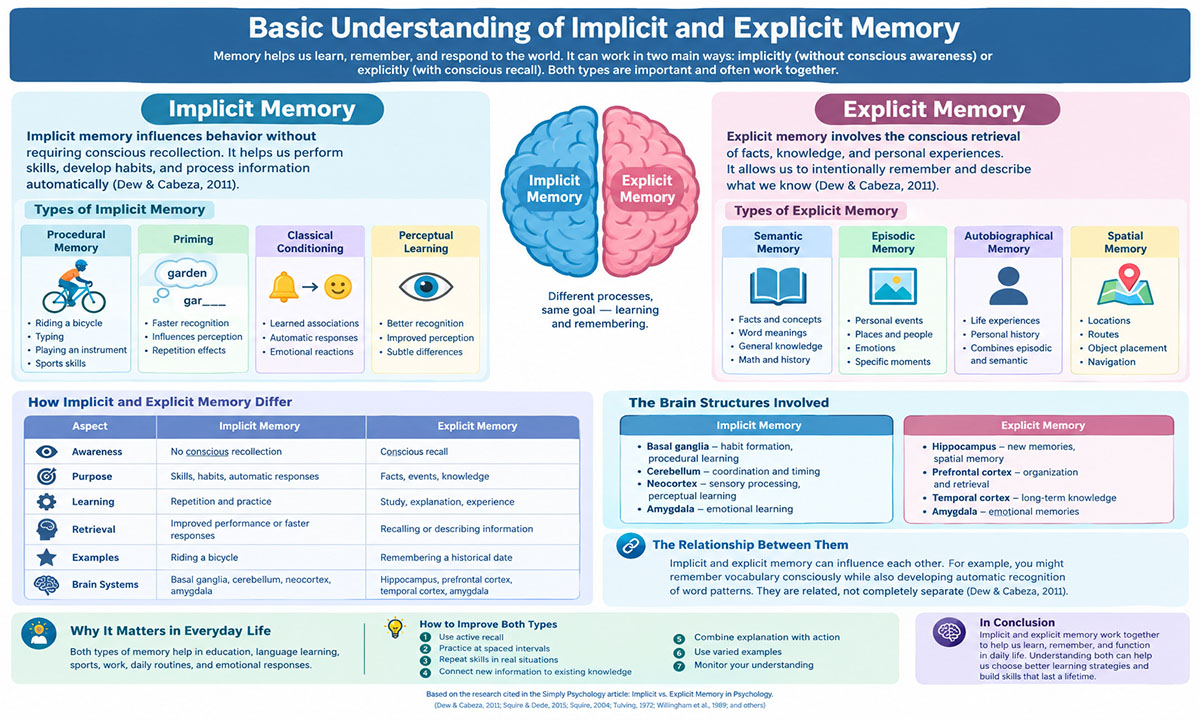
Psychologists commonly distinguish between two forms of long-term memory: implicit memory and explicit memory. Implicit memory refers to the influence of previous experiences on our behavior without conscious recollection. Explicit memory involves consciously remembering facts, information, and personal experiences (Squire, 2004).
These two types of memory help explain how people learn, remember, and respond to their surroundings. Understanding them is useful in psychology, education, neuroscience, and everyday life. This article explores their definitions, types, examples, brain mechanisms, differences, and relationship.
What Is Implicit Memory?
Implicit memory, also called non-declarative memory, refers to the effects of previous experiences on current behavior without requiring conscious recollection of those experiences. People may use information learned in the past without remembering when or how they acquired it (Dew & Cabeza, 2011).
For example, a person who has learned to ride a bicycle can usually perform the necessary movements without consciously thinking about every movement of their legs, hands, and body. Similarly, an experienced typist can type familiar words without deliberately recalling the position of every key.
Implicit memory often develops through repetition, practice, and experience. Once a skill becomes well learned, performing it may require less conscious attention. However, implicit memory is not limited to physical skills. It can also influence perception, reactions, habits, and emotional responses.
Types of Implicit Memory:
1. Procedural memory: Procedural memory is the type of implicit memory involved in learning and performing skills. It supports activities that become increasingly automatic with practice.
Examples include:
- Riding a bicycle
- Tying shoelaces
- Swimming
- Typing on a keyboard
- Playing a familiar musical instrument
- Performing routine movements during a sport
Procedural learning develops as people repeatedly practice an activity. With time, the movements become smoother and require less conscious control. Research has shown that procedural learning can remain relatively intact even when a person has serious difficulties forming new conscious memories (Cohen & Squire, 1980; Willingham et al., 1989).
2. Priming: Priming occurs when previous exposure to a stimulus influences how a person processes a related stimulus later. This influence can occur without consciously remembering the earlier exposure.
For example, imagine that someone reads the word garden. Later, when asked to complete the word fragment gar___, they may be more likely to produce the word garden because they encountered it earlier.
Priming can take different forms. Perceptual priming depends on the physical appearance or sensory features of a stimulus. Conceptual priming depends more on the meaning of the stimulus.
Priming demonstrates that previous experiences can influence recognition and information processing even when people do not deliberately recall those experiences. Research on repetition priming has also identified neural changes associated with processing previously encountered information (Lee et al., 2020).
3. Classical conditioning: Classical conditioning is a form of associative learning in which a person or animal learns a relationship between two stimuli. Eventually, one stimulus may produce a response because of its association with another stimulus.
For example, a person who repeatedly experiences anxiety during a particular type of medical procedure may begin to feel nervous when entering a similar medical setting. The response can occur before the person consciously thinks about previous experiences.
Some conditioned responses can operate automatically. However, the extent to which a particular conditioned response depends on implicit or explicit processes varies with the learning situation.
4. Perceptual learning: Perceptual learning involves improvements in recognizing or distinguishing stimuli through experience. For example, a musician may become better at identifying small differences between musical notes after years of practice.
Similarly, repeated exposure to a language can help a learner recognize familiar speech sounds more accurately. These improvements may occur without the learner consciously recalling each previous exposure.
What Is Explicit Memory?
Explicit memory, also known as declarative memory, involves the conscious retrieval of facts, knowledge, and personal experiences. When people intentionally remember information and can describe what they remember, they are using explicit memory (Dew & Cabeza, 2011).
For example, recalling the name of a country’s capital, remembering what happened during a school examination, or describing a recent conversation involves explicit memory.
Explicit memory is important for education, communication, planning, and decision-making. Students use it when recalling information from textbooks, answering examination questions, and explaining concepts they have learned.
Unlike implicit memory, explicit memory usually involves a conscious awareness that information is being remembered. People may need to make a deliberate effort to retrieve information, especially when the memory is not immediately accessible.
Types of Explicit Memory:
1. Semantic memory: Semantic memory stores general knowledge about the world, including facts, concepts, meanings, and language.
Examples include:
- Knowing that Dhaka is the capital of Bangladesh.
- Knowing that the Earth revolves around the Sun.
- Understanding the meaning of a word.
- Knowing basic mathematical rules.
- Remembering historical facts.
Semantic memory is not necessarily connected to the circumstances in which the information was learned. A person may know a fact without remembering the lesson, book, or conversation through which they first encountered it.
2. Episodic memory: Episodic memory involves remembering personally experienced events and their associated contexts, such as where and when something happened.
Examples include:
- Remembering the first day at school.
- Recalling a family celebration.
- Remembering a conversation with a friend.
- Recalling what happened during a recent examination.
- Remembering a particular journey.
Episodic memories can include details about places, people, emotions, and events. These memories help people connect their present experiences with their personal past (Tulving, 1972).
3. Autobiographical memory: Autobiographical memory concerns information and experiences related to a person’s own life. It includes memories of specific events as well as general knowledge about personal history.
For example, someone may remember their first day at university and also know that they studied there for several years. The first example is a specific personal event, while the second is general knowledge about their life.
Autobiographical memory therefore draws on both episodic and semantic information.
4. Spatial memory: Spatial memory allows people to remember the locations of objects, places, and routes. It supports navigation and helps individuals understand how different places relate to one another.
For example, remembering the route from home to work or knowing where books are arranged in a library involves spatial memory.
Spatial memory may operate with different levels of conscious awareness. Deliberately recalling a route is an example of explicit retrieval, although familiar navigation can also become more automatic through practice.
Key Differences Between Implicit and Explicit Memory:
Although both forms of memory help people learn from experience, they differ in how previous information influences behavior and how it is retrieved.
- Awareness: Implicit memory influences behavior without requiring conscious recollection. Explicit memory involves consciously retrieving information or experiences.
- Purpose: Implicit memory supports skills, habits, and automatic responses. Explicit memory supports the deliberate recall of facts, events, and knowledge.
- Learning: Implicit memory often develops through repeated practice or exposure. Explicit memory can develop through study, explanation, observation, and meaningful experiences.
- Retrieval: Implicit memory may appear through improved performance or faster responses. Explicit memory is commonly demonstrated by recalling or describing previously learned information.
- Examples: Riding a bicycle without thinking about every movement illustrates implicit memory. Remembering the date of an essential historical event illustrates explicit memory.
- Brain systems: Implicit memory involves several neural systems, depending on the type of learning. Explicit memory relies heavily on the hippocampus and related medial temporal lobe structures, particularly for forming and retrieving new episodic memories (Squire & Dede, 2015).
These differences are useful, but they should not be interpreted as meaning that the two forms of memory never interact. Research suggests that their boundaries can be more complex than a simple division between conscious and unconscious processing (Dew & Cabeza, 2011).
Brain Structures Involved in Implicit Memory:
Implicit memory does not depend on a single brain region. Different structures support different forms of learning.
- Basal ganglia: These structures, particularly the striatum, contribute to habit formation, procedural learning, and the development of repeated action sequences. They help people improve the performance of practiced activities (Ullman, 2004).
- Cerebellum: The cerebellum contributes to the coordination and timing of movements. It is also involved in certain forms of motor learning and conditioned responses.
- Neocortex: Different areas of the neocortex process sensory information, including visual and auditory input. Changes in how these areas respond to familiar stimuli may contribute to perceptual learning and priming.
- Amygdala: The amygdala contributes to emotional learning, including certain forms of conditioned emotional responses.
The involvement of these structures depends on the type of implicit learning taking place. This distributed organization helps explain why a person may retain certain skills even when other forms of memory are seriously impaired (Dew & Cabeza, 2011; Squire & Dede, 2015).
Brain Structures Involved in Explicit Memory:
Explicit memory depends on communication among several brain regions.
- Hippocampus: The hippocampus plays a central role in forming and consolidating new episodic memories. It also supports spatial memory and navigation. Damage to this structure can severely impair the formation of new conscious memories (Squire & Dede, 2015).
- Prefrontal cortex: The prefrontal cortex supports the organization, monitoring, and retrieval of information. It helps people search for memories, maintain relevant details, and organize information during recall.
- Temporal cortex: Areas of the temporal cortex contribute to the storage and retrieval of long-term knowledge. Over time, aspects of declarative memory become represented across broader cortical networks.
- Amygdala: The amygdala can influence the formation of emotionally significant memories. Emotional experiences may be remembered particularly well under certain conditions because emotional processing can affect memory consolidation.
Together, these structures support the formation, organization, and conscious retrieval of facts and personal experiences. However, explicit memory is not controlled by one isolated brain region. It depends on interactions among several systems (Squire, 2009; Squire & Dede, 2015).
The Relationship Between Implicit and Explicit Memory:
Implicit and explicit memory are often described as separate forms of long-term memory. Nevertheless, they can influence one another during learning and everyday activities.
For example, a student learning a new language may consciously remember vocabulary and grammar rules through explicit memory. At the same time, repeated exposure to spoken conversations may improve the student’s ability to recognize familiar sounds and word patterns without deliberate recall.
Similarly, a person learning to play a musical instrument may consciously remember musical notation while gradually developing automatic finger movements through procedural learning.
Priming may also influence conscious judgments. A person who has recently encountered a particular word may process it more quickly or find it easier to recognize later, even if they do not remember the original encounter.
Dew and Cabeza (2011) reviewed behavioral and neuroscientific evidence suggesting that implicit and explicit memory can overlap and interact. Their work challenges the idea that the two forms always operate as completely independent systems.
Are Implicit and Explicit Memory Separate Systems?
Researchers have proposed different explanations for the relationship between implicit and explicit memory.
One view argues that they depend on different memory systems. Evidence from people with amnesia supports this position because some patients have severe difficulties remembering facts and events but can still learn certain skills. Squire and Dede (2015) explain that declarative memory relies heavily on the hippocampus and related structures, whereas nondeclarative learning involves several other neural systems.
Another view emphasizes that memory performance depends partly on the mental processes required by a test. Roediger (1990) argued that implicit memory effects can be understood in terms of retention without conscious remembering and highlighted the importance of distinguishing memory tests and the processes they require.
Dew and Cabeza (2011) also discussed evidence that implicit and explicit memory are not always completely independent. The same task may involve both forms of processing, and the results can depend on how information was learned and how memory is tested.
The evidence therefore supports meaningful differences between implicit and explicit memory, but the exact relationship between them remains a subject of scientific discussion.
The Development of Research on Implicit and Explicit Memory:
The Case of Henry Molaison: A crucial development in memory research came from the study of Henry Molaison, widely known in scientific literature as patient H.M.
Molaison underwent brain surgery in 1953 to treat severe epilepsy. The surgery removed portions of the medial temporal lobes, including substantial parts of the hippocampal region. Following the operation, he developed severe anterograde amnesia, which left him unable to form many new conscious memories of events and information.
Scoville and Milner (1957) documented the effects of the surgery on memory. Later research showed that Molaison could improve at certain motor tasks through practice even though he did not consciously remember completing the earlier practice sessions (Corkin, 2002).
This finding was important because it showed that learning and conscious recollection could be affected differently. Some forms of skill learning remained possible despite severe impairment in forming new declarative memories.
Graf and Schacter’s Research: Graf and Schacter (1985) helped establish the modern distinction between implicit and explicit memory.
Their research examined memory for new associations in people with and without amnesia. Participants studied word pairs and later completed tasks that measured memory in different ways.
The results showed that previous learning could influence performance even when participants did not consciously recollect the original learning episode. Explicit memory tests, however, showed substantial impairment among amnesic participants.
This research helped demonstrate that previous experience can affect performance without conscious remembering and contributed to the development of experimental methods for studying implicit memory.
Nissen and Bullemer’s Serial Reaction Time Task: Nissen and Bullemer (1987) developed an influential experimental approach for investigating learning without full conscious awareness.
In the serial reaction time task, participants respond to stimuli appearing in different screen locations by pressing corresponding keys. Unknown to them, the locations may follow a repeating sequence.
As participants continue the task, their responses may become faster when the sequence follows the learned pattern. This improvement can indicate that they have acquired knowledge of the sequence even when they cannot clearly describe it.
The task has become an important method for investigating implicit sequence learning. However, performance improvement does not automatically prove that participants have no conscious knowledge of the pattern. Researchers must consider both learning performance and participants’ awareness.
Research has also raised questions about the reliability of this task when it is used to measure differences between individual people. Oliveira et al. (2023) found that the task showed learning effects at the group level but had limitations in test-retest reliability. This means that researchers should be cautious when using a single score to draw conclusions about an individual’s implicit learning ability.
The Importance of Implicit and Explicit Memory in Everyday Life:
Both forms of memory contribute to everyday activities, although their roles vary according to the situation.
- Education: Explicit memory helps students remember definitions, formulas, dates, and theories. Implicit learning supports the development of reading fluency, handwriting, typing, and other skills through repeated practice.
- Language learning: Explicit memory helps learners understand grammar rules and remember vocabulary. Implicit learning supports the gradual recognition of speech patterns and familiar expressions through exposure and use.
- Sports and physical activities: Athletes consciously remember strategies and instructions while developing automatic movement patterns through repeated practice.
- Workplace performance: Employees may explicitly remember procedures and regulations while relying on implicit learning to perform familiar tasks efficiently.
- Daily routines: People consciously remember appointments and planned activities, while many familiar actions, such as brushing their teeth, may be performed with little deliberate attention.
- Emotional responses: Previous experiences can influence how people respond to familiar situations. Some responses may develop through associative learning, although emotional reactions can also involve conscious memories and interpretations.
Understanding these processes can help teachers, students, and professionals choose appropriate learning strategies. Combining clear explanations with repeated practice can support both conscious knowledge and the development of automatic skills.
How to Improve Explicit and Implicit Memory:
Although implicit and explicit memory operate differently, several learning strategies can support their development.
- Use active recall: Instead of repeatedly reading material, close the book and try to remember the main points. This encourages the conscious retrieval of information.
- Practice at spaced intervals: Review information across several sessions rather than studying everything at once. Spaced practice can improve long-term retention.
- Use practical repetition: Repeat relevant skills in realistic situations. Typing, playing an instrument, and learning a sport all benefit from regular practice.
- Connect new information with existing knowledge: Explain new ideas in your own words and relate them to familiar concepts. Meaningful connections can make information easier to understand and remember.
- Combine explanation with action: When learning a practical skill, understand the instructions and then apply them repeatedly. This allows conscious knowledge and practiced performance to develop together.
- Use varied examples: Apply knowledge in different situations. Varied practice can help learners recognize when a skill or concept is useful.
- Monitor your understanding: Test yourself regularly to identify what you can recall and what still needs practice. Remember that performing a task successfully does not always mean you can explain the knowledge behind it.
These methods do not affect every type of memory in exactly the same way. Their effectiveness depends on the learning goal, the nature of the material, and the conditions in which the information must later be retrieved.
In conclusion, implicit and explicit memory are two important aspects of human memory. Implicit memory allows previous experiences to influence behavior without requiring conscious recollection. It supports skills, habits, priming, and certain forms of conditioned learning. Explicit memory allows people to consciously remember facts, personal experiences, and information about the world.
Research on patient H.M., procedural learning, and experimental memory tasks has helped psychologists understand that learning can continue even when conscious recollection is seriously impaired. Studies also show that implicit and explicit memory can interact, making their relationship more complex than a simple division between conscious and unconscious processes.
Both forms of memory are essential for learning and everyday functioning. Explicit memory helps people understand and recall information, while implicit memory helps them develop skills and respond efficiently to familiar situations. By combining meaningful study, active recall, regular practice, and real-world application, learners can develop knowledge and skills that support them throughout life.
References:
- 13.2 The central nervous system. (2013, March 6). OpenTextBC. https://opentextbc.ca/anatomyandphysiology/chapter/13-2-the-central-nervous-system/
- Brooks, D. N., & Baddeley, A. D. (1976). What can amnesic patients learn? Neuropsychologia, 14(1), 111–122. https://doi.org/10.1016/0028-3932(76)90012-9
- Cohen, N. J., & Squire, L. R. (1980). Preserved learning and retention of pattern analyzing skill in amnesia: Dissociation of knowing how and knowing that. Science, 210(4466), 207–210. https://doi.org/10.1126/science.7414331
- Corkin, S. (2002). What’s new with the amnesic patient H.M.? Nature Reviews Neuroscience, 3(2), 153–160. https://doi.org/10.1038/nrn726
- Dew, I. T. Z., & Cabeza, R. (2011). The porous boundaries between explicit and implicit memory: Behavioral and neural evidence. Annals of the New York Academy of Sciences, 1224(1), 174–190. https://doi.org/10.1111/j.1749-6632.2010.05946.x
- Graf, P., & Schacter, D. L. (1985). Implicit and explicit memory for new associations in normal and amnesic subjects. Journal of Experimental Psychology: Learning, Memory, and Cognition, 11(3), 501–518. https://doi.org/10.1037/0278-7393.11.3.501
- Lee, S. M., Henson, R. N., & Lin, C. Y. (2020). Neural correlates of repetition priming: A coordinate-based meta-analysis of fMRI studies. Frontiers in Human Neuroscience, 14, Article 565114. https://doi.org/10.3389/fnhum.2020.565114
- Nissen, M. J., & Bullemer, P. (1987). Attentional requirements of learning: Evidence from performance measures. Cognitive Psychology, 19(1), 1–32. https://doi.org/10.1016/0010-0285(87)90002-8
- Oliveira, C. M., Hayiou Thomas, M. E., & Henderson, L. M. (2023). The reliability of the serial reaction time task: Meta-analysis of test-retest correlations. Royal Society Open Science, 10(7), Article 221542. https://doi.org/10.1098/rsos.221542
- Roediger, H. L., III. (1990). Implicit memory: Retention without remembering. American Psychologist, 45(9), 1043–1056. https://doi.org/10.1037/0003-066X.45.9.1043
- Scoville, W. B., & Milner, B. (1957). Loss of recent memory after bilateral hippocampal lesions. Journal of Neurology, Neurosurgery, and Psychiatry, 20(1), 11–21. https://doi.org/10.1136/jnnp.20.1.11
- Squire, L. R. (2004). Memory systems of the brain: A brief history and current perspective. Neurobiology of Learning and Memory, 82(3), 171–177. https://doi.org/10.1016/j.nlm.2004.06.005
- Squire, L. R. (2009). The legacy of patient H.M. for neuroscience. Neuron, 61(1), 6–9. https://doi.org/10.1016/j.neuron.2008.12.023
- Squire, L. R., & Dede, A. J. O. (2015). Conscious and unconscious memory systems. Cold Spring Harbor Perspectives in Biology, 7(3), Article a021667. https://doi.org/10.1101/cshperspect.a021667
- Tulving, E. (1972). Episodic and semantic memory. In E. Tulving & W. Donaldson (Eds.), Organization of memory (pp. 381–403). Academic Press.
- Ullman, M. T. (2004). Contributions of memory circuits to language: The declarative/procedural model. Cognition, 92(1–2), 231–270. https://doi.org/10.1016/j.cognition.2003.10.008
- Willingham, D. B., Nissen, M. J., & Bullemer, P. (1989). On the development of procedural knowledge. Journal of Experimental Psychology: Learning, Memory, and Cognition, 15(6), 1047–1060. https://doi.org/10.1037/0278-7393.15.6.1047
Meta Psychological Education focuses on the foundational, higher-order skills (meta-skills) that allow individuals to “learn how to learn,” manage their own cognitive processes, and adapt to new situations, often termed meta-learning. It bridges psychological research with practical application in learning and development.