
The Working Memory Model:
Working memory is one of the most important cognitive systems involved in human thinking, learning, reasoning, and decision-making. It allows people to temporarily hold and manipulate information while performing mental tasks such as reading, solving mathematical problems, following instructions, or engaging in conversation. Unlike simple short-term memory, which mainly stores information briefly, working memory actively processes and organizes information for immediate use. Cognitive psychologists often describe it as a “mental workspace” or “scratchpad” that enables individuals to coordinate complex cognitive activities (Baddeley & Hitch, 1974). The concept of working memory became especially influential after Alan Baddeley and Graham Hitch proposed the Working Memory Model in 1974, challenging earlier theories that viewed short-term memory as a single passive storage system. Their model suggested that working memory consists of several specialized components working together to support cognition. Over time, this framework has become central to cognitive psychology, neuroscience, education, and clinical psychology because it helps explain differences in learning ability, academic performance, attention, and problem-solving skills (Baddeley, 2000).
Research shows that working memory is strongly connected to educational achievement, language comprehension, executive functioning, and intellectual performance. Difficulties in working memory are also associated with conditions such as ADHD, dyslexia, and other learning disorders. As a result, understanding working memory has important implications not only for psychological theory but also for classroom practice, educational intervention, and mental health support (Cowan, 1995).
Difference Between Working Memory and Short-Term Memory:
Although the terms working memory and short-term memory are often used interchangeably in everyday conversation, cognitive psychologists distinguish between them in important ways. Both systems involve the temporary retention of information, but they differ in terms of purpose, complexity, cognitive involvement, and functional role in human thinking. Understanding this distinction is essential because it helps explain how people learn, reason, solve problems, and perform everyday mental tasks.
Traditionally, early memory models viewed short-term memory as a simple temporary storage system that briefly held information before it either faded away or transferred into long-term memory. However, later research demonstrated that human cognition requires more than passive storage. People not only retain information temporarily but also actively manipulate and process it while carrying out complex tasks. This realization led Baddeley and Hitch (1974) to develop the concept of working memory, which expanded the understanding of temporary memory systems.
What Is Short-Term Memory?
Short-term memory (STM) refers to the ability to temporarily store a limited amount of information for a short duration, usually between a few seconds and about 30 seconds without rehearsal. Its primary function is storage rather than active processing.
For example, if someone tells you a phone number and you remember it long enough to dial it, you are using short-term memory. Similarly, remembering a room number while walking down a hallway or briefly holding a person’s name in mind after introduction are examples of STM in action.
Research by Miller (1956) suggested that short-term memory capacity is limited to approximately seven items, plus or minus two, although later studies proposed that the actual capacity may be closer to four meaningful chunks of information (Cowan, 2001).
Short-term memory is therefore characterized by:
- Temporary information storage
- Limited capacity
- Rapid forgetting without rehearsal
- Minimal manipulation of information
Information in STM tends to disappear quickly unless actively repeated or rehearsed. For instance, when a person mentally repeats a phone number several times, rehearsal helps maintain the information temporarily.
What Is Working Memory?
Working memory is a more advanced cognitive system that not only stores information temporarily but also actively manipulates and processes it to support ongoing mental activities. It is involved in reasoning, comprehension, learning, decision-making, and problem-solving (Baddeley, 2000).
Unlike STM, working memory functions as a dynamic mental workspace. It allows individuals to simultaneously retain information while mentally operating on it.
For example:
- Solving a mathematical equation mentally
- Following multi-step directions
- Reading and understanding a paragraph
- Planning a response during conversation
- Comparing ideas while writing an essay
All require working memory because the individual must continuously process incoming information while temporarily maintaining relevant details.
Baddeley and Hitch’s (1974) Working Memory Model proposed that working memory consists of multiple interacting components rather than a single storage unit. These include the central executive, phonological loop, visuospatial sketchpad, and episodic buffer.
Thus, working memory is characterized by:
- Temporary storage and active processing
- Attention control and executive functioning
- Manipulation of information
- Coordination of multiple cognitive tasks
- Integration with long-term memory
Working memory is therefore considered essential for higher-order cognition.
Historical Development of the Distinction:
The distinction between STM and working memory emerged from dissatisfaction with earlier models of memory, especially the Atkinson and Shiffrin (1968) Multi-Store Model, which treated short-term memory mainly as a passive holding area.
Researchers noticed that people could perform complex cognitive activities while simultaneously storing information temporarily. For example, an individual could solve reasoning problems while remembering a sequence of digits. This suggested that temporary memory systems involved active processing rather than mere storage.
Baddeley and Hitch (1974) argued that the term short-term memory was too simplistic because it failed to explain how people mentally manipulate information during cognitive tasks. Their Working Memory Model therefore replaced the concept of a single short-term store with a more flexible and interactive system.
This shift represented a major development in cognitive psychology because it connected memory more directly with attention, reasoning, language comprehension, and executive functioning.
Key Differences Between Working Memory and Short-Term Memory:
- Storage vs. Processing: The most important difference is that short-term memory mainly stores information temporarily, whereas working memory both stores and manipulates information.
Example of Short-Term Memory: Remembering a verification code long enough to enter it into a website involves temporary storage only.
Example of Working Memory: Mentally calculating the total cost of several grocery items requires holding numbers in mind while simultaneously performing calculations.
Thus, STM is relatively passive, whereas working memory is active and dynamic.
- Complexity of Cognitive Function: Short-term memory handles simple retention tasks, while working memory supports complex cognitive activities.
Working memory is heavily involved in:
- Reading comprehension
- Logical reasoning
- Decision-making
- Learning new concepts
- Problem-solving
- Planning behavior
For example, when reading a complex sentence, working memory allows the reader to retain earlier parts of the sentence while integrating new information into overall meaning (Baddeley, 2012).
STM alone cannot adequately explain these higher-order cognitive processes.
- Role of Attention: Working memory strongly depends on attentional control. The central executive allocates attention, suppresses distractions, and coordinates cognitive activities.
Short-term memory, by contrast, does not necessarily involve executive attention to the same degree.
This is why distractions often interfere more with working memory tasks than with simple short-term storage tasks. For instance, solving mental arithmetic problems while listening to noise is more difficult because attentional resources become overloaded.
Cowan (1995) emphasized that working memory is closely tied to the focus of attention, suggesting that only a limited amount of information can remain actively accessible at one time.
- Structure and Components: Short-term memory is often described as a single temporary storage system. Working memory, however, consists of multiple specialized subsystems.
According to Baddeley’s model:
- The phonological loop handles verbal information
- The visuospatial sketchpad processes visual and spatial information
- The central executive controls attention and coordination
- The episodic buffer integrates information across systems
This multi-component structure allows working memory to manage different forms of information simultaneously.
For example, a person can visually follow directions on a map while mentally rehearsing verbal instructions because separate systems process visual and verbal information independently.
- Relationship With Learning: Working memory has a stronger relationship with learning and academic achievement than simple short-term memory.
Research shows that working memory capacity predicts success in:
- Reading comprehension
- Mathematics
- Writing
- Language learning
- General intelligence measures
Students with poor working memory often struggle to follow classroom instructions, solve multi-step problems, or retain relevant information during learning activities (Gathercole & Alloway, 2008).
Although short-term memory contributes to learning, working memory plays a more central role because learning usually requires simultaneous storage and processing.
- Neural Activity and Brain Involvement: Neuroscientific research also distinguishes between STM and working memory.
Working memory tasks typically involve greater activation in the:
- Prefrontal cortex
- Parietal cortex
- Attention-control networks
These brain regions support executive functioning, attentional control, and information manipulation (Smith & Jonides, 1997).
Simple short-term storage tasks generally require less complex neural coordination.
This evidence supports the idea that working memory is cognitively more demanding than STM.
Similarities Between Working Memory and Short-Term Memory:
Despite their differences, the two systems share several important features.
Both involve:
- Temporary information retention
- Limited capacity
- Vulnerability to interference
- Dependence on attention to some extent
- Interaction with long-term memory
In many everyday situations, STM functions as part of the broader working memory system. This overlap explains why the terms are sometimes confused.
Some researchers even argue that short-term memory may represent the storage component of working memory rather than a completely separate system (Baddeley, 2000).
Real-Life Examples Illustrating the Difference:
Example 1: Remembering a Phone Number: If you hear a phone number and hold it briefly before dialing, you are mainly using short-term memory.
However, if you mentally rearrange the digits, compare them with another number, or calculate patterns within the number, you are engaging working memory.
Example 2: Reading a Paragraph: Simply remembering a few words temporarily involves STM.
Understanding the paragraph’s meaning, integrating ideas across sentences, and drawing conclusions requires working memory.
Example 3: Mental Arithmetic: Remembering numbers alone uses STM.
Performing calculations mentally while keeping intermediate results active requires working memory.
Importance of Distinguishing Between the Two:
Understanding the difference between STM and working memory has important implications for:
Education: Teachers increasingly recognize that many learning difficulties involve working memory limitations rather than lack of intelligence. Students may understand concepts but struggle to manage information overload during complex tasks.
Clinical Psychology: Working memory deficits are associated with ADHD, dyslexia, traumatic brain injury, schizophrenia, and other neuropsychological conditions.
Assessing working memory therefore helps psychologists better understand cognitive functioning and learning difficulties.
Cognitive Research: The distinction has also influenced theories of attention, intelligence, language processing, and executive control.
Modern cognitive psychology now views working memory as one of the central systems underlying human thought.
The Working Memory Model:
The Working Memory Model is one of the most influential theories in cognitive psychology and explains how people temporarily store and manipulate information during complex mental activities. Developed by Alan Baddeley and Graham Hitch in 1974, the model challenged earlier ideas that short-term memory functioned as a single passive storage system. Instead, Baddeley and Hitch proposed that temporary memory is an active, dynamic system composed of multiple interacting components that support thinking, learning, reasoning, and comprehension (Baddeley & Hitch, 1974).
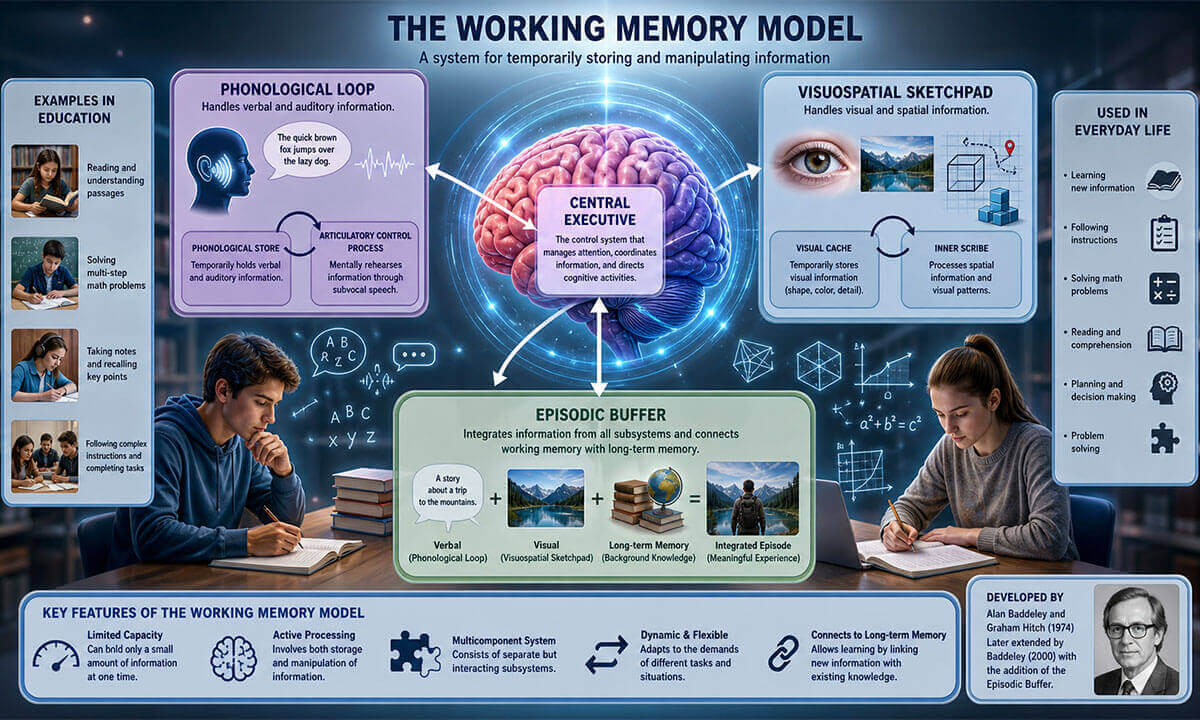
The model emerged as a response to limitations in earlier theories, especially the Atkinson and Shiffrin (1968) Multi-Store Model, which treated short-term memory as a single unitary store. Researchers noticed that people could perform reasoning tasks while simultaneously retaining information, suggesting that temporary memory involved more than simple storage. For example, individuals could remember short lists of numbers while solving verbal reasoning problems with only minor reductions in performance. These findings indicated that cognitive processing and temporary storage could occur simultaneously, leading to the development of the Working Memory Model.
Baddeley and Hitch argued that working memory functions as a mental workspace where information is temporarily stored, manipulated, and coordinated to support ongoing cognitive activities. Over time, the model became central to understanding attention, language, problem-solving, learning, and executive functioning. It has also had major implications for education, neuroscience, and clinical psychology.
Core Assumptions of the Working Memory Model:
The Working Memory Model is based on several important assumptions:
- Temporary memory is an active processing system rather than passive storage.
- Different types of information are handled by separate subsystems.
- Attention and executive control are essential for coordinating mental activities.
- Working memory has limited capacity.
- Working memory interacts closely with long-term memory.
These assumptions distinguish working memory from earlier short-term memory theories and explain why people can perform multiple cognitive tasks simultaneously under certain conditions.
Components of the Working Memory Model:
Originally, the model consisted of three major components:
- The Central Executive
- The Phonological Loop
- The Visuospatial Sketchpad
Later, Baddeley (2000) added a fourth component called the Episodic Buffer to address limitations in the original framework.
Each component performs specialized functions while interacting with the others.
- The Central Executive: The central executive is considered the most important and complex component of the Working Memory Model because it controls attention and coordinates the activities of the other subsystems. Rather than storing information itself, the central executive acts as a supervisory system that manages cognitive resources.
Baddeley compared the central executive to the director of a company or the conductor of an orchestra because it decides which information receives attention and how mental resources are distributed (Baddeley, 2012).
Functions of the Central Executive: The central executive performs several critical cognitive functions:
- Attention Control: It directs attention toward relevant information and suppresses distractions. For example, when reading in a noisy environment, the central executive helps maintain focus on the text rather than surrounding conversations.
- Task Switching: It allows individuals to shift attention between different activities. A person cooking while answering phone calls relies on the central executive to alternate between tasks efficiently.
- Coordination of Subsystems: The central executive integrates information from the phonological loop and visuospatial sketchpad. For instance, solving a geometry problem may require both verbal instructions and mental visualization.
- Decision-Making and Planning: The central executive supports higher-order cognitive activities such as reasoning, planning, and problem-solving.
- Inhibitory Control: It helps prevent irrelevant information from interfering with ongoing tasks. This function is especially important in maintaining concentration during demanding activities.
Limitations of the Central Executive Concept: Despite its importance, the central executive has been criticized because it remains somewhat vague and difficult to define precisely. Some psychologists argue that it may not be a single unified system but rather a collection of executive processes involving different brain networks (Baddeley, 2000).
Neuroscientific research suggests that executive control involves regions of the prefrontal cortex associated with attentional regulation and cognitive flexibility (Smith & Jonides, 1997). However, researchers continue to debate exactly how executive processes are organized within the brain.
- The Phonological Loop: The phonological loop is responsible for temporarily storing and processing verbal and auditory information. It plays a crucial role in language comprehension, vocabulary learning, reading, and verbal reasoning.
This subsystem enables individuals to retain speech-based information through rehearsal and temporary storage.
Components of the Phonological Loop: Baddeley proposed that the phonological loop consists of two subcomponents:
- The Phonological Store: The phonological store temporarily holds auditory and speech-based information for approximately one to two seconds.
Because information decays rapidly, it must be refreshed through rehearsal to remain active.
For example, when someone hears a phone number, the phonological store briefly retains the digits before they disappear.
- The Articulatory Rehearsal System: The articulatory rehearsal system refreshes information through silent repetition or subvocal rehearsal.
For example, mentally repeating a phone number several times before dialing it keeps the information active within working memory.
This rehearsal mechanism explains why people often repeat information to themselves while trying to remember it temporarily.
Evidence Supporting the Phonological Loop: Several psychological findings support the existence of the phonological loop.
- The Word Length Effect: People remember short words more easily than long words because short words can be rehearsed more quickly (Baddeley, Thomson, & Buchanan, 1975).
For example, lists containing words like “dog” or “cat” are easier to recall than lists containing longer words such as “university” or “refrigerator.”
- The Phonological Similarity Effect: Words that sound similar are more difficult to remember than words that sound different.
For example, recalling a list containing “B,” “D,” “P,” and “T” is more difficult because the sounds interfere with one another.
This finding suggests that verbal information is stored acoustically within the phonological loop.
Educational Importance of the Phonological Loop: The phonological loop is especially important for language acquisition and literacy development.
Children use this system when learning new vocabulary because they must temporarily retain unfamiliar sound patterns before transferring them into long-term memory.
Research indicates that phonological loop capacity strongly predicts vocabulary development and reading ability in children (Gathercole & Baddeley, 1993).
- The Visuospatial Sketchpad: The visuospatial sketchpad temporarily stores and manipulates visual and spatial information. It is often described as the “mind’s eye” because it enables individuals to mentally visualize objects, locations, and movements.
This subsystem supports tasks involving:
- Mental imagery
- Navigation
- Spatial reasoning
- Visual problem-solving
- Object recognition
For example, mentally rotating shapes, visualizing a route on a map, or imagining how furniture will look in a room all involve the visuospatial sketchpad.
Visual and Spatial Functions: Some researchers suggest that the visuospatial sketchpad may contain separate visual and spatial subsystems.
- Visual Processing: Handles characteristics such as color, shape, and appearance.
- Spatial Processing: Handles movement, location, and spatial relationships.
This distinction is supported by evidence showing that people can sometimes perform visual and spatial tasks simultaneously with minimal interference.
Evidence Supporting the Visuospatial Sketchpad: Dual-task experiments provide strong evidence for this subsystem.
For example, participants may struggle when asked to perform two visual tasks simultaneously, such as tracking moving objects while mentally visualizing shapes. However, combining a verbal task with a visual task often produces less interference because different systems are involved.
Neuroimaging research also suggests that visuospatial processing activates brain regions associated with visual perception and spatial awareness, particularly in the parietal and occipital lobes (Smith & Jonides, 1997).
- The Episodic Buffer: In 2000, Baddeley added the episodic buffer to the model because the original three-component system could not fully explain how information from different sources became integrated into coherent experiences.
The episodic buffer is a temporary storage system that combines information from:
- The phonological loop
- The visuospatial sketchpad
- Long-term memory
It creates unified episodes or meaningful representations.
Functions of the Episodic Buffer:
- Integration of Information: The episodic buffer combines visual, verbal, and contextual information into a coherent whole.
For example, when remembering a birthday party, individuals integrate faces, conversations, emotions, music, and environmental details into a single memory episode.
- Link Between Working Memory and Long-Term Memory: The episodic buffer acts as a bridge connecting temporary processing with stored knowledge.
This explains how prior experiences influence ongoing cognitive activities such as reading comprehension and reasoning.
- Conscious Awareness: Baddeley suggested that the episodic buffer contributes to conscious awareness because it allows multiple forms of information to become integrated into unified experiences (Baddeley, 2000).
Evidence Supporting the Working Memory Model:
Dual-Task Studies: One of the strongest sources of evidence comes from dual-task experiments.
Baddeley and Hitch demonstrated that people can often perform two tasks simultaneously if the tasks rely on different subsystems. For example, an individual may successfully perform a verbal reasoning task while tracking a visual pattern.
However, performance declines when two tasks compete for the same subsystem, supporting the idea of separate working memory components.
Neuropsychological Evidence: Research involving brain-injured patients also supports the model.
Some individuals show impairments in verbal memory while retaining relatively intact visual memory, whereas others display the opposite pattern. These dissociations suggest the existence of specialized subsystems rather than a single short-term store.
Neuroimaging Studies: Brain imaging research has identified distinct neural activation patterns during verbal and visuospatial tasks.
Verbal tasks typically activate left-hemisphere language regions, while visuospatial tasks more strongly involve right posterior brain areas (Smith & Jonides, 1997).
This evidence supports the idea that different forms of information are processed separately within working memory.
Strengths of the Working Memory Model:
The Working Memory Model has several major strengths:
- It explains complex cognitive activities more effectively than earlier short-term memory theories.
- It accounts for multitasking abilities.
- It is supported by extensive experimental evidence.
- It has strong practical applications in education and clinical psychology.
- It explains differences between verbal and visual processing.
The model has become especially influential in understanding learning difficulties, attention disorders, and cognitive development.
Criticisms of the Working Memory Model:
Despite its influence, the model has been criticized in several ways.
- Vagueness of the Central Executive: Researchers argue that the central executive lacks precise definition and may oversimplify executive functioning.
- Oversimplification of Memory Processes: Some psychologists believe the model divides cognitive systems too rigidly. Modern theories suggest that working memory may emerge from broader interactions among attention, perception, and long-term memory systems (Postle, 2006).
- Limited Explanation of Consciousness: Although the episodic buffer improved the model, questions remain about how conscious experience and integration actually occur.
- Contemporary Developments: Modern research increasingly emphasizes the relationship between working memory and attention.
Cowan (1995) proposed that working memory reflects the currently activated portion of long-term memory under attentional control rather than separate storage systems.
Similarly, neuroscience research suggests that working memory involves dynamic neural networks rather than isolated cognitive “boxes.”
Nevertheless, Baddeley’s model remains highly influential because it provides a clear and practical framework for understanding temporary information processing.
Educational Importance of Working Memory:
Working memory plays a central role in education because it supports the mental processes required for learning, comprehension, reasoning, and academic performance. In classroom settings, students constantly rely on working memory to retain and manipulate information while completing cognitive tasks such as reading, writing, solving mathematical problems, following instructions, and participating in discussions. Researchers increasingly view working memory as one of the strongest predictors of academic success because it influences how effectively students process, organize, and use information during learning activities (Gathercole & Alloway, 2008).
Unlike simple short-term memory, working memory involves both temporary storage and active mental processing. This makes it essential for complex educational tasks that require students to hold information in mind while simultaneously manipulating or integrating it with previously learned knowledge. For example, when students solve multi-step equations, interpret reading passages, or write essays, they must continuously coordinate information using working memory resources.
Educational psychologists have found that children with poor working memory often experience difficulties in learning environments even when they possess normal intelligence. These students may struggle to keep track of instructions, organize ideas, complete tasks, or retain information long enough to use it effectively. Consequently, understanding working memory has become increasingly important for teachers, curriculum designers, and educational psychologists seeking to improve learning outcomes and classroom support systems (Baddeley, 2012).
- Working Memory and Learning Processes: Learning involves much more than memorizing facts. Students must actively process information, connect ideas, organize knowledge, and apply concepts to new situations. Working memory enables these processes by functioning as a temporary mental workspace.
During learning, working memory allows students to:
- Hold information temporarily while processing it
- Integrate new knowledge with prior knowledge
- Organize information meaningfully
- Focus attention on relevant material
- Suppress distractions
- Monitor progress during tasks
- Solve problems step by step
Without efficient working memory, students may understand individual pieces of information but struggle to combine them into coherent understanding.
For example, while listening to a teacher explain a scientific concept, students must retain earlier parts of the explanation while processing new information. If working memory capacity becomes overloaded, comprehension suffers because important information is lost before integration can occur (Cowan, 1995).
- Working Memory and Reading Comprehension: One of the most important educational functions of working memory is supporting reading comprehension.
Reading is not simply recognizing words on a page. Effective comprehension requires students to:
- Remember previous words and sentences
- Connect ideas across paragraphs
- Infer meaning from context
- Interpret relationships between concepts
- Maintain attention throughout the text
Working memory enables readers to temporarily retain earlier information while integrating new material into an overall understanding of the text.
For example, when reading a complex paragraph, students must remember the beginning of a sentence while processing its later parts. They also need to connect ideas from earlier paragraphs to current information. Students with limited working memory often lose track of important details before comprehension is completed.
Research consistently demonstrates a strong relationship between working memory capacity and reading ability. Gathercole and Alloway (2008) found that children with poor working memory frequently struggle with reading comprehension because they cannot effectively maintain and manipulate verbal information during reading tasks.
Working memory also supports vocabulary acquisition. When learning unfamiliar words, students temporarily hold sound patterns and meanings in working memory before transferring them into long-term memory. This process is especially important during early literacy development.
- Working Memory and Mathematics Learning: Mathematics heavily depends on working memory because mathematical tasks require students to retain and manipulate information simultaneously.
When solving arithmetic or algebraic problems, students must:
- Remember numbers and formulas
- Perform calculations step by step
- Retain intermediate results
- Follow procedural rules
- Monitor accuracy during problem-solving
For example, solving a long division problem requires students to keep track of multiple operations at once. Similarly, algebra requires students to manipulate symbols while remembering earlier calculation steps.
Students with weak working memory often struggle in mathematics because they lose track of information before completing the task. Even if they understand mathematical concepts, working memory limitations can interfere with execution.
Research suggests that working memory deficits are strongly associated with difficulties in mathematics achievement, especially in tasks involving mental calculations and multi-step reasoning (Swanson & Jerman, 2006).
- Working Memory and Writing Skills: Writing is one of the most cognitively demanding academic activities because it requires the simultaneous coordination of multiple mental processes.
During writing, students must:
- Generate ideas
- Organize thoughts
- Apply grammatical rules
- Monitor spelling and punctuation
- Structure sentences logically
- Remember overall writing goals
Working memory coordinates these processes while allowing students to maintain focus on the topic and intended meaning.
For example, when composing an essay, a student must remember the main argument while organizing supporting evidence and constructing grammatically correct sentences. Students with poor working memory may produce incomplete, disorganized, or repetitive writing because they cannot effectively manage these simultaneous demands.
Research indicates that working memory capacity significantly predicts writing quality, particularly in tasks requiring planning and organization (Alloway & Alloway, 2010).
- Working Memory and Following Instructions: Classroom learning frequently depends on the ability to follow verbal or written instructions. Working memory allows students to retain instructions temporarily while carrying them out.
For example, a teacher may say:
“Open your textbook to page 45, read the first paragraph, underline the key concepts, and answer questions one through three.”
To complete this task successfully, students must retain multiple pieces of information simultaneously.
Children with working memory difficulties often:
- Forget parts of instructions
- Miss important task steps
- Become confused during activities
- Require repeated explanations
- Appear inattentive or unmotivated
However, these difficulties may actually reflect cognitive overload rather than lack of effort or intelligence.
Gathercole et al. (2004) found that children with poor working memory frequently fail classroom activities because they lose track of instructions before task completion.
- Working Memory and Attention Control: Working memory is closely connected to attention because it helps students focus on relevant information while ignoring distractions.
In classroom environments, students constantly encounter competing stimuli, including conversations, noise, visual distractions, and unrelated thoughts. Working memory supports attentional control by helping students maintain focus on learning tasks.
The central executive component of working memory is particularly important for:
- Sustaining concentration
- Switching attention appropriately
- Inhibiting irrelevant responses
- Managing cognitive interference
Students with working memory difficulties often appear distracted because their cognitive resources become overloaded easily.
This relationship between attention and working memory is especially important in understanding conditions such as ADHD, where deficits in executive functioning interfere with classroom performance (Baddeley, 2012).
- Working Memory and Problem-Solving: Problem-solving requires students to hold information temporarily while evaluating possible solutions and monitoring progress.
For example, scientific reasoning tasks often require students to:
- Remember hypotheses
- Compare evidence
- Evaluate relationships between variables
- Draw conclusions logically
Working memory enables students to coordinate these cognitive operations simultaneously.
Similarly, critical thinking activities depend heavily on working memory because students must consider multiple ideas while analyzing arguments and making judgments.
Students with stronger working memory generally perform better on tasks involving reasoning, abstract thinking, and intellectual flexibility (Cowan, 2001).
- Working Memory and Classroom Performance: Research consistently demonstrates that working memory strongly predicts overall classroom achievement.
Children with poor working memory often experience difficulties in:
- Reading comprehension
- Mathematics
- Note-taking
- Task completion
- Organization
- Independent learning
Importantly, these difficulties can occur even among students with average or above-average intelligence.
Alloway and Alloway (2010) found that working memory performance predicted academic success more accurately than IQ scores in some educational contexts.
Teachers may mistakenly interpret working memory difficulties as laziness, inattentiveness, or lack of motivation because the symptoms often resemble behavioral problems. However, the underlying issue may actually involve limited cognitive capacity.
- Working Memory and Learning Difficulties: Working memory deficits are common among students with learning disorders and developmental conditions.
ADHD: Children with ADHD often struggle with working memory because attentional control problems reduce their ability to maintain information actively.
They may:
- Forget instructions quickly
- Lose track of tasks
- Make careless mistakes
- Struggle with organization
Dyslexia: Students with dyslexia frequently experience phonological working memory difficulties, which interfere with reading, spelling, and language processing.
Autism Spectrum Disorder (ASD): Some individuals with ASD experience challenges in executive functioning and working memory, particularly during socially or cognitively demanding tasks.
General Learning Disabilities: Many learning disabilities involve limitations in working memory capacity, making it difficult for students to process complex information effectively.
Understanding these relationships helps educators develop targeted support strategies for struggling learners.
- Cognitive Load Theory and Education: The educational importance of working memory is closely connected to Cognitive Load Theory, developed by Sweller (1988).
This theory proposes that working memory has limited capacity, and learning becomes ineffective when instructional demands exceed available cognitive resources.
There are three types of cognitive load:
- Intrinsic Load: The natural complexity of the material itself.
- Extraneous Load: Unnecessary mental effort caused by poor instructional design.
- Germane Load: Mental effort devoted to meaningful learning and understanding.
Teachers can improve learning by reducing unnecessary cognitive load and presenting information in ways that support working memory efficiency.
For example:
- Breaking information into smaller steps
- Using visual aids
- Providing worked examples
- Organizing lessons clearly
- Avoiding excessive distractions
These approaches help prevent working memory overload during learning.
Strategies for Supporting Working Memory in Education:
Educators can use several evidence-based strategies to support students with working memory difficulties.
- Breaking Tasks Into Smaller Steps: Complex tasks should be divided into manageable parts to reduce cognitive overload.
- Using Visual Supports: Charts, diagrams, and written instructions help reduce reliance on temporary memory storage.
- Repetition and Rehearsal: Repeating key information helps strengthen retention and comprehension.
- Reducing Distractions: Quiet and organized classroom environments support attentional control.
- Encouraging Note-Taking: External memory aids reduce working memory demands.
- Activating Prior Knowledge: Connecting new information to existing knowledge improves learning efficiency.
- Providing Structured Routines: Predictable routines reduce cognitive effort required for task management.
These strategies do not necessarily increase working memory capacity directly, but they help students use cognitive resources more effectively.
Contemporary Perspectives on Working Memory in Education:
Modern educational research increasingly views working memory as a foundation for academic learning and intellectual development.
Advances in neuroscience have shown that working memory involves distributed brain networks associated with attention, executive functioning, and cognitive control (Diamond, 2013). Researchers now emphasize the importance of integrating cognitive psychology findings into educational practice.
There is also growing interest in how stress, sleep, nutrition, anxiety, and emotional regulation influence working memory performance in educational settings.
For example, anxiety can consume working memory resources by occupying attentional capacity with worry and intrusive thoughts, thereby impairing learning and test performance.
In conclusion, working memory is a foundational cognitive system that supports learning, reasoning, language, attention, and everyday functioning. Unlike simple short-term storage, it allows individuals to actively manipulate information while engaging in complex mental tasks. The Working Memory Model proposed by Baddeley and Hitch transformed cognitive psychology by demonstrating that short-term processing involves multiple specialized systems working together.
The central executive, phonological loop, visuospatial sketchpad, and episodic buffer each contribute uniquely to human cognition, enabling individuals to coordinate thoughts, solve problems, and interact effectively with their environments. Extensive research from psychology, neuroscience, and education has shown that working memory strongly influences academic achievement, language comprehension, and executive functioning.
Although debates continue regarding the precise structure and neural basis of working memory, the concept remains one of the most influential frameworks in modern cognitive psychology. Understanding working memory not only deepens scientific knowledge of human cognition but also provides valuable practical insights for education, clinical intervention, and everyday life.
Frequently Asked Questions (FAQs):
Why is working memory important in education?
Working memory is essential for academic learning because students use it during:
- Reading comprehension
- Mathematical problem-solving
- Writing
- Following instructions
- Note-taking
- Critical thinking
Students with stronger working memory generally perform better academically because they can process and organize information more effectively (Gathercole & Alloway, 2008).
How does working memory affect reading comprehension?
Reading comprehension requires readers to remember earlier parts of a sentence or paragraph while processing new information. Working memory helps readers:
- Connect ideas across sentences
- Understand context
- Draw conclusions
- Retain important details
Students with weak working memory may struggle to maintain information long enough to understand the overall meaning of a text.
How does working memory influence mathematics learning?
Mathematics depends heavily on working memory because students must retain numbers, follow procedures, and manipulate information simultaneously.
For example, solving algebraic equations or mental arithmetic requires students to keep track of multiple steps at once. Limited working memory can therefore interfere with mathematical performance (Swanson & Jerman, 2006).
Can working memory capacity be improved?
Research suggests that working memory can be supported and strengthened to some extent through practice, strategy training, and structured learning environments. However, evidence regarding long-term improvement through “brain training” programs remains mixed.
Helpful strategies include:
- Breaking tasks into smaller steps
- Using visual reminders
- Repetition and rehearsal
- Reducing distractions
- Organizing information meaningfully
These methods help individuals manage cognitive load more effectively.
What causes poor working memory?
Several factors can contribute to weak working memory, including:
- ADHD
- Learning disabilities
- Stress and anxiety
- Sleep deprivation
- Brain injuries
- Cognitive overload
- Neurological conditions
In some cases, working memory difficulties may also occur in otherwise healthy individuals during stressful or mentally demanding situations.
Is working memory related to intelligence?
Working memory is strongly associated with intelligence, particularly fluid intelligence, which involves reasoning and problem-solving abilities.
Individuals with higher working memory capacity often perform better on tasks involving:
- Logical reasoning
- Learning
- Abstract thinking
- Cognitive flexibility
However, working memory and intelligence are not identical concepts. A person may have strong intelligence while still experiencing working memory challenges in certain situations (Cowan, 2001).
How does stress affect working memory?
Stress and anxiety can significantly reduce working memory performance because intrusive thoughts consume attentional resources.
For example, students experiencing test anxiety may struggle to recall information or concentrate effectively because worry occupies part of their working memory capacity.
Research shows that emotional stress can impair executive control and reduce cognitive efficiency during demanding tasks (Diamond, 2013).
What are signs of working memory difficulties in children?
Children with working memory problems may:
- Forget instructions easily
- Lose track of tasks
- Struggle with multi-step activities
- Appear inattentive
- Have difficulty organizing work
- Make frequent careless mistakes
- Forget classroom information quickly
These children are sometimes mistakenly viewed as lazy or unmotivated when the underlying issue is actually cognitive overload.
How is working memory connected to ADHD?
Many individuals with ADHD experience deficits in working memory and executive functioning.
They may struggle to:
- Maintain attention
- Follow instructions
- Organize information
- Complete tasks consistently
Working memory difficulties contribute significantly to academic and behavioral challenges commonly associated with ADHD (Baddeley, 2012).
What is the role of the phonological loop?
The phonological loop temporarily stores and rehearses verbal and auditory information. It helps individuals:
- Remember spoken language
- Learn new vocabulary
- Rehearse information mentally
- Process verbal instructions
This subsystem plays a particularly important role in language learning and reading development.
What is the visuospatial sketchpad?
The visuospatial sketchpad is the component of working memory responsible for handling visual and spatial information. It allows individuals to:
- Visualize objects mentally
- Navigate environments
- Understand maps and diagrams
- Manipulate visual images
Tasks such as mental rotation and spatial reasoning rely heavily on this subsystem.
What is the episodic buffer?
The episodic buffer is a temporary storage system that integrates information from different sources, including verbal information, visual information, and long-term memory.
It helps create coherent and meaningful experiences by combining multiple forms of information into unified memory episodes (Baddeley, 2000).
How does working memory relate to long-term memory?
Working memory and long-term memory interact continuously.
Working memory temporarily processes information before some of it becomes stored in long-term memory. At the same time, previously stored knowledge from long-term memory supports ongoing thinking and comprehension.
For example, reading comprehension depends on both current information in working memory and background knowledge stored in long-term memory.
What is cognitive load theory?
Cognitive Load Theory proposes that working memory has limited capacity, and learning becomes less effective when too much information is processed simultaneously (Sweller, 1988).
Educational strategies based on this theory aim to reduce unnecessary mental demands so students can focus on meaningful learning.
How do teachers support students with weak working memory?
Teachers can support students by:
- Giving shorter instructions
- Using visual aids
- Repeating important information
- Breaking tasks into smaller steps
- Encouraging note-taking
- Providing structured routines
- Reducing distractions in the classroom
These approaches help reduce cognitive overload and improve learning efficiency.
Why is working memory important in everyday life?
Working memory is essential for many daily activities, including:
- Holding conversations
- Planning schedules
- Cooking from recipes
- Driving while navigating
- Managing finances
- Making decisions
- Problem-solving
Without working memory, individuals would struggle to coordinate information and complete complex mental tasks effectively.
References:
- Alloway, T. P., & Alloway, R. G. (2010). Investigating the predictive roles of working memory and IQ in academic attainment. Journal of Experimental Child Psychology, 106(1), 20–29. https://doi.org/10.1016/j.jecp.2009.11.003
- Atkinson, R. C., & Shiffrin, R. M. (1968). Human memory: A proposed system and its control processes. In K. W. Spence & J. T. Spence (Eds.), The psychology of learning and motivation (Vol. 2, pp. 89–195). Academic Press.
- Baddeley, A. D. (2000). The episodic buffer: A new component of working memory? Trends in Cognitive Sciences, 4(11), 417–423. https://doi.org/10.1016/S1364-6613(00)01538-2
- Baddeley, A. D. (2012). Working memory: Theories, models, and controversies. Annual Review of Psychology, 63, 1–29. https://doi.org/10.1146/annurev-psych-120710-100422
- Baddeley, A. D., & Hitch, G. J. (1974). Working memory. In G. H. Bower (Ed.), Psychology of learning and motivation (Vol. 8, pp. 47–89). Academic Press.
- Baddeley, A. D., & Hitch, G. J. (1976). Investigation of working memory. In G. H. Bower (Ed.), Recent advances in learning and motivation (Vol. 8, pp. 47–90). Academic Press.
- Baddeley, A. D., Thomson, N., & Buchanan, M. (1975). Word length and the structure of short-term memory. Journal of Verbal Learning and Verbal Behavior, 14(6), 575–589. https://doi.org/10.1016/S0022-5371(75)80045-4
- Cowan, N. (1995). Attention and memory: An integrated framework. Oxford University Press.
- Cowan, N. (2001). The magical number 4 in short-term memory: A reconsideration of mental storage capacity. Behavioral and Brain Sciences, 24(1), 87–114. https://doi.org/10.1017/S0140525X01003922
- Diamond, A. (2013). Executive functions. Annual Review of Psychology, 64, 135–168. https://doi.org/10.1146/annurev-psych-113011-143750
- Gathercole, S. E., & Alloway, T. P. (2008). Working memory and learning: A practical guide for teachers. Sage.
- Gathercole, S. E., & Baddeley, A. D. (1993). Working memory and language. Psychology Press.
- Gathercole, S. E., Lamont, E., & Alloway, T. P. (2004). Working memory in the classroom. In S. Pickering (Ed.), Working memory and education (pp. 219–240). Elsevier.
- Harrison, S. A., & Tong, F. (2009). Decoding reveals the contents of visual working memory in early visual areas. Nature, 458(7238), 632–635. https://doi.org/10.1038/nature07832
- Lewis-Peacock, J. A., & Postle, B. R. (2008). Temporary activation of long-term memory supports working memory. Journal of Neuroscience, 28(35), 8765–8771. https://doi.org/10.1523/JNEUROSCI.1953-08.2008
- Lieberman, M. (1980). The role of visualization in the visuospatial sketchpad debate. Cognitive Psychology Review, 5(2), 112–126.
- Miller, G. A. (1956). The magical number seven, plus or minus two: Some limits on our capacity for processing information. Psychological Review, 63(2), 81–97. https://doi.org/10.1037/h0043158
- Oberauer, K. (2002). Access to information in working memory: Exploring the focus of attention. Journal of Experimental Psychology: Learning, Memory, and Cognition, 28(3), 411–421. https://doi.org/10.1037/0278-7393.28.3.411
- Postle, B. R. (2006). Working memory as an emergent property of the mind and brain. Neuroscience, 139(1), 23–38. https://doi.org/10.1016/j.neuroscience.2005.06.005
- Smith, E. E., & Jonides, J. (1997). Working memory: A view from neuroimaging. Cognitive Psychology, 33(1), 5–42. https://doi.org/10.1006/cogp.1997.0658
- Swanson, H. L., & Jerman, O. (2006). Math disabilities: A selective meta-analysis of the literature. Review of Educational Research, 76(2), 249–274. https://doi.org/10.3102/00346543076002249
- Sweller, J. (1988). Cognitive load during problem solving: Effects on learning. Cognitive Science, 12(2), 257–285. https://doi.org/10.1207/s15516709cog1202_4

Meta Psychological Education focuses on the foundational, higher-order skills (meta-skills) that allow individuals to “learn how to learn,” manage their own cognitive processes, and adapt to new situations, often termed meta-learning. It bridges psychological research with practical application in learning and development.