How Cognitive Complexity Shapes Impression Management:
Have you ever wondered why some people navigate tricky social situations with complete ease, while others struggle to read the room? The secret often lies in two psychological concepts: cognitive complexity and impression management. When we interact with others (whether we are presenting at work, going on a first date, or posting on social media), we naturally try to control how people perceive us. That’s impression management. But our ability to do this effectively depends heavily on how our brain processes information—which is where cognitive complexity comes in. Here is a clear look at how cognitive complexity shapes the way we manage impressions, and why developing this mental trait can transform your personal and professional relationships.
What Is Cognitive Complexity?
Cognitive complexity is the ability to recognize that people, events, and situations are often more complicated than they first appear. Instead of seeing things as simply right or wrong, good or bad, people with high cognitive complexity consider multiple viewpoints before forming conclusions.
For example, imagine a colleague who appears unfriendly during a meeting. A person with low cognitive complexity may immediately assume that the colleague dislikes them. In contrast, someone with high cognitive complexity may think that the colleague could be stressed, tired, dealing with personal problems, or simply focused on work. This broader way of thinking leads to more balanced judgments and better social understanding.
Cognitive complexity develops through education, life experiences, critical thinking, and interactions with diverse people. It allows individuals to understand emotions, motivations, and behaviors more accurately.
From the above, we can say that cognitive complexity is your brain’s ability to see nuances, process complex information, and consider multiple perspectives at once. A person with high cognitive complexity doesn’t just see the world in black-and-white; they recognize shades of gray.
Understanding Impression Management:
Impression management is the process of influencing how others perceive us. People often adjust their behavior, appearance, communication style, and emotional expressions to create a desired impression.
Impression management occurs in many everyday situations, including:
- Job interviews
- Business meetings
- Classroom discussions
- Social gatherings
- Online communication
- Family interactions
For instance, a job applicant may dress professionally, speak confidently, and highlight their strengths to appear competent and reliable. Similarly, a teacher may remain calm and encouraging to create an image of professionalism and care.
Effective impression management is not always about pretending to be someone else. Instead, it often involves presenting the best version of oneself while remaining honest and respectful.
In simple terms, we can say that impression management is the effort to control or influence how other people see you. It involves choosing what to say, how to act, and how to present yourself to leave a desired impact.
How Cognitive Complexity Improves Impression Management:
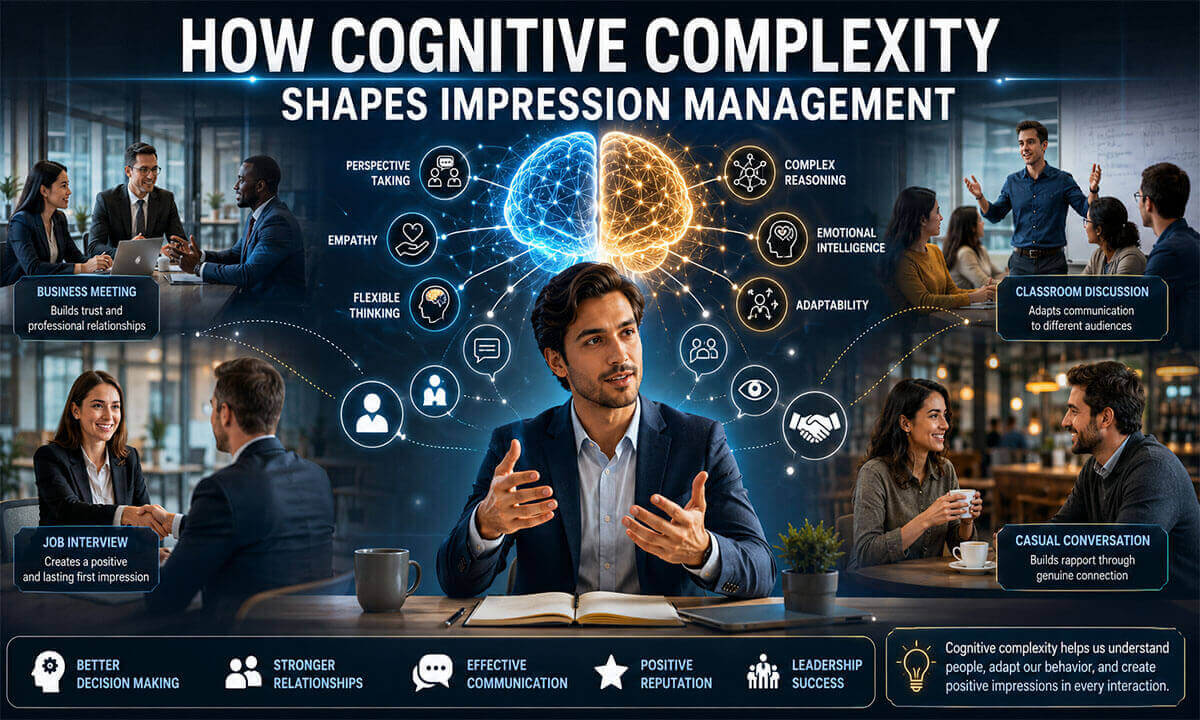
Cognitive complexity plays a major role in helping people manage the impressions they create in social and professional situations. It allows individuals to think beyond simple assumptions and understand that every person, conversation, and situation can have multiple meanings. Because of this broader way of thinking, people with higher cognitive complexity are often more successful at presenting themselves positively while remaining genuine and respectful.
1. Helps People Understand Different Perspectives: Cognitive complexity is the ability to see situations from more than one point of view. Instead of focusing only on their own thoughts and feelings, people with high cognitive complexity try to understand how others think, feel, and react.
For example, during a workplace discussion, one employee may disagree with another. A person with low cognitive complexity may immediately assume that the disagreement is personal. However, someone with higher cognitive complexity understands that the other person may simply have different experiences, priorities, or information. This understanding helps them respond calmly and respectfully, creating a positive impression.
By recognizing different perspectives, individuals avoid unnecessary conflict and show empathy, which makes others see them as thoughtful and mature.
2. Improves Communication Skills: Effective impression management depends heavily on good communication. People with high cognitive complexity are usually better communicators because they think carefully before speaking. They consider the listener’s background, emotions, knowledge, and expectations before choosing their words.
Instead of using the same communication style with everyone, they adjust their language to fit the situation. They may speak more formally during a business meeting, more simply when explaining something to a child, or more casually when talking with close friends.
This flexibility makes conversations smoother and helps others feel understood and respected. As a result, these individuals often appear confident, intelligent, and approachable.
3. Encourages Better Emotional Control: Social interactions do not always go as planned. People sometimes face criticism, misunderstandings, or stressful situations. In these moments, emotional control becomes very important.
Individuals with higher cognitive complexity are less likely to react impulsively. Before responding, they take time to consider why the situation happened and what response would be most appropriate. They understand that an emotional outburst can damage relationships and leave a negative impression.
For instance, if a manager criticizes an employee’s work, a person with high cognitive complexity may see the feedback as an opportunity to improve rather than as a personal attack. This calm and professional response creates a positive impression of maturity and self-control.
4. Increases Social Flexibility: Different social situations require different behaviors. The way people interact during a family gathering is often different from how they behave during a job interview or an important business meeting.
People with high cognitive complexity recognize these differences and adapt naturally without losing their authenticity. They understand social expectations and adjust their behavior in ways that are appropriate for each situation.
For example, they know when to speak, when to listen, when to express opinions, and when to remain quiet. This flexibility allows them to build stronger relationships with people from different backgrounds and cultures.
5. Builds Trust and Credibility: Trust is one of the most valuable outcomes of successful impression management. People are more likely to trust individuals who appear honest, respectful, and emotionally balanced.
Cognitive complexity helps build this trust because it encourages fairness, careful thinking, and empathy. Instead of making quick judgments, people with high cognitive complexity listen carefully and consider all available information before forming opinions.
Others often view them as reliable decision makers who are willing to understand different viewpoints rather than simply defending their own opinions.
6. Improves Problem Solving During Social Interactions: Many social situations involve solving problems or resolving disagreements. Cognitive complexity helps people analyze problems from several angles before deciding how to respond.
For example, if two coworkers have different opinions about a project, a cognitively complex individual will try to understand both sides of the disagreement. Rather than choosing one side immediately, they look for a solution that benefits everyone involved.
This balanced approach reduces conflict and leaves a positive impression because people appreciate fairness and cooperation.
7. Supports Authentic Self-Presentation: Successful impression management does not mean pretending to be someone else. Instead, it involves presenting one’s true strengths in a positive and appropriate way.
People with higher cognitive complexity understand that authenticity is essential for building lasting relationships. They know that acting differently in every situation simply to gain approval often creates confusion and distrust.
Instead, they adapt their communication while remaining consistent with their personal values, beliefs, and character. This combination of honesty and flexibility helps others see them as genuine and dependable.
8. Enhances Leadership and Professional Relationships: Leaders often interact with people who have different personalities, experiences, and expectations. Cognitive complexity allows leaders to understand these differences and communicate effectively with a wide range of individuals.
A leader with high cognitive complexity listens carefully, considers multiple viewpoints, and makes balanced decisions. Employees are more likely to respect leaders who show fairness, empathy, and thoughtful judgment.
In professional environments, these qualities strengthen teamwork, improve collaboration, and create a positive reputation. Colleagues often see such individuals as trustworthy, competent, and emotionally intelligent.
9. Helps Build Long-Term Relationships: First impressions are important, but maintaining positive relationships over time requires consistent behavior. Cognitive complexity supports long term relationship building because it encourages patience, understanding, and effective communication.
People with high cognitive complexity are better able to forgive mistakes, understand changing circumstances, and adapt to the needs of others. They recognize that every relationship has challenges and that lasting trust develops through mutual respect and honest communication.
Whether in friendships, family relationships, romantic partnerships, or professional networks, these qualities help create deeper and more meaningful connections.
Cognitive Complexity and Professional Success:
In professional environments, impression management plays an important role in career development. Employees are constantly evaluated by managers, colleagues, and clients.
Workers with higher cognitive complexity often demonstrate qualities such as:
- Strong communication skills
- Adaptability
- Emotional intelligence
- Problem-solving abilities
- Respect for diverse viewpoints
- Professional behavior
Because they understand workplace dynamics more deeply, they are better able to collaborate with others, manage conflicts, and build strong professional relationships.
Leaders especially benefit from cognitive complexity because they must consider multiple perspectives before making decisions that affect many people.
Cognitive Complexity in Personal Relationships:
The influence of cognitive complexity extends beyond the workplace. It also improves friendships, family relationships, and romantic partnerships.
People with greater cognitive complexity are more likely to:
- Listen carefully before judging.
- Show empathy during disagreements.
- Respect differences in personality and beliefs.
- Communicate honestly and respectfully.
- Build trust over time.
These behaviors naturally create positive impressions and strengthen long-term relationships.
The Role of Self-Awareness:
Self-awareness is closely connected to both cognitive complexity and impression management. Individuals who understand their own strengths, weaknesses, emotions, and values are better able to present themselves authentically.
Rather than trying to impress everyone, self-aware individuals focus on behaving consistently with their values while adapting appropriately to different situations. This balance creates genuine trust because others recognize honesty and sincerity.
Can Cognitive Complexity Be Developed?
The encouraging news is that cognitive complexity is not a fixed ability. It can grow throughout life with practice and experience.
Some practical ways to develop cognitive complexity include:
- Reading books from different cultures and perspectives.
- Engaging in meaningful conversations with diverse people.
- Practicing active listening without interrupting.
- Reflecting on personal experiences and decisions.
- Learning to question assumptions before reaching conclusions.
- Considering several possible explanations for people’s behavior.
- Developing emotional intelligence through self-reflection.
As cognitive complexity increases, people become better at understanding others, making thoughtful decisions, and managing impressions naturally.
Challenges of High Cognitive Complexity:
While high cognitive complexity gives you a sharp social radar and great empathy, it isn’t always smooth sailing. Processing every situation from five different angles takes a real toll, and seeing the world in “shades of gray” can create a surprising amount of internal and external friction. Here are the major challenges people with high cognitive complexity face—and why having a highly adaptable brain can sometimes feel like a double-edged sword.
1. Analysis Paralysis (Overthinking Simple Decisions): When your brain automatically generates multiple perspectives, even simple choices can become exhausting.
Because you see all potential outcomes, risks, and viewpoints, making a quick decision is tough. Where someone with lower cognitive complexity might see a straightforward “yes or no,” you see five hidden variables and three potential edge cases. This often leads to overthinking, second-guessing, and delays in action.
In practice: Choosing how to reply to an ambiguous email might take you 20 minutes because you are mentally testing how the recipient will interpret every single word.
2. Decision Fatigue and Mental Exhaustion: Constantly reading subtle cues, managing how you present yourself, and tracking everyone’s emotional states consumes a massive amount of energy.
People with high cognitive complexity often experience social and mental burnout much faster than others. Your brain is running continuous background processing during every conversation, which can leave you feeling completely drained after basic social interactions or work meetings.
3. Accusations of Inauthenticity or “Flipping”: When you are capable of deeply understanding two completely opposite viewpoints, people around you might misinterpret your flexibility as a lack of conviction.
Because you can easily see why Person A is right and why Person B is also right, you might come across as indecisive, wishy-washy, or two-faced. People who view the world in strict black-and-white terms may get frustrated with you for not taking a hard stance or picking a side immediately.
In practice: In a team debate, you might defend a point of view you personally disagree with just because you understand its underlying logic—leading others to wonder where your true loyalty lies.
4. Perfectionism in Impression Management: Seeing every nuance in how people react to you can make you hyper-aware of how you are perceived.
Instead of just being yourself, you might constantly monitor your tone, posture, and choice of words to make sure you don’t send the wrong signal. This hyper-awareness can lead to a subtle form of performance anxiety, where social interaction feels less like connecting with people and more like performing on stage.
5. Difficulty Communicating with “Black-and-White” Thinkers: One of the most frustrating challenges is trying to explain complex, nuanced ideas to people who prefer simple, rigid answers.
If your boss or partner just wants a straight “is this good or bad?” answer, and you give them a detailed explanation of all the conditional factors involved, they may view you as evasive or overly academic. Translating complex thoughts into brief, actionable statements requires extra effort.
How to Balance High Cognitive Complexity:
If you recognize these challenges in yourself, here are three practical ways to keep your mental balance:
- Set “Good Enough” Limits: Force yourself to stop gathering information once you hit 80% certainty on low-stakes decisions.
- Practice Hard Boundaries: Remind yourself that understanding someone else’s perspective doesn’t mean you have to agree with it or solve it for them.
- Simplify Your Communication: Practice summarizing your nuanced thoughts into a single, direct main point before offering the underlying background details.
Can You Develop Cognitive Complexity?
The great news is that cognitive complexity isn’t a fixed trait you are born with; it is a skill you can build over time. Here are a few ways to sharpen it:
- Practice Perspective-Taking: Before judging someone’s reaction, actively try to imagine three different reasons why they might be acting that way.
- Seek Out Diverse Ideas: Read books, watch content, or talk to people outside your usual social circle to challenge your default assumptions.
- Pause Before Responding: Instead of relying on instant reactions, take a moment to evaluate the room and consider how your words will be received.
In conclusion, successful impression management isn’t about manipulating people; it’s about effective communication and empathy. By developing higher cognitive complexity, you gain a deeper understanding of human behavior and social context. This mental agility allows you to present your best self, build stronger relationships, and navigate complex social landscapes with confidence.
References:
- Bandura, A. (1997). Self-efficacy: The exercise of control. W. H. Freeman.
- Fiske, S., & Taylor, S. (2021). Social cognition. (Vols. 1-0). SAGE Publications Ltd, https://doi.org/10.4135/9781036232405
- Goffman, E. (1959). The presentation of self in everyday life. Doubleday.
- Hogg, M. A., & Vaughan, G. M. (2022). Social psychology (9th ed.). Pearson.
- Markus, H. R., & Zajonc, R. B. (1985). The cognitive perspective in social psychology. In G. Lindzey & E. Aronson (Eds.), The handbook of social psychology (3rd ed., Vol. 1, pp. 137–230). Random House.
- Myers, D. G., & Twenge, J. M. (2025). Social psychology (14th ed.). McGraw Hill.
- Mischel, W. (1973). Toward a cognitive social learning reconceptualization of personality. Psychological Review, 80(4), 252–283. https://doi.org/10.1037/h0035002
- Schneider, D. J. (1981). Tactical self-presentation: Toward a broader conception. In J. T. Tedeschi (Ed.), Impression management theory and social psychological research (pp. 23–40). Academic Press.
- Tetlock, P. E. (1983). Cognitive style and political ideology. Journal of Personality and Social Psychology, 45(1), 118–126. https://doi.org/10.1037/0022-3514.45.1.118
- Tedeschi, J. T. (Ed.). (1981). Impression management theory and social psychological research. Academic Press.
- Tedeschi, J. T., & Riess, M. (1981). Identities, the phenomenal self, and laboratory research. In J. T. Tedeschi (Ed.), Impression management theory and social psychological research (pp. 3–22). Academic Press.

Meta Psychological Education focuses on the foundational, higher-order skills (meta-skills) that allow individuals to “learn how to learn,” manage their own cognitive processes, and adapt to new situations, often termed meta-learning. It bridges psychological research with practical application in learning and development.