Critical Period in Brain Development: Understanding Its Importance in Human Growth
The human brain is one of the most complex and remarkable parts of the body. It controls how we think, learn, feel, communicate, remember, and interact with the world around us. Although brain development continues throughout life, there are certain stages when the brain is especially sensitive to experiences and environmental influences. These stages are often described as critical periods of brain development. A critical period refers to a specific stage in development when the brain is particularly ready to develop certain abilities. During these periods, experiences can have a strong influence on the formation and organisation of neural connections. This is especially important during early childhood, when the brain develops rapidly and children learn many fundamental skills. The idea of critical periods helps us understand why early experiences matter so much. The quality of a child’s relationships, learning opportunities, environment, nutrition, stimulation, and emotional experiences can influence brain development and later behaviour. At the same time, it is important to understand that the end of a critical period does not mean that learning or development becomes impossible. The brain remains capable of change throughout life, although some forms of learning may become more difficult with age. In the rest of this article, we will explore critical period in brain development (understanding its importance in human growth).
What Is a Critical Period in Brain Development?
A critical period is a particular stage of development during which the brain is highly responsive to certain types of experiences. During this time, the brain is especially prepared to develop particular abilities or functions.
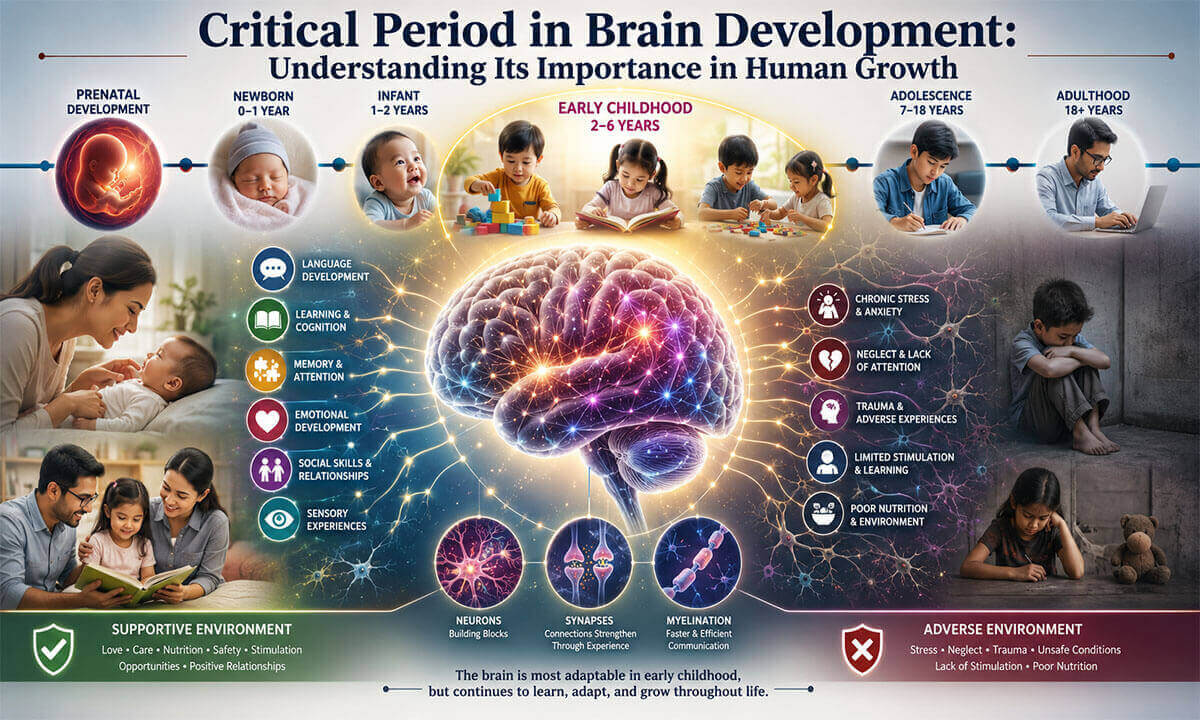
Brain development begins before birth and continues throughout childhood, adolescence, and adulthood. However, the early years of life are particularly important because the developing brain is highly flexible. During this period, the brain creates and strengthens many connections between nerve cells.
For example, when a young child hears people speaking, interacts with caregivers, plays with objects, and explores the surrounding environment, these experiences provide information that helps shape the developing brain. Repeated experiences can strengthen particular neural pathways, making them more efficient over time.
Therefore, brain development is not determined only by biology. It is also strongly influenced by experience and the environment.
Brain Plasticity and the Critical Period:
One of the most important concepts connected with critical periods is brain plasticity. Brain plasticity refers to the brain’s ability to change, adapt, reorganize, and form new connections in response to experiences.
During early childhood, the brain has a high level of plasticity. Children can learn new information and skills very quickly because their developing brains are highly responsive to their surroundings.
The brain continuously receives information from the environment. Experiences such as talking, playing, reading, listening, touching, observing, and interacting with other people provide stimulation. These experiences influence how neural connections develop.
Some connections become stronger because they are used frequently, while connections that are rarely used may become weaker. In this way, experiences help the brain become more organized and specialized.
Why Early Childhood Is So Important:
Early childhood is one of the most significant stages of human development. During these years, children develop many fundamental abilities that support later learning and behavior.
Children learn how to communicate, move, recognize people and objects, express emotions, develop relationships, solve simple problems, and understand the world around them. These abilities do not develop separately. They influence and support one another.
For example, a child who receives regular opportunities to communicate with adults may develop stronger language skills. A child who is encouraged to explore and play may develop important cognitive and problem solving abilities. Similarly, children who experience safe and supportive relationships may develop stronger emotional and social skills.
This does not mean that every aspect of development must be completed during early childhood. Rather, early childhood provides an especially important foundation for future development.
The Role of Early Experiences:
A child’s experiences can play an important role in shaping brain development. Positive and supportive experiences can provide the stimulation and security that a developing brain needs. Some helpful experiences include:
- Early Experiences Help Build Neural Connections: A child’s brain does not develop only because of biological growth. Experiences also play an important role in organizing the brain.
When children repeatedly experience something, the brain can strengthen the neural pathways involved in that experience. For example, when parents regularly talk to a baby, the child hears different sounds, words, tones, and patterns of communication. Over time, these experiences support the development of language-related brain networks.
Similarly, when children play, move, explore objects, and interact with people, they are using different parts of their brains. Repeated practice and experience help these neural connections become more efficient.
This is why everyday experiences can be important for brain development, even when they do not look like formal learning.
- Relationships Provide Emotional Security: Relationships are among the most important early experiences in a child’s life. Young children depend on parents, caregivers, and other trusted adults not only for physical care but also for emotional security.
When adults respond to children with warmth, attention, consistency, and care, children gradually learn that the world can be a safe and predictable place. This sense of security can support healthy emotional and social development.
For example, when a baby cries and a caregiver responds appropriately, the child begins to experience a pattern of communication. The child expresses a need, and another person responds. Repeated experiences of this kind can contribute to the development of trust, emotional regulation, and social understanding.
Supportive relationships can therefore provide an important foundation for later relationships and emotional wellbeing.
- Communication Supports Language Development: Children learn language through regular exposure and interaction. Talking, listening, singing, reading stories, and responding to a child’s sounds and questions all provide valuable language experiences.
A child does not need to understand every word immediately. Hearing language repeatedly allows the developing brain to become familiar with sounds, vocabulary, sentence structures, and patterns of communication.
For example, a parent who talks to a young child while preparing food might describe what they are doing. Although the child may not respond with complete sentences, the experience provides exposure to language.
As children grow, these experiences can help them develop vocabulary, communication skills, comprehension, and eventually reading and writing abilities.
- Play Encourages Learning and Brain Development: Play is not simply an activity for entertainment. It is one of the natural ways children learn about the world.
Through play, children can practise problem solving, creativity, movement, communication, decision making, and social interaction. Building with blocks, drawing pictures, playing pretend games, solving puzzles, and playing with other children all provide different forms of mental stimulation.
For example, when a child builds a tower with blocks, the child may experiment with balance and size. When the tower falls, the child can try again and change the arrangement. This simple activity involves observation, problem solving, attention, and learning through trial and error.
Therefore, play provides children with opportunities to learn while actively engaging with their environment.
- Exploration Helps Children Understand the World: Young children are naturally curious. They want to touch, observe, move, ask questions, and discover how things work. This curiosity is an important part of learning.
When children are given safe opportunities to explore, they receive information through their senses. They learn about shapes, sounds, textures, movement, distance, cause and effect, and relationships between objects.
For instance, a child may learn that a ball rolls when pushed, that some objects are heavier than others, or that a particular action produces a particular sound. These simple experiences gradually help children develop an understanding of their physical and social environment.
- Positive Experiences Support Cognitive Development: Early experiences can contribute to the development of important cognitive abilities such as attention, memory, reasoning, problem solving, and learning.
Children learn by observing what happens around them and making connections between different experiences. When adults encourage children to ask questions and think about possible answers, they can support the development of these abilities.
For example, instead of immediately giving a child the answer to a simple problem, an adult might ask, “What do you think will happen if we try this?” Such conversations encourage children to observe, predict, think, and learn from the results.
In this way, ordinary experiences can become opportunities for cognitive development.
- Early Experiences Influence Emotional Development: Children gradually learn how to understand and manage their emotions. They do not automatically know how to deal with anger, sadness, fear, frustration, or disappointment. They learn these skills through experience and through interaction with supportive adults.
When caregivers help children name their feelings and respond calmly to emotional situations, children can gradually learn that emotions are normal and manageable.
For example, if a child becomes frustrated because they cannot complete a task, a supportive adult might acknowledge the frustration and encourage the child to try again. Over time, experiences like this can help children develop patience, emotional regulation, and resilience.
- Social Experiences Teach Children How to Interact: Children also learn social behavior through experience. Interaction with parents, siblings, teachers, friends, and other people teaches them how to communicate, cooperate, share, take turns, resolve disagreements, and understand other people’s feelings.
For example, when children play together, they may have to negotiate who gets to use a particular toy. With appropriate guidance, they can learn how to communicate their needs and consider the needs of others.
These experiences help build social skills that become increasingly important as children grow older.
- A Supportive Environment Encourages Healthy Development: The environment surrounding a child can strongly influence the experiences available to them. A supportive environment provides opportunities for children to learn, explore, communicate, play, and develop relationships.
A supportive environment does not have to be expensive or highly sophisticated. Simple things such as talking with children, reading books, answering their questions, playing together, providing safe spaces for exploration, and showing affection can make a meaningful difference.
Children benefit from environments where they feel safe enough to explore while knowing that supportive adults are available when they need help.
- Negative Experiences Can Affect Development: Early experiences are not always positive. Some children experience neglect, abuse, severe stress, family conflict, trauma, poverty, or a lack of appropriate care and stimulation. These experiences can create challenges for healthy development.
Long periods of stress can affect children’s emotional and behavioral responses. A child who frequently experiences fear or insecurity may find it difficult to concentrate, regulate emotions, trust others, or feel safe.
Neglect can also limit the opportunities children have to receive language, social, emotional, and cognitive stimulation.
However, it is important to remember that negative early experiences do not mean that a child’s future is permanently determined. The brain continues to change throughout life. Supportive relationships, education, appropriate interventions, and positive later experiences can contribute to continued development and improvement.
- Early Experiences Can Influence Later Learning: The experiences children have during their early years can create a foundation for later learning. Children who have opportunities to develop language, attention, memory, social skills, and emotional regulation may be better prepared to participate in formal education.
For example, a child who has developed the ability to listen carefully may find it easier to follow classroom instructions. A child who has learned to manage frustration may be better able to continue working when a task becomes difficult.
This does not mean that early childhood completely determines academic success. Later experiences, teaching quality, motivation, family circumstances, and many other factors also influence learning. Early experiences simply provide an important foundation.
- Early Experiences and Brain Plasticity: The importance of early experiences is closely connected with brain plasticity. During early childhood, the brain is particularly adaptable and responsive to experience.
When a child repeatedly receives particular experiences, the brain can strengthen the neural pathways associated with those experiences. This is one reason why repeated practice and exposure are important in childhood learning.
For example, children who regularly hear and use language have many opportunities to strengthen language-related skills. Children who regularly practise physical activities have opportunities to develop coordination and motor skills.
This shows that the developing brain is not simply waiting for information. It is actively responding to and changing through experience.
- The Role of Parents and Caregivers: Parents and caregivers have a particularly important role because they are often the people with whom young children have the most frequent interaction. They can support development through simple daily activities such as:
- Talking and listening to children
- Reading stories together
- Playing and exploring together
- Encouraging questions
- Showing affection and attention
- Helping children identify their emotions
- Providing consistent routines
- Encouraging safe exploration
- Praising effort rather than only achievement
- Responding appropriately when children need help
These activities can create a supportive environment in which children can learn and develop naturally.
- The Role of Teachers and Educational Institutions: Teachers also contribute significantly to children’s development. Schools provide opportunities for children to learn academic knowledge as well as social, emotional, and communication skills.
A good learning environment encourages curiosity, participation, cooperation, creativity, and problem-solving. Teachers can also help children develop confidence by treating mistakes as opportunities to learn rather than simply as failures.
Early education is particularly valuable because it can provide children with structured opportunities to communicate, interact, explore, and learn.
- Early Experiences Do Not Determine Everything: Although early experiences are highly important, they should not be viewed as the only factor that shapes human development.
Human development results from the interaction of many influences, including genetics, relationships, education, culture, health, environment, personal experiences, and individual differences.
A difficult childhood does not necessarily mean that a person will have a difficult adulthood. Similarly, a positive childhood does not guarantee that every aspect of later life will be successful.
The brain remains capable of change throughout life. People can continue learning, adapting, developing new skills, changing habits, and building healthier relationships at different stages of life.
These experiences do not need to be expensive or complicated. Everyday activities such as talking with a child, reading a story, playing together, answering questions, and showing affection can provide valuable developmental experiences.
Negative Experiences and Brain Development:
Just as positive experiences can support healthy development, negative experiences can also influence the developing brain. Severe or prolonged stress, neglect, abuse, trauma, and a lack of appropriate stimulation may interfere with healthy development.
When children repeatedly experience fear, insecurity, neglect, or extreme stress, their developing systems may be affected. Such experiences can influence emotional regulation, learning, attention, social relationships, and behaviour.
However, it is essential not to assume that negative early experiences permanently determine a person’s future. Human development is complex, and the brain continues to have the ability to change.
Supportive relationships, education, intervention, therapy when appropriate, and positive later life experiences can contribute to recovery and continued development.
Critical Periods and Language Development:
Language development is one of the most commonly discussed examples of a critical period. Young children can often learn language naturally through regular interaction with people around them.
They do not usually need formal lessons to understand basic language patterns. Through listening and communicating, they gradually develop vocabulary, pronunciation, grammar, and communication skills.
The idea of a critical period in language development suggests that early exposure to language can provide important advantages. As people become older, learning a new language remains possible, but some aspects of language acquisition, particularly pronunciation and natural fluency, may become more challenging.
This does not mean that adults cannot learn languages. Adults can successfully learn new languages, but the process may require greater conscious effort and practice.
Critical Periods and Different Abilities:
It is vital to understand that there is not necessarily one single critical period for the entire brain. Different abilities may have different periods of heightened sensitivity.
For example, visual development begins very early in life. Language development also has important periods of sensitivity, particularly during childhood. Motor skills, social development, emotional development, and other abilities may also have their own developmental patterns.
Therefore, the critical period concept should not be understood as one fixed age when all brain development either happens or stops. Brain development is a gradual and complex process.
What Happens After a Critical Period?
One common misunderstanding is that once a critical period ends, a person can no longer learn or develop a particular ability. This is not accurate.
The brain continues to change throughout life. Adults can learn new languages, develop new skills, change habits, gain knowledge, and adapt to new environments.
However, some types of learning may be easier during earlier stages of life because the developing brain is particularly flexible. As people grow older, certain forms of brain plasticity may become less pronounced.
Therefore, the end of a critical period should be understood as a change in the brain’s level of sensitivity, rather than a complete end to learning.
The Importance of a Supportive Environment:
The concept of critical periods shows why children need supportive environments during their early years. Parents, caregivers, teachers, communities, and society all have important roles to play.
Children need opportunities to learn, communicate, explore, play, and build relationships. They also need safety, emotional support, adequate nutrition, and protection from serious harm.
A supportive environment does not mean that children must receive constant educational activities. Children also learn naturally through everyday experiences. A simple conversation, a shared story, a game, or an opportunity to explore can contribute to development.
Schools and educational institutions also have an important role. Teachers can provide children with opportunities to ask questions, solve problems, communicate with others, develop creativity, and build confidence.
The Importance of Early Intervention:
Understanding critical periods also explains why early intervention can be valuable when developmental difficulties are identified.
If a child has difficulties with language, hearing, vision, movement, learning, or social interaction, identifying the difficulty early can provide an opportunity to offer appropriate support.
Early intervention does not guarantee a particular outcome, but it can provide additional opportunities for learning and development while the brain is highly responsive.
This is particularly important because development is interconnected. Supporting one area of development may also support other areas.
Critical Periods Do Not Mean That the Future Is Fixed:
It is momentous to avoid interpreting the critical period concept too strictly. Early experiences are important, but they do not completely determine a person’s future.
Human beings continue to learn and change throughout their lives. A difficult childhood does not automatically mean that a person will experience difficulties forever. Similarly, having a supportive childhood does not guarantee that every aspect of later life will be easy.
Many factors influence human development, including genetics, family relationships, education, social environment, culture, health, personal experiences, and individual choices.
The critical period concept therefore helps us understand the importance of timing without suggesting that human development is completely predetermined.
Why the Critical Period Concept Matters:
The concept of critical periods has important implications for parents, educators, psychologists, healthcare professionals, and society.
For parents and caregivers, it highlights the value of providing children with loving relationships, communication, play, and opportunities to explore.
For teachers, it emphasizes the importance of creating supportive learning environments where children can develop cognitive, emotional, social, and communication skills.
For psychologists and healthcare professionals, it highlights the importance of recognizing developmental difficulties and providing appropriate support when needed.
For society, it demonstrates why investment in early childhood education, family support, child protection, healthcare, and safe environments can be valuable for long-term human development.
In conclusion, the critical period of brain development is an important concept for understanding how early experiences influence human growth. During certain stages of development, particularly early childhood, the brain is highly adaptable and especially responsive to environmental experiences. During these periods, neural connections are formed, strengthened, reorganized, and refined in response to what children experience.
Positive experiences such as loving relationships, communication, play, learning opportunities, social interaction, and emotional support can provide a strong foundation for healthy development. In contrast, serious neglect, prolonged stress, trauma, and a lack of appropriate stimulation may create challenges for development.
However, the critical period concept should not be understood as meaning that development stops after childhood. The human brain remains capable of learning and adapting throughout life. Later experiences can still contribute to growth, change, and recovery.
Ultimately, the most necessary message is that early experiences matter, but they do not completely determine a person’s future. Understanding the critical periods of brain development reminds us of the importance of giving children safe, supportive, stimulating, and caring environments. By providing children with the right conditions during their early years, families, schools, and communities can help create a strong foundation for lifelong learning, emotional wellbeing, social development, and healthy human growth.
References:
- Siahaan, F. (2022). The Critical Period Hypothesis of SLA Eric Lenneberg’s. Journal of Applied Linguistics, 2(1), 40–45. https://doi.org/10.52622/joal.v2i2.77
- Bath, K. G. (2020). Synthesizing views to understand sex differences in response to early life adversity. Trends in Neurosciences, 43(5), 300–310. https://doi.org/10.1016/j.tins.2020.02.004
- Colombo, J., Gustafson, K. M., & Carlson, S. E. (2019). Critical and sensitive periods in development and nutrition. Annals of Nutrition and Metabolism, 75(Suppl. 1), 34–42. https://doi.org/10.1159/000508053
- Patton, M. H., Blundon, J. A., & Zakharenko, S. S. (2019). Rejuvenation of plasticity in the brain: Opening the critical period. Current Opinion in Neurobiology, 54, 83–89. https://doi.org/10.1016/j.conb.2018.09.003

Meta Psychological Education focuses on the foundational, higher-order skills (meta-skills) that allow individuals to “learn how to learn,” manage their own cognitive processes, and adapt to new situations, often termed meta-learning. It bridges psychological research with practical application in learning and development.