Understanding Cognitive Distortions: How Negative Thinking Shapes Our Emotions and Behavior
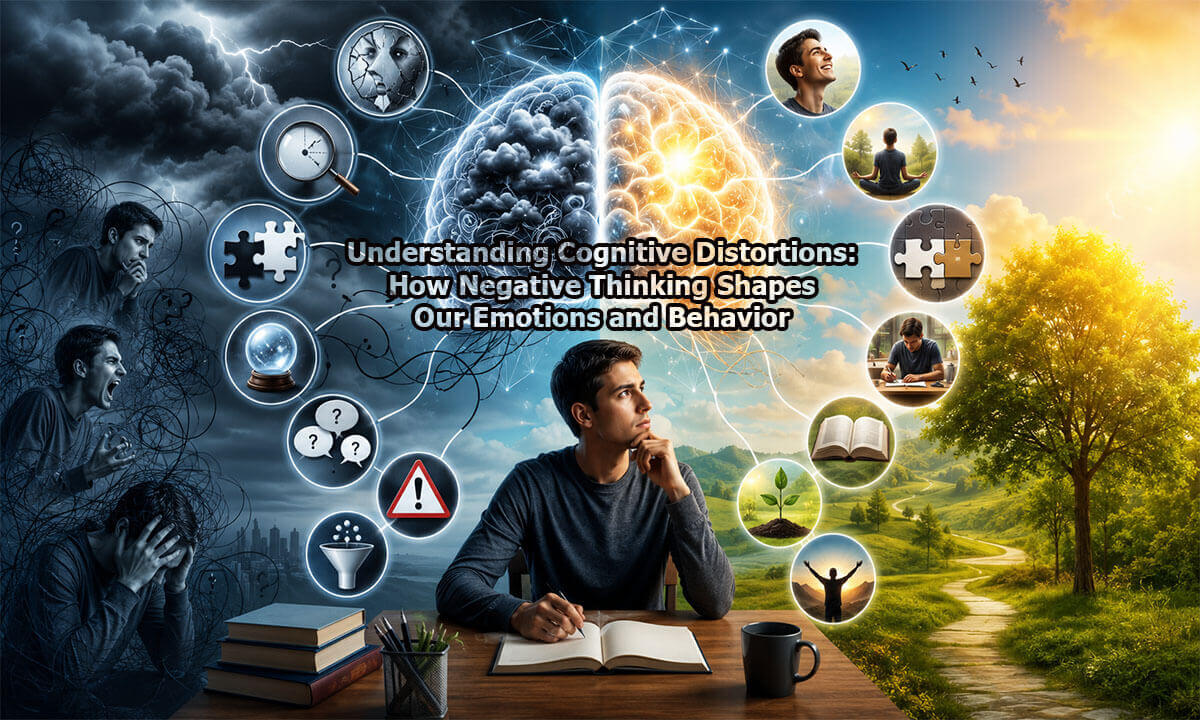
Every person experiences negative thoughts from time to time. Feeling worried before an important exam, believing that a mistake defines one’s abilities, or assuming that others are judging us are common experiences. While these thoughts may seem harmless, they can sometimes become habitual and unrealistic. When this happens, they are known as cognitive distortions. Cognitive distortions are inaccurate patterns of thinking that cause people to view themselves, other people, and everyday situations in an overly negative or unrealistic way. These distorted thoughts often occur automatically without conscious awareness and can influence emotions, decisions, and behavior. If left unchallenged, they may contribute to stress, anxiety, depression, low self-esteem, and relationship problems. The concept of cognitive distortions is central to Cognitive Behavioral Therapy (CBT), a psychological approach developed by psychiatrist Aaron T. Beck. CBT teaches that our emotions are influenced not only by what happens to us but also by how we interpret those events. By identifying and changing distorted thinking patterns, individuals can develop healthier emotions, make better decisions, and improve their overall mental wellbeing. This article explains understanding cognitive distortions, their characteristics, common types, causes, effects, and practical strategies for overcoming them.
What Are Cognitive Distortions?
Cognitive distortions are automatic thinking errors that lead people to interpret reality in a biased or exaggerated manner. These thoughts are usually negative and often appear so quickly that people accept them as facts without questioning them.
For example, imagine a student receives a low grade on one examination. Instead of thinking, “I need to study differently next time,” the student may think, “I always fail. I am not intelligent.” This conclusion ignores many other possibilities and represents a distorted way of thinking rather than an objective assessment.
Cognitive distortions do not necessarily reflect reality. Instead, they are mental shortcuts that simplify information in ways that are often inaccurate. Although everyone experiences these thinking errors occasionally, frequent cognitive distortions can negatively affect emotional health and daily functioning.
Why Do Cognitive Distortions Develop?
Cognitive distortions develop through a combination of life experiences, personality, emotions, and learned patterns of thinking. They often become stronger during periods of stress or emotional difficulty.
Several factors contribute to their development:
- Childhood experiences, including criticism, neglect, or unrealistic expectations.
- Stressful life events such as loss, failure, or conflict.
- Anxiety and depression, which increase negative thinking.
- Low self-confidence and poor self-esteem.
- Repeated exposure to negative beliefs or environments.
- Habitual patterns of interpreting situations pessimistically.
Over time, these repeated thought patterns become automatic, making it difficult for individuals to recognize that their thinking is distorted.
Characteristics of Cognitive Distortions:
Cognitive distortions have numerous distinct characteristics that make them different from logical and balanced thinking. These characteristics explain why distorted thoughts can feel so convincing, even when they are inaccurate. Understanding these features helps individuals recognize unhealthy thinking patterns and replace them with more realistic and constructive thoughts. The following are the major characteristics of cognitive distortions.
- They Occur Automatically: One of the most important characteristics of cognitive distortions is that they appear automatically without conscious effort. People do not usually choose to think in a distorted way. Instead, these thoughts arise instantly in response to situations, often before the person has time to analyze the facts.
For example, after making a small mistake during a presentation, a person may immediately think, “Everyone thinks I am incompetent.” This thought appears almost instantly, even though there is no evidence to support it.
Because these thoughts happen so quickly, many people accept them as true without questioning them. Learning to slow down and examine automatic thoughts is an important skill in Cognitive Behavioral Therapy.
- They Are Often Negative: Cognitive distortions usually focus on negative possibilities rather than balanced or positive interpretations. People tend to notice failures, weaknesses, mistakes, or potential dangers while overlooking achievements and strengths.
For instance, an employee who receives positive feedback from several colleagues may continue thinking only about one minor criticism. The positive comments become less important, while the negative feedback dominates their thinking.
This constant focus on negativity can increase stress, anxiety, sadness, and self-doubt over time.
- They Are Based on Inaccurate Interpretations: Cognitive distortions are not objective facts. They are inaccurate interpretations of situations, people, or events. Individuals often misunderstand reality because they rely on assumptions rather than evidence.
For example, if a friend does not answer a text message immediately, someone might think, “They must be angry with me.” In reality, the friend may simply be busy, driving, or unable to respond.
This characteristic shows that cognitive distortions involve interpreting situations incorrectly instead of viewing them realistically.
- They Feel True Even When They Are Not: One reason cognitive distortions are so powerful is that they often feel completely true. Strong emotions such as fear, sadness, embarrassment, or anger make these thoughts seem believable.
For example, someone who feels anxious before an examination may think, “I am definitely going to fail.” Although there is no evidence for this prediction, the emotional intensity makes the thought feel like a fact.
Feelings are real and important, but they do not always represent reality accurately.
- They Are Repetitive: Cognitive distortions often occur repeatedly. The same negative thoughts may appear every time a similar situation arises. Over time, these repeated thoughts become habitual patterns of thinking.
For example, a person with low self-confidence may repeatedly think, “I am not good enough,” whenever they start a new project, meet new people, or face a challenge.
The more frequently these thoughts occur, the stronger and more automatic they become.
- They Influence Emotions: Thoughts and emotions are closely connected. Cognitive distortions often trigger strong emotional reactions because people believe their distorted thoughts are accurate.
For example, believing “Nobody likes me” may lead to sadness, loneliness, or anxiety, even when there is no evidence that others dislike the person.
When distorted thoughts change, emotional responses often become healthier and more balanced.
- They Affect Behavior: Cognitive distortions do not only influence thoughts and emotions. They also shape how people behave.
For example, someone who believes they will embarrass themselves during a meeting may avoid speaking altogether. Although avoiding participation reduces anxiety temporarily, it also prevents the person from gaining confidence or proving that their fear was unrealistic.
In this way, distorted thinking often leads to behaviors that reinforce negative beliefs.
- They Ignore Evidence: People experiencing cognitive distortions often ignore evidence that contradicts their negative beliefs. They pay attention only to information that supports their existing assumptions.
For example, a student who believes they are unintelligent may remember every poor examination result but completely forget the many times they performed well.
This selective attention strengthens distorted thinking and makes it more difficult to develop a balanced perspective.
- They Are Rigid and Inflexible: Cognitive distortions usually involve rigid patterns of thinking. People see situations in fixed ways and struggle to consider alternative explanations.
For example, a person may believe, “If I am not perfect, I am worthless.” This belief leaves no room for the possibility that people can succeed while still making mistakes.
Healthy thinking is flexible and recognizes that life is rarely completely right or completely wrong.
- They Increase Psychological Distress: Persistent cognitive distortions contribute to emotional suffering. When people constantly interpret situations negatively, they are more likely to experience anxiety, depression, frustration, guilt, stress, and low self-esteem.
For example, constantly expecting the worst outcome can make even ordinary situations feel overwhelming. Over time, this ongoing mental strain can affect work performance, relationships, physical health, and overall quality of life.
Recognizing these distortions is an important step toward reducing psychological distress.
- They Can Become Learned Habits: Cognitive distortions often develop gradually through repeated experiences. Childhood experiences, family beliefs, stressful life events, trauma, or ongoing criticism can shape how people interpret the world.
If a child repeatedly hears negative comments about their abilities, they may grow up believing they are incapable or not good enough. Eventually, these beliefs become automatic thinking habits that continue into adulthood.
The encouraging news is that learned thinking habits can also be changed through practice and psychological interventions such as Cognitive Behavioral Therapy.
- They Can Be Challenged and Changed: Although cognitive distortions may feel deeply rooted, they are not permanent. One of their most important characteristics is that they can be identified, questioned, and replaced with healthier ways of thinking.
People can ask themselves questions such as:
- What evidence supports this thought?
- Is there another possible explanation?
- Am I assuming the worst without proof?
- What would I say to a friend who had this thought?
By regularly examining distorted thoughts, individuals gradually develop more realistic and balanced thinking patterns.
Common Types of Cognitive Distortions:
Cognitive distortions are patterns of inaccurate thinking that influence how people interpret themselves, others, and everyday situations. These thoughts often occur automatically and feel convincing, even when they are not supported by facts. They can increase feelings of stress, anxiety, sadness, frustration, and low self-esteem. Recognizing these thinking errors is the first step toward replacing them with more realistic and balanced thoughts. The following are the most common types of cognitive distortions found in Cognitive Behavioral Therapy (CBT).
- All or Nothing Thinking: All or nothing thinking, also known as black and white thinking, occurs when people see situations in extreme categories without recognizing the middle ground. Everything is viewed as either completely good or completely bad, perfect or a total failure. This way of thinking leaves little room for flexibility or realistic judgment.
People with this distortion often believe that unless they achieve perfection, they have failed completely. They ignore the fact that most situations fall somewhere between success and failure.
Example:
A university student receives 85 percent on an examination but thinks, “I did not get the highest grade, so I am a failure.”
In reality, an 85 percent score is a strong achievement, but all-or-nothing thinking prevents the student from recognizing that success can exist without perfection.
Effects:
- Creates unrealistic expectations.
- Increases disappointment and frustration.
- Reduces motivation after small setbacks.
- Encourages perfectionism.
- Overgeneralization: Overgeneralization occurs when a person takes one negative experience and believes that it represents a never-ending pattern. Instead of viewing an event as an isolated incident, they assume the same outcome will always happen.
People often use words such as “always,” “never,” or “everyone” when overgeneralizing.
Example:
A job applicant is rejected during one interview and concludes, “I will never find a good job.”
One unsuccessful interview does not determine future opportunities, yet overgeneralization creates the false belief that failure is permanent.
Effects:
- Increases hopelessness.
- Discourages people from trying again.
- Strengthens negative beliefs about oneself.
- Promotes fear of future challenges.
- Mental Filtering: Mental filtering occurs when people focus only on the negative aspects of a situation while ignoring all positive information. It is similar to looking at life through a dark filter that blocks out positive experiences.
Even when many good things happen, one small negative event becomes the only thing they remember.
Example:
A teacher receives praise from twenty students, but one student complains. Instead of appreciating the positive feedback, the teacher spends the entire day thinking about the single complaint.
Effects:
- Reduces happiness and satisfaction.
- Creates unnecessary worry.
- Lowers self-confidence.
- Makes problems appear larger than they actually are.
- Discounting the Positive: People who discount the positive reject compliments, achievements, or success by convincing themselves that these positive experiences do not really count. Rather than accepting success, they find reasons to dismiss it.
Example:
A manager compliments an employee’s excellent work, but the employee responds internally, “They are just being polite.”
This thinking prevents people from appreciating their own abilities and accomplishments.
Effects:
- Lowers self-esteem.
- Reduces motivation.
- Prevents personal growth.
- Maintains negative self-beliefs.
- Jumping to Conclusions: Jumping to conclusions occurs when people make negative assumptions without having enough evidence. Instead of gathering facts, they immediately believe the worst.
This distortion includes two common forms:
a) Mind Reading: Mind reading involves assuming that other people have negative thoughts about you without any proof.
Example:
A colleague does not greet someone at work, and the person immediately thinks, “They must dislike me.”
There may be many other explanations, such as the colleague being busy or distracted.
Effects:
- Creates unnecessary social anxiety.
- Damages relationships.
- Increases self-doubt.
b) Fortune Telling: Fortune telling occurs when people predict that something bad will happen in the future even though they have no evidence.
Example:
Before giving a presentation, someone thinks, “I know everyone will think I am terrible.”
This expectation increases nervousness and may reduce performance.
Effects:
- Increases anxiety.
- Discourages people from taking opportunities.
- Reinforces fear of failure.
- Magnification and Minimization: This distortion involves exaggerating negative events while minimizing positive ones. Small mistakes become enormous problems, while personal strengths and achievements seem insignificant.
Example:
A student makes one spelling mistake in an essay and believes the entire assignment is ruined, despite receiving an excellent grade.
Effects:
- Creates unnecessary stress.
- Lowers confidence.
- Increases self-criticism.
- Prevents appreciation of achievements.
- Emotional Reasoning: Emotional reasoning occurs when people believe that their emotions represent objective facts. Instead of asking whether their thoughts are accurate, they assume that because they feel something, it must be true.
Example:
Someone thinks, “I feel useless, so I must be useless.”
Feelings are real and important, but they are not always accurate reflections of reality.
Effects:
- Strengthens negative beliefs.
- Increases depression and anxiety.
- Reduces logical thinking.
- Encourages impulsive decisions.
- Should Statements: Should statements involve placing rigid and unrealistic expectations on oneself or others. People constantly tell themselves what they “should,” “must,” or “ought” to do.
When these expectations are not met, they often experience guilt, frustration, or disappointment.
Example:
“I should never make mistakes.”
Since mistakes are a normal part of learning, this belief creates unnecessary pressure.
Effects:
- Increases guilt and shame.
- Creates unrealistic standards.
- Encourages perfectionism.
- Causes frustration with oneself and others.
- Labeling: Labeling occurs when people define themselves or others using negative labels instead of describing specific behaviors.
Rather than saying that they made a mistake, they conclude that they are a failure as a person.
Example:
A person forgets an important appointment and immediately thinks, “I am so irresponsible.”
A single mistake does not define an individual’s entire character.
Effects:
- Damages self-identity.
- Reduces confidence.
- Encourages self-criticism.
- Makes change seem impossible.
- Personalization: Personalization occurs when people assume responsibility for events that are not completely under their control. They blame themselves for situations that have many different causes.
Example:
A parent believes their child’s poor examination results are entirely their fault, even though many factors influenced the outcome.
People often take responsibility for things they could not realistically control.
Effects:
- Creates unnecessary guilt.
- Increases stress.
- Encourages excessive self-blame.
- Makes people feel responsible for other people’s emotions.
- Catastrophizing: Catastrophizing is the tendency to imagine the worst possible outcome and treat it as if it is certain to happen. Small problems become major disasters in the person’s mind.
Example:
Someone forgets to reply to an email and immediately thinks, “I am going to lose my job.”
In reality, most mistakes have much smaller consequences than people imagine.
Effects:
- Increases fear and panic.
- Creates chronic anxiety.
- Reduces confidence in handling challenges.
- Encourages avoidance of difficult situations.
How Cognitive Distortions Affect Mental Health:
Persistent cognitive distortions can have significant consequences for psychological well-being.
They may lead to:
- Increased anxiety and excessive worrying.
- Depression and hopelessness.
- Low self-esteem.
- Reduced motivation.
- Poor decision-making.
- Relationship conflicts.
- Social withdrawal.
- Increased stress and emotional exhaustion.
When distorted thoughts become frequent, they create a cycle in which negative thinking leads to negative emotions, which then reinforce the original distorted beliefs.
The Role of Cognitive Behavioral Therapy:
Cognitive Behavioral Therapy is one of the most effective psychological treatments for cognitive distortions.
CBT is based on the idea that thoughts, emotions, and behaviors are closely connected. By changing unhealthy thinking patterns, people can improve their emotional well-being and behavior.
During CBT, individuals learn to:
- Identify automatic negative thoughts.
- Examine the evidence supporting and opposing those thoughts.
- Replace distorted beliefs with balanced and realistic alternatives.
- Develop healthier emotional responses.
- Practice new ways of thinking in everyday life.
Rather than encouraging unrealistic optimism, CBT promotes accurate and balanced thinking.
Practical Strategies to Overcome Cognitive Distortions:
Cognitive Behavioral Therapy (CBT) provides several practical techniques for overcoming cognitive distortions. These strategies help individuals develop a more realistic perspective, improve emotional well-being, and respond to life’s challenges with greater confidence and resilience. The following are some of the most effective strategies for overcoming cognitive distortions.
- Develop Awareness of Automatic Thoughts: The first step in overcoming cognitive distortions is becoming aware of them. Many distorted thoughts happen so quickly that people do not even realize they are thinking in an unrealistic way.
Whenever a strong emotion such as anxiety, sadness, anger, or guilt appears, it is helpful to pause and ask:
- What am I thinking right now?
- What happened just before I felt this emotion?
- Is this thought based on facts or assumptions?
Simply noticing automatic thoughts helps create distance between the individual and the thought itself. Instead of immediately believing every thought, people begin to observe their thinking more objectively.
Example:
After making a small mistake at work, someone immediately thinks, “I always ruin everything.”
By recognizing this thought, they can begin questioning whether it is actually true.
- Identify the Type of Cognitive Distortion: Once a negative thought has been recognized, the next step is to identify which cognitive distortion it represents.
Ask questions such as:
- Am I expecting the worst possible outcome?
- Am I ignoring positive information?
- Am I thinking in extremes?
- Am I assuming I know what others are thinking?
Giving a name to the distortion makes it easier to challenge because it reminds people that the thought is a thinking error rather than an objective fact.
Example:
Thinking, “Everyone will laugh at me during my presentation,” is an example of catastrophizing and fortune telling.
Recognizing the distortion reduces its emotional power.
- Examine the Evidence: One of the most effective CBT techniques is evaluating the evidence supporting a thought.
Instead of accepting thoughts automatically, ask:
- What evidence supports this belief?
- What evidence contradicts it?
- Have I ignored important facts?
People often discover that their negative thoughts are based on assumptions rather than actual evidence.
Example:
Thought:
“I failed one examination. I am not intelligent.”
Evidence against the thought:
- Previous examinations were passed successfully.
- Many intelligent people occasionally perform poorly.
- One examination does not determine overall ability.
Looking at the evidence encourages more balanced thinking.
- Replace Negative Thoughts with Balanced Thoughts: The goal of CBT is not to replace negative thoughts with unrealistic optimism. Instead, it encourages balanced and realistic thinking.
Rather than asking, “How can I think positively?” ask, “What is the most accurate way to view this situation?”
Example:
Instead of thinking:
“I will definitely fail.”
A balanced thought would be:
“I may face challenges, but I have prepared well and will do my best.”
Balanced thoughts reduce emotional distress while remaining realistic.
- Challenge Extreme Thinking: Cognitive distortions often include extreme words such as:
- Always
- Never
- Everyone
- Nobody
- Completely
- Impossible
These words usually indicate that thinking has become exaggerated.
Replace these absolute statements with more accurate language.
Example:
Instead of:
“I always make mistakes.”
Think:
“Sometimes I make mistakes, but I also do many things well.”
Small changes in language often lead to healthier emotional responses.
- Consider Alternative Explanations: People experiencing cognitive distortions often assume there is only one explanation for a situation, and it is usually negative. Instead, practice generating several possible explanations.
Example:
A friend does not reply to a message.
Negative interpretation:
“They are ignoring me because they do not like me.”
Alternative explanations:
- They may be busy.
- Their phone battery may be dead.
- They may have forgotten to reply.
- They may respond later.
Considering multiple explanations prevents unnecessary worry and reduces emotional distress.
- Keep a Thought Journal: Writing thoughts down is an excellent way to identify recurring thinking patterns.
A simple thought journal may include:
- The situation.
- Automatic thoughts.
- Emotions experienced.
- Evidence supporting the thought.
- Evidence against the thought.
- A more balanced conclusion.
Over time, people begin to notice repeated patterns and become better at challenging cognitive distortions.
For example:
Situation: Received criticism from a supervisor.
Automatic thought: “I am terrible at my job.”
Balanced thought: “Everyone receives feedback. This criticism helps me improve.”
Keeping a journal increases self-awareness and encourages healthier thinking habits.
- Practice Self-Compassion: Many cognitive distortions involve harsh self-criticism. People often judge themselves much more severely than they judge others.
Practicing self-compassion means treating yourself with patience, understanding, and kindness during difficult moments.
Ask yourself:
- Would I speak this way to a close friend?
- Am I being unnecessarily harsh with myself?
- What would be a kinder way to view this situation?
Self-compassion reduces guilt, shame, and perfectionism while promoting emotional resilience.
- Focus on Facts Instead of Feelings: Emotions are valuable because they provide important information about our experiences. However, emotions do not always reflect reality. When emotions become intense, separate feelings from facts.
Example:
Feeling:
“I feel like everyone dislikes me.”
Fact:
“No one has actually said they dislike me.”
Learning to distinguish emotions from evidence prevents emotional reasoning.
- Practice Mindfulness: Mindfulness teaches people to observe their thoughts without immediately reacting to them.
Instead of believing every thought, mindfulness encourages individuals to simply notice thoughts as temporary mental events.
For example, rather than saying:
“I am a failure.”
Practice thinking:
“I am noticing the thought that I am a failure.”
This small change creates psychological distance and reduces the emotional impact of negative thinking.
Regular mindfulness practice also improves concentration, emotional regulation, and stress management.
- Replace Perfectionism with Progress: Many cognitive distortions are linked to perfectionism.
People often believe they must perform perfectly in every situation. When perfection is not achieved, they consider themselves failures.
Instead, focus on gradual improvement rather than flawless performance.
Example:
Instead of thinking:
“I must never make mistakes.”
Think:
“Mistakes are part of learning, and every experience helps me improve.”
This mindset encourages growth, confidence, and resilience.
- Talk to Someone You Trust: Sharing thoughts with trusted friends, family members, teachers, or mentors can provide a more balanced perspective.
Other people often notice thinking errors that individuals cannot see themselves.
Simply discussing worries with someone supportive may help reduce anxiety and challenge unrealistic beliefs.
Healthy conversations also remind people that they are not alone in their struggles.
- Learn Effective Problem Solving: Sometimes people spend so much time worrying about a problem that they forget to look for practical solutions.
Instead of asking:
“Why does everything go wrong?”
Ask:
“What can I do to improve this situation?”
Breaking problems into smaller, manageable steps makes challenges feel less overwhelming and increases confidence.
- Seek Professional Support: When cognitive distortions become severe or begin interfering with daily life, work, relationships, or emotional well-being, seeking help from a qualified mental health professional is highly beneficial.
Cognitive Behavioral Therapy is one of the most effective treatments for identifying and changing distorted thinking patterns.
A trained therapist can help individuals:
- Recognize automatic negative thoughts.
- Challenge irrational beliefs.
- Develop healthier thinking habits.
- Improve emotional regulation.
- Build long-term coping skills.
Seeking professional support is a positive step toward better mental health and personal growth.
Benefits of Using These Strategies:
Regularly practicing these techniques offers many long-term benefits, including:
- Improved emotional wellbeing.
- Greater self-confidence.
- Reduced anxiety and depression.
- Better decision-making.
- Stronger relationships.
- Increased resilience during difficult situations.
- Improved problem-solving abilities.
- More balanced and realistic thinking.
- Enriched stress management.
- Higher overall quality of life.
As these strategies become daily habits, people often notice that negative thoughts lose their intensity and are replaced by healthier, more constructive ways of thinking.
In conclusion, Cognitive distortions are common thinking errors that influence how people interpret themselves, others, and the world around them. Although everyone experiences these distorted thoughts occasionally, relying on them too often can lead to emotional distress, poor decision-making, and mental health challenges. These patterns usually develop automatically and may feel convincing, but they are not always accurate reflections of reality. Understanding cognitive distortions is the first step toward developing healthier thinking habits. By learning to identify negative thought patterns, questioning their accuracy, and replacing them with balanced perspectives, individuals can improve their emotional well-being and respond to life’s challenges more effectively. Cognitive Behavioral Therapy provides practical and evidence-based techniques that help people break the cycle of distorted thinking and build a more realistic, confident, and resilient mindset. Ultimately, changing the way we think can positively transform the way we feel, behave, and experience everyday life.
References:
- Binnie, J., & Blainey, S. (2013). The use of cognitive behavioural therapy for adults with autism spectrum disorders: A review of the evidence. Mental Health Review Journal, 18(2), 93–104. https://doi.org/10.1108/MHRJ-05-2013-0017
- Carpenter, J. K., Andrews, L. A., Witcraft, S. M., Powers, M. B., Smits, J. A. J., & Hofmann, S. G. (2018). Cognitive behavioral therapy for anxiety and related disorders: A meta-analysis of randomized placebo-controlled trials. Depression and anxiety, 35(6), 502–514. https://doi.org/10.1002/da.22728
- DeRubeis, R. J., Siegle, G. J., & Hollon, S. D. (2008). Cognitive therapy versus medication for depression: treatment outcomes and neural mechanisms. Nature reviews. Neuroscience, 9(10), 788–796. https://doi.org/10.1038/nrn2345
- Hofmann, S. G., Asnaani, A., Vonk, I. J., Sawyer, A. T., & Fang, A. (2012). The Efficacy of Cognitive Behavioral Therapy: A Review of Meta-analyses. Cognitive therapy and research, 36(5), 427–440. https://doi.org/10.1007/s10608-012-9476-1
- Lam, D. H., Bright, J., Jones, S., Hayward, P., Schuck, N., Chisholm, D., & Sham, P. (2000). Cognitive therapy for bipolar illness—a pilot study of relapse prevention. Cognitive Therapy and Research, 24(5), 503–520. https://doi.org/10.1023/A:1005557911051
- Lopes, R. T., Gonçalves, M. M., Machado, P. P., Sinai, D., Bento, T., & Salgado, J. (2014). Narrative therapy vs. cognitive-behavioral therapy for moderate depression: empirical evidence from a controlled clinical trial. Psychotherapy research: journal of the Society for Psychotherapy Research, 24(6), 662–674. https://doi.org/10.1080/10503307.2013.874052
- Mendes, D. D., Mello, M. F., Ventura, P., Passarela, C.deM., & Mari, J.deJ. (2008). A systematic review on the effectiveness of cognitive behavioral therapy for posttraumatic stress disorder. International journal of psychiatry in medicine, 38(3), 241–259. https://doi.org/10.2190/PM.38.3.b
- Nathan, P., Rees, C., Lim, L., & Correia, H. (2003). Back from the Bluez. Perth, Western Australia: Centre for Clinical Interventions.
- Salla, M., Aguilera, M., Paz, C., Moya, J., & Feixas, G. (2025). The effect of cumulative trauma and polarised thinking on severity of depressive disorder. Psychology and psychotherapy, 98(4), 974–986. https://doi.org/10.1111/papt.12602
- Scott, J., Garland, A., & Moorhead, S. (2001). A pilot study of cognitive therapy in bipolar disorders. Psychological medicine, 31(3), 459–467. https://doi.org/10.1017/s0033291701003373
- Sizoo, B. B., & Kuiper, E. (2017). Cognitive behavioural therapy and mindfulness based stress reduction may be equally effective in reducing anxiety and depression in adults with autism spectrum disorders. Research in developmental disabilities, 64, 47–55. https://doi.org/10.1016/j.ridd.2017.03.004
- Velthorst, E., Koeter, M., van der Gaag, M., Nieman, D. H., Fett, A. K., Smit, F., Staring, A. B., Meijer, C., & de Haan, L. (2015). Adapted cognitive-behavioural therapy required for targeting negative symptoms in schizophrenia: meta-analysis and meta-regression. Psychological medicine, 45(3), 453–465. https://doi.org/10.1017/S0033291714001147

Meta Psychological Education focuses on the foundational, higher-order skills (meta-skills) that allow individuals to “learn how to learn,” manage their own cognitive processes, and adapt to new situations, often termed meta-learning. It bridges psychological research with practical application in learning and development.