Just Noticeable Difference (JND) in Psychology:
Human beings constantly interact with a world full of sensory information. We notice changes in brightness, sound, weight, temperature, taste, and countless other stimuli every day. However, not every change in our environment is strong enough to be detected immediately. Psychologists studying sensation and perception became interested in understanding the smallest amount of change a person can notice. This idea led to the development of the concept known as the Just Noticeable Difference (JND), also called the difference threshold. The Just Noticeable Difference refers to the minimum change in a stimulus that a person can detect reliably. The concept emerged from the work of German psychologist Ernst Heinrich Weber during the nineteenth century and later became central to the field of psychophysics, which examines the relationship between physical stimuli and human perception (Nickerson, 2023). Understanding JND is important because it explains how humans perceive differences in everyday experiences. It also has practical applications in marketing, product design, medicine, sound engineering, and technology. From adjusting the brightness of smartphone screens to determining how consumers notice price changes, the principles of JND continue to influence modern life. In the rest of this article, we will explore the Just Noticeable Difference (JND) in psychology.
Understanding the Just Noticeable Difference:
The Just Noticeable Difference is the smallest detectable difference between two sensory stimuli. In simple terms, it describes the point at which a person can recognize that something has changed. According to psychological research, the difference threshold is often measured as the level at which people can correctly identify a difference about 50% to 75% of the time (Nickerson, 2023).
For example, imagine holding two objects that are almost identical in weight. If one object becomes slightly heavier, there will be a point at which you begin to notice the difference. That minimum detectable change is the Just Noticeable Difference.
The concept is closely associated with sensory perception. Different senses have different thresholds. Humans may notice tiny changes in sound volume but require larger changes in weight or brightness before recognizing a difference. These thresholds are not fixed universally because sensitivity differs from person to person.
Historical Development of the Concept JND:
The historical development of the JND is closely connected to the emergence of experimental psychology and the scientific study of sensation and perception. Before the nineteenth century, philosophers often discussed perception in abstract and theoretical ways, but there was little systematic experimentation regarding how humans detect sensory changes. The work of German scientists during the nineteenth century transformed this area into a measurable scientific field known as psychophysics, and the concept of JND became one of its foundational principles.
Early Interest in Sensation and Human Perception: Long before psychology became an independent scientific discipline, philosophers and physicians were interested in how humans experience the world through the senses. Ancient Greek philosophers such as Aristotle discussed vision, hearing, touch, taste, and smell, but these discussions were mostly philosophical rather than experimental. During the Enlightenment period, scientists became increasingly interested in understanding whether sensory experiences could be measured objectively.
By the early nineteenth century, advances in physiology encouraged researchers to study the nervous system scientifically. Scientists began asking important questions such as:
- How sensitive are human senses?
- What is the smallest detectable change in stimulation?
- Do humans perceive changes absolutely or relatively?
- Can psychological experiences be measured mathematically?
These questions laid the groundwork for the later development of psychophysics and the Just Noticeable Difference.
Ernst Heinrich Weber and the Origins of JND: The modern concept of the Just Noticeable Difference originated with the work of German physician and anatomist Ernst Heinrich Weber (1795–1878). Weber conducted pioneering experiments on tactile sensation, weight perception, and sensory discrimination. His research represented one of the earliest systematic attempts to measure psychological experiences scientifically (Ross, 1995).
Weber became particularly interested in how people perceive differences between stimuli. He designed experiments in which participants compared objects of different weights, brightness levels, or sound intensities. Through repeated observations, Weber discovered that people did not detect differences based on fixed amounts. Instead, perception depended on the relative proportion of change compared to the original stimulus.
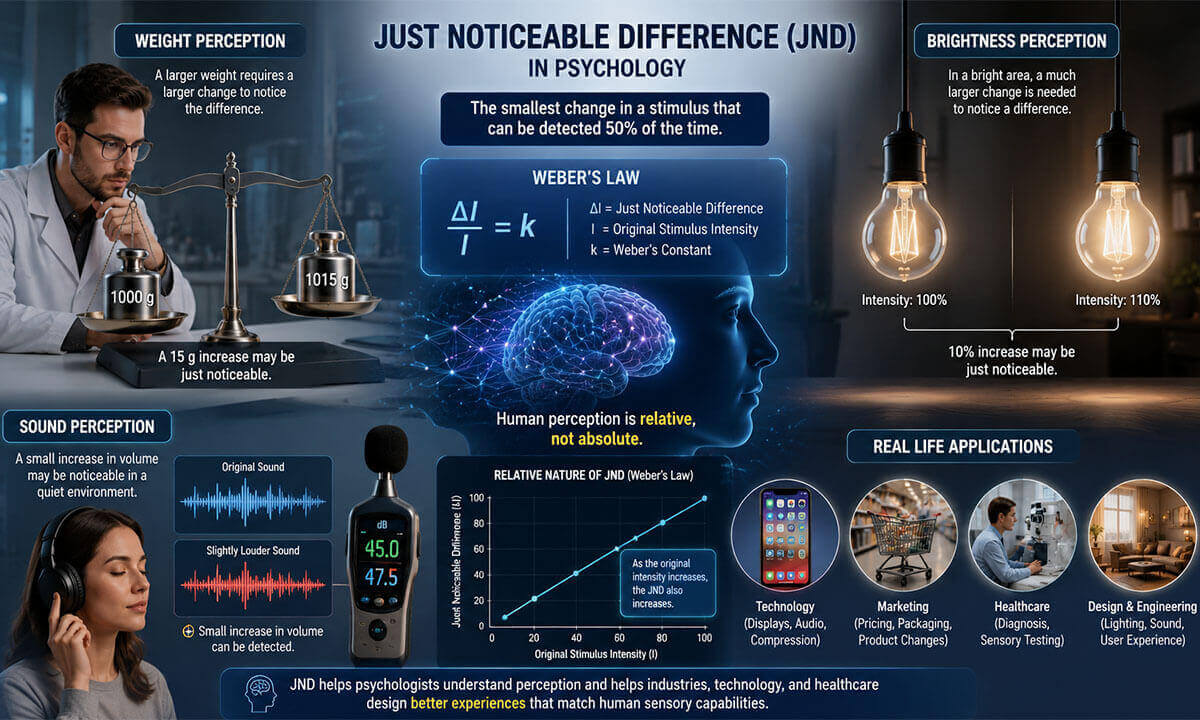
For example, Weber observed that if a person was holding a 100-gram weight, adding 2 grams might not be noticeable, but adding 5 grams could be detected. However, if the original weight increased to 1000 grams, a much larger increase would be required before the difference became noticeable. This finding suggested that sensory perception operates proportionally rather than absolutely (Nickerson, 2023).
This discovery eventually became known as Weber’s Law, one of the earliest quantitative laws in psychology.
Weber’s Law and Mathematical Measurement: Weber’s Law formalized the relationship between stimulus intensity and perceptual sensitivity. The law states that the Just Noticeable Difference is a constant proportion of the original stimulus.
ΔI/I = K
In this equation:
- ΔI represents the minimum detectable change in the stimulus
- I represents the original intensity of the stimulus
- K is a constant specific to each sensory modality
This principle demonstrated that humans perceive changes relatively. For example, people notice a small increase in candlelight in a dark room much more easily than the same increase in a brightly illuminated hall.
Weber’s findings were revolutionary because they suggested that subjective psychological experiences could be studied scientifically using mathematical methods. His work helped bridge the gap between physiology and psychology.
Gustav Fechner and the Birth of Psychophysics: The work of Weber was later expanded by another German scientist, Gustav Theodor Fechner (1801–1887), who is often considered the founder of psychophysics. Fechner was deeply influenced by Weber’s discoveries and sought to create a mathematical relationship between physical stimuli and mental experiences.
Fechner introduced the term psychophysics to describe the scientific study of the relationship between physical events and psychological sensations. Building upon Weber’s Law, Fechner proposed that sensation increases logarithmically as stimulus intensity increases (Gescheider, 2013).
Fechner believed that even though mental experiences are subjective, they could still be measured indirectly through carefully controlled experiments. He developed experimental techniques to measure sensory thresholds, including:
- The method of limits
- The method of constant stimuli
- The method of adjustment
These methods became foundational tools in experimental psychology and are still used in sensory research today.
Fechner’s work transformed JND from a simple observation into a central scientific concept. Through his research, psychology began moving away from philosophy toward becoming an experimental science.
Wilhelm Wundt and Experimental Psychology: The influence of Weber and Fechner extended directly into the work of Wilhelm Wundt, who established the first psychology laboratory in Leipzig, Germany, in 1879. Wundt incorporated psychophysical methods into his experiments and emphasized the importance of measuring conscious experiences scientifically.
Because of this development, JND became one of the earliest experimentally studied psychological phenomena. Researchers began applying psychophysical principles to hearing, vision, touch, taste, and reaction time.
Wundt’s laboratory attracted students from around the world, spreading psychophysical methods internationally and helping establish psychology as an independent academic discipline.
Expansion of JND Research in the Twentieth Century: During the twentieth century, research on sensory thresholds expanded significantly. Psychologists and neuroscientists began exploring more complex aspects of perception, including attention, adaptation, and signal detection.
Researchers discovered that JND is influenced by many factors, including:
- Motivation
- Expectation
- Fatigue
- Context
- Prior experience
- Emotional state
This led to the development of Signal Detection Theory during the mid-twentieth century, which argued that perception depends not only on stimulus intensity but also on decision-making processes and environmental uncertainty.
Scientists also found that Weber’s Law works best within moderate ranges of stimulation but may become less accurate for extremely weak or extremely strong stimuli (Ross, 1995).
Despite these limitations, the core principle of JND remained highly influential across psychology and neuroscience.
Modern Developments and Technological Applications: In modern psychology and cognitive science, the concept of JND continues to play a major role in understanding sensory processing. Researchers now investigate perceptual thresholds using advanced technologies such as brain imaging, computerized testing, and artificial intelligence systems.
JND principles are widely applied in:
- Audio engineering
- Virtual reality
- Consumer product design
- Medical diagnostics
- Human-computer interaction
- Artificial intelligence
- Image and video compression
For example, digital media companies use JND research to compress images and sounds efficiently without creating changes noticeable to human users. Similarly, neuroscientists study perceptual thresholds to better understand how the brain processes sensory information.
Recent machine learning research has even explored how imperceptible visual changes can influence artificial intelligence systems differently from human perception (Akan et al., 2020).
Importance of the Historical Development of JND: The historical development of the Just Noticeable Difference represents a turning point in psychology. Before Weber and Fechner, mental experiences were often considered impossible to measure scientifically. Their work demonstrated that subjective sensations could be quantified and studied experimentally.
This achievement had several lasting impacts:
- It established psychology as an empirical science.
- It introduced mathematical measurement into psychological research.
- It helped create the field of psychophysics.
- It influenced later developments in cognitive psychology and neuroscience.
- It provided practical applications across technology, medicine, and marketing.
Today, the concept of JND remains one of the clearest examples of how psychological processes can be investigated scientifically through experimentation and quantitative analysis.
Examples of Just Noticeable Difference:
The concept of the JND becomes easier to understand when examined through real-life examples. JND refers to the smallest change in a stimulus that a person can detect reliably. Since human perception works comparatively rather than absolutely, the detectability of change depends on the original intensity of the stimulus. These perceptual differences can be observed in nearly every sensory experience, including weight, sound, light, taste, smell, temperature, and even social and economic situations such as pricing and product design.
Studying examples of JND helps psychologists understand how humans interpret sensory information and adapt to changing environments. It also demonstrates why certain changes are immediately noticeable while others remain undetected.
1. Weight Perception: One of the earliest and most famous examples of JND comes from experiments involving weight discrimination. Ernst Heinrich Weber originally studied how individuals detect differences in the heaviness of objects.
For example, imagine a person holding a 100-gram weight. If an additional 1 gram is added, the person may not notice any difference. However, if 5 grams are added, the increase may become detectable. In contrast, when holding a 1,000-gram weight, the person would require a much larger increase before recognizing a change (Nickerson, 2023).
This example illustrates the principle behind Weber’s Law:
ΔI/I = k
The law suggests that perception depends on the ratio between the original stimulus and the change, rather than the absolute size of the change itself.
Weight perception experiments demonstrated that human sensory systems are sensitive to proportional changes. These findings became foundational in psychophysics and helped establish psychology as a measurable science.
2. Brightness and Light Perception: Visual perception provides another common example of JND. Human sensitivity to brightness changes varies depending on the surrounding lighting conditions.
For instance, in a completely dark room, lighting a single candle creates a noticeable increase in brightness. However, adding the same candle to a brightly illuminated stadium would produce almost no perceptible difference.
This happens because the human visual system adapts to existing light intensity. Small changes are easier to notice when the baseline level is low, but much larger changes are required in highly illuminated environments (Gescheider, 2013).
Modern technology industries use this principle extensively. Smartphone manufacturers, television companies, and computer monitor designers study how much brightness adjustment users can actually perceive. Increasing screen brightness beyond the JND threshold may waste battery power without improving user experience.
Similarly, photographers and filmmakers use knowledge of perceptual thresholds to create realistic lighting and contrast effects.
3. Sound and Volume Perception: JND also plays a major role in hearing and sound perception. Human ears can detect subtle differences in volume, pitch, and tone, but these differences depend on the original sound intensity.
For example, when listening to soft music in a quiet room, even a small increase in volume may be noticeable. In contrast, at a loud concert or in a noisy factory, much larger changes in sound intensity are needed before listeners detect a difference.
Audio engineers apply JND principles when designing:
- Headphones
- Music streaming systems
- Hearing aids
- Audio compression software
- Recording studios
Digital audio compression technologies such as MP3 systems remove sounds that fall below the human JND threshold, allowing files to become smaller without noticeably reducing perceived sound quality (Manocha et al., 2020).
Musicians also demonstrate highly refined auditory sensitivity. Trained musicians can often detect smaller changes in pitch or rhythm than individuals without musical training, showing that experience and practice can influence perceptual thresholds.
4. Color Perception: The human eye is extremely sensitive to color variation, yet there are limits to how much change can be detected.
For example, if a painter gradually mixes blue paint into red paint, the color may initially appear unchanged. Eventually, however, the concentration reaches a threshold where observers begin noticing a visible difference. That point represents the Just Noticeable Difference in color perception.
Graphic designers and digital imaging experts rely heavily on JND research. Modern image processing systems use perceptual thresholds to compress images efficiently while preserving visual quality. Compression algorithms often remove color details unlikely to be noticed by the average viewer (Seo et al., 2019).
Color JND is also important in industries such as:
- Fashion
- Printing
- Interior decoration
- Cosmetic manufacturing
- Advertising
Even slight changes in color tone can influence consumer reactions and emotional responses.
5. Taste Perception: Taste sensitivity also follows JND principles. In food and beverage industries, researchers carefully study how much sugar, salt, bitterness, or flavoring must change before consumers notice a difference.
For example, adding a tiny amount of sugar to tea may not produce a detectable change. However, once the sugar concentration reaches a certain threshold, people begin perceiving the tea as sweeter.
Restaurants and food manufacturers use this information to:
- Improve recipes
- Reduce sugar or sodium gradually
- Develop healthier products
- Maintain customer satisfaction
Interestingly, gradual reductions in unhealthy ingredients often remain below the consumer’s JND threshold, allowing companies to make products healthier without significantly affecting taste perception.
Taste thresholds can vary widely among individuals depending on genetics, culture, age, and prior experience.
6. Smell and Fragrance Perception: The sense of smell demonstrates another practical example of JND. Perfume makers and fragrance scientists study how much scent concentration must change before users perceive a stronger or weaker smell.
For instance, someone entering a bakery may immediately notice the smell of fresh bread. However, after remaining inside for some time, the scent becomes less noticeable due to sensory adaptation. If the smell intensity increases sufficiently, the individual may detect the change again.
Fragrance companies use JND research to create perfumes with balanced scent progression over time. Similarly, environmental scientists examine odor thresholds when monitoring air pollution and hazardous gases.
7. Temperature Perception: Temperature sensitivity is another area where JND can be observed clearly.
Imagine placing one hand in cool water and then gradually warming the water. At first, small increases in temperature may not be noticeable. Eventually, however, the person detects that the water has become warmer.
The same principle applies to air conditioning systems and climate control technologies. Engineers attempt to maintain comfortable temperatures while minimizing unnecessary energy use. Slight temperature adjustments below the JND threshold may help conserve electricity without causing discomfort.
Temperature perception is also influenced by environmental context. A 5-degree change may feel dramatic during mild weather but less noticeable during extreme heat or cold.
8. Pain Perception: Pain perception involves complex JND processes as well. Medical professionals often evaluate how sensitive patients are to changes in discomfort, pressure, or temperature.
For example, when increasing pressure during a medical examination, doctors observe the point at which patients report feeling pain or discomfort. Understanding pain thresholds and difference thresholds is important in:
- Neurology
- Physical therapy
- Anesthesia
- Rehabilitation medicine
Researchers also study how emotional and psychological factors influence pain perception. Anxiety, stress, and attention can alter a person’s sensitivity to painful stimuli.
9. Pricing and Consumer Behavior: JND has become extremely important in marketing and economics. Companies frequently attempt to change prices or product quantities without consumers immediately noticing.
For example:
- A product price may increase slightly while remaining below the customer’s JND threshold.
- A snack package may contain slightly fewer chips while appearing visually unchanged.
- A subscription fee may rise gradually over time to avoid attracting attention.
At the same time, marketers also use JND positively by making product improvements noticeable enough to influence purchasing decisions.
Packaging designers carefully consider how much visual change is needed for consumers to recognize a “new and improved” product while still maintaining brand familiarity.
10. Technology and Digital Interfaces: Modern technology relies heavily on perceptual thresholds. User interface designers study how much change in brightness, vibration, sound, or animation users can perceive comfortably.
For example:
- Smartphone notifications use vibration strengths above the tactile JND threshold.
- Video games adjust visual effects based on perceptual sensitivity.
- Virtual reality systems use JND research to create immersive experiences.
Artificial intelligence and image compression systems also use JND principles to reduce data size while preserving perceived quality.
In machine learning research, scientists have shown that extremely small visual modifications invisible to humans may still affect AI systems dramatically (Akan et al., 2020).
11. Social and Psychological Examples: JND can even appear in social and emotional contexts. Small gradual changes in relationships, workload, stress, or lifestyle may go unnoticed initially but become detectable over time.
For example:
- A gradual increase in work pressure may not seem obvious day by day.
- Slowly changing attitudes or habits may become noticeable only after significant accumulation.
- Incremental changes in social behavior may eventually alter interpersonal relationships.
Although JND originated in sensory psychology, the broader principle of threshold detection has influenced many areas of human behavior and cognition.
12. Importance of Real-Life Examples: Examples of JND demonstrate that perception is not a direct reflection of physical reality. Instead, the brain interprets sensory information relative to context, prior stimulation, and proportional differences.
Understanding these examples is important because they:
- Explain how humans process sensory information
- Help psychologists study perception scientifically
- Improve technology and product design
- Influence marketing and consumer behavior
- Support medical and clinical assessments
- Contribute to neuroscience and artificial intelligence research
The widespread presence of JND in everyday life shows how deeply perception shapes human experience.
Key Differences Between Absolute Threshold and Difference Threshold:
Although both concepts involve sensory detection, they measure different perceptual processes.
|
Aspect |
Absolute Threshold |
Difference Threshold (JND) |
| Main focus | Detecting the presence of a stimulus | Detecting changes between stimuli |
| Basic question | “Can the stimulus be detected?” | “Can the change be noticed?” |
| Measurement | Minimum detectable intensity | Minimum detectable difference |
| Associated researcher | Gustav Fechner and psychophysics | Ernst Heinrich Weber |
| Example | Hearing a faint sound | Noticing a volume increase |
| Type of perception | Initial detection | Comparative detection |
The absolute threshold concerns the point where sensation begins, whereas the difference threshold concerns sensitivity to change after a stimulus is already present.
Relationship Between the Two Concepts: Although the concepts differ, they are closely related within psychophysics. Both attempt to measure human sensory capabilities scientifically and both reveal that perception has limits.
The relationship can be understood as follows:
- The absolute threshold determines whether a stimulus can enter awareness.
- The difference threshold determines whether changes in that stimulus can be perceived.
For example:
- A person first hears music because it exceeds the absolute threshold.
- The person later notices that the volume increases because the change exceeds the difference threshold.
Together, these thresholds help psychologists understand how sensory systems process environmental information.
Factors Influencing Both Thresholds: Both absolute and difference thresholds are influenced by numerous biological and psychological factors.
- Attention: People detect stimuli more easily when paying close attention. A distracted person may fail to notice subtle sensory changes.
- Fatigue: Tiredness can reduce sensory sensitivity. For example, exhausted individuals may require stronger stimuli before detection occurs.
- Motivation and Expectation: Expectations influence perception. Someone expecting an important phone call may notice faint sounds more easily than usual.
- Adaptation: Continuous exposure to stimulation can reduce sensitivity over time. This process is called sensory adaptation.
For instance:
- People stop noticing the feeling of clothing on their skin
- Strong smells fade into the background after prolonged exposure
- Constant background noise becomes less noticeable
Adaptation can raise both absolute and difference thresholds temporarily.
- Age and Biological Factors: Sensory abilities change with age. Older adults often experience higher hearing and vision thresholds compared to younger individuals.
Genetics, health conditions, and neurological functioning also influence perceptual sensitivity.
- Signal Detection Theory and Thresholds: Modern psychology recognizes that sensory detection is more complex than fixed thresholds alone. This led to the development of Signal Detection Theory during the twentieth century.
Signal Detection Theory suggests that perception depends not only on stimulus intensity but also on decision-making processes, expectations, and uncertainty.
For example, a person may report hearing a faint sound even when none exists because they expect it to occur. Similarly, someone may fail to detect a real stimulus due to distraction or low motivation.
This theory expanded the understanding of thresholds beyond simple stimulus-response relationships.
Practical Applications:
- Medicine: Doctors use threshold testing in hearing exams, eye examinations, and neurological assessments.
- Marketing: Businesses study perceptual thresholds to determine how much price or packaging changes consumers will notice.
- Technology: Smartphones, televisions, and digital interfaces are designed using threshold research to optimize sensory experiences.
- Safety Systems: Alarm systems and warning signals must exceed sensory thresholds to ensure detection under stressful conditions.
Importance in Psychology: The distinction between absolute threshold and difference threshold is fundamental in psychology because it explains how humans experience the environment. These concepts demonstrated that sensation could be measured scientifically, helping establish psychology as an experimental discipline.
Research on thresholds also contributed to the development of:
- Psychophysics
- Cognitive psychology
- Neuroscience
- Human-computer interaction
- Consumer psychology
Today, threshold research continues influencing science, medicine, and technology.
Applications of Just Noticeable Difference:
The concept of the JND has far-reaching applications across psychology, business, medicine, technology, engineering, and everyday life. Although the idea originally emerged from laboratory studies on sensory perception, researchers and professionals soon realized that understanding perceptual thresholds could solve practical real-world problems. The JND explains how much change is required before people notice differences in stimuli such as sound, brightness, weight, taste, price, or physical sensation. Because human perception depends on proportional rather than absolute changes, industries use JND principles to design products, improve user experiences, influence consumer behavior, and optimize communication systems. Today, the concept is widely applied in fields ranging from digital technology and neuroscience to advertising and healthcare.
1. Applications in Marketing and Consumer Behavior: One of the most well-known applications of JND is in marketing and consumer psychology. Businesses carefully study how consumers perceive changes in product prices, packaging, quality, and branding.
1.1 Price Changes: Companies often attempt to increase prices gradually while remaining below consumers’ difference thresholds. Small increases may go unnoticed if they are proportionally minor relative to the original price.
For example:
- A small price increase in an expensive product may attract less attention than the same increase in a cheaper product.
- Streaming services may raise subscription fees incrementally to reduce customer resistance.
Marketers understand that consumers react more strongly when changes exceed perceptual thresholds.
1.2 Product Size and Quantity Reduction: Businesses sometimes reduce product quantity slightly without dramatically changing packaging appearance. This practice, often called shrinkflation, relies heavily on JND principles.
For instance:
- A snack company may reduce chip quantity slightly while keeping the bag size nearly identical.
- Beverage containers may contain slightly less liquid without obvious visual changes.
If the reduction remains below the consumer’s JND threshold, many customers may not notice the difference immediately.
1.3 Advertising and Branding: JND research helps marketers determine how much change is needed to make advertisements noticeable without becoming overwhelming.
Companies frequently redesign logos, packaging, and product labels. Designers must balance two goals:
- Making the product appear new and modern
- Maintaining enough familiarity for customers to recognize the brand
Changes that are too subtle may go unnoticed, while drastic changes may confuse consumers.
Research in online marketing suggests that understanding perceptual thresholds improves customer engagement and advertising effectiveness (Vojtko, 2014).
2. Applications in Technology and Digital Media: Modern technology relies extensively on JND principles because digital systems are designed around human sensory experiences.
2.1 Image and Video Compression: Image and video compression systems use JND research to reduce file sizes while maintaining perceived quality.
Compression algorithms remove visual details that fall below the threshold of human perception. As a result:
- Images require less storage space
- Videos stream more efficiently
- Users experience minimal noticeable quality loss
This principle is used in technologies such as:
- JPEG image compression
- Streaming video platforms
- Smartphone photography systems
- Digital television broadcasting
Researchers continue improving visual compression using advanced JND-based models (Seo et al., 2019).
2.2 Audio Compression and Sound Engineering: The music and audio industries heavily depend on perceptual thresholds.
Audio compression technologies such as MP3 systems remove sounds that most listeners cannot perceive. This reduces file sizes significantly while preserving perceived sound quality.
Sound engineers also apply JND principles when:
- Mixing music tracks
- Designing headphones
- Adjusting speaker systems
- Creating surround sound experiences
Research on perceptual audio metrics demonstrates how JND models improve digital sound processing (Manocha et al., 2020).
2.3 Smartphone and Screen Design: Manufacturers study visual thresholds to optimize display quality.
For example:
- Increasing screen brightness beyond the JND threshold may waste battery power without improving user experience.
- Higher screen resolutions may not produce noticeable improvements after a certain point.
- Slight animation or vibration adjustments can improve interface usability.
Human-computer interaction research often focuses on identifying the minimum detectable changes users can perceive comfortably.
3. Applications in Medicine and Healthcare: JND principles play an important role in clinical diagnosis, rehabilitation, and medical technology.
3.1 Hearing Tests: Audiologists use threshold testing to evaluate hearing sensitivity. Patients listen to tones of varying intensities while clinicians determine:
- The faintest detectable sounds
- The smallest detectable changes in volume or pitch
These measurements help diagnose hearing impairments and guide treatment planning.
3.2 Vision Assessment: Eye specialists examine visual thresholds when assessing visual acuity, contrast sensitivity, and color perception.
For example, patients may be asked to identify subtle differences in brightness or detect small changes in visual patterns.
JND research has improved technologies such as:
- Corrective lenses
- Retinal imaging systems
- Vision rehabilitation tools
3.3 Pain Management: Doctors and psychologists study perceptual thresholds related to pain and physical discomfort.
Pain sensitivity varies across individuals, and understanding JND helps clinicians:
- Evaluate treatment effectiveness
- Adjust medication dosages
- Monitor patient recovery
Physical therapists also examine how patients perceive gradual changes in pressure, temperature, or muscle resistance.
3.4 Neurological Evaluation: Neurologists use sensory threshold testing to identify disorders affecting the nervous system.
Changes in tactile sensitivity, hearing, or visual discrimination may indicate neurological conditions such as:
- Peripheral neuropathy
- Brain injuries
- Multiple sclerosis
- Parkinson’s disease
Threshold testing provides valuable information about sensory processing and neural functioning.
4. Applications in Psychology and Neuroscience: The concept of JND remains central in experimental psychology and neuroscience.
4.1 Sensory Research: Psychologists use JND experiments to study:
- Attention
- Perception
- Learning
- Sensory adaptation
- Cognitive processing
Researchers investigate how factors such as fatigue, stress, emotions, and expectations influence perceptual sensitivity.
4.2 Cognitive Psychology: Cognitive psychologists explore how the brain interprets sensory changes and how attention affects threshold detection.
For example, people may notice subtle environmental changes more easily when highly focused than when distracted.
4.3 Neuroscience: Modern neuroscience uses brain imaging technologies to examine how sensory information is processed neurologically.
Scientists study:
- Neural responses to threshold-level stimuli
- Brain regions involved in perception
- Sensory adaptation mechanisms
This research improves the understanding of consciousness and human cognition.
5. Applications in Artificial Intelligence and Machine Learning: Recent technological advances have extended JND research into artificial intelligence and computer vision.
5.1 Adversarial Images: Researchers discovered that tiny visual modifications invisible to humans can strongly affect AI systems.
For example, an image altered below the human JND threshold may still confuse a machine-learning model into misclassifying objects (Akan et al., 2020).
This research has become important in:
- Cybersecurity
- Facial recognition systems
- Autonomous vehicles
- AI safety research
5.2 Human-Centered AI Design: Developers use perceptual thresholds to create AI systems that align better with human sensory experiences.
Applications include:
- Voice assistants
- Virtual reality systems
- Augmented reality interfaces
- Interactive robots
Understanding JND helps ensure smoother human-computer interaction.
6. Applications in Education and Learning: Educational psychologists and instructional designers apply JND principles when developing learning materials.
6.1 Classroom Learning: Teachers may introduce information gradually so students can detect meaningful conceptual differences without cognitive overload.
For example:
- Gradual increases in task difficulty help maintain engagement
- Small feedback adjustments improve learning without discouragement
6.2 Educational Technology: Digital learning platforms use perceptual principles to optimize:
- Visual layouts
- Notification systems
- Audio instructions
- Interactive content
Understanding sensory thresholds improves accessibility and student attention.
7. Applications in Environmental and Industrial Design:
7.1 Warning Systems: Safety systems must exceed perceptual thresholds to attract immediate attention.
Examples include:
- Fire alarms
- Emergency sirens
- Traffic signals
- Industrial hazard warnings
Designers ensure that warning signals are noticeable even in noisy or visually complex environments.
7.2 Climate Control and Architecture: Engineers use JND principles when designing heating, cooling, and lighting systems.
For instance:
- Small temperature changes below the JND threshold may reduce energy costs without affecting comfort.
- Gradual lighting adjustments create more natural indoor environments.
Architects and environmental designers also study sensory comfort in workplaces and public spaces.
8. Applications in Food and Beverage Industries: Food scientists carefully examine perceptual thresholds related to taste, texture, and smell.
8.1 Flavor Development: Manufacturers determine how much sugar, salt, or spice can change before consumers notice differences.
This allows companies to:
- Reduce unhealthy ingredients gradually
- Improve recipes
- Maintain customer satisfaction
For example, reducing sodium levels slightly over time may help consumers adapt without perceiving dramatic taste differences.
8.2 Beverage Production: Coffee, tea, soda, and juice companies study JND to optimize flavor consistency and product quality.
Consumers often expect highly consistent sensory experiences, making threshold research essential for quality control.
9. Applications in Sports and Physical Training: Athletes and coaches use perceptual sensitivity principles during training and performance evaluation.
For example:
- Weightlifters learn to detect subtle differences in resistance
- Musicians and athletes refine auditory and motor sensitivity through practice
- Professional tasters and sommeliers develop highly sensitive perceptual discrimination abilities
Training can improve sensitivity to certain stimuli, demonstrating that perceptual thresholds are partly shaped by experience.
10. Ethical Concerns and Criticisms: Although JND applications provide many benefits, they also raise ethical concerns.
Some companies may intentionally use perceptual thresholds to manipulate consumers, such as:
- Hiding product reductions
- Gradually increasing prices
- Influencing purchasing behavior subtly
Critics argue that businesses should apply psychological principles transparently and responsibly.
At the same time, ethical applications of JND can improve healthcare, accessibility, education, and technological design.
11. Importance of JND Applications: The wide range of applications demonstrates that the Just Noticeable Difference is far more than a theoretical psychological concept. It helps explain how humans interact with products, environments, technologies, and social experiences.
The practical importance of JND includes:
- Improving human-centered technology
- Enhancing medical diagnosis and treatment
- Optimizing communication systems
- Supporting effective learning environments
- Influencing marketing and consumer behavior
- Advancing artificial intelligence research
Its continued relevance highlights the importance of understanding human perception scientifically.
Criticisms and Limitations of JND:
Although JND is highly influential, psychologists recognize several limitations.
First, sensory perception varies among individuals. Age, experience, training, fatigue, and cultural background can all influence detection thresholds. For example, musicians may notice smaller differences in sound pitch than non-musicians.
Second, Weber’s Law does not apply perfectly under all conditions. Extremely weak or extremely intense stimuli may not follow the proportional relationship predicted by the theory (Ross, 1995).
Finally, perception is influenced not only by physical stimuli but also by psychological factors such as attention, expectations, and emotional state.
Modern Relevance of JND:
The Just Noticeable Difference remains highly relevant in contemporary psychology and neuroscience. Researchers continue investigating how humans perceive subtle changes in digital environments, virtual reality, artificial intelligence systems, and multimedia technology.
Online discussions among psychology students and researchers also show continuing interest in understanding Weber’s Law and psychophysical measurement methods.
As technology becomes increasingly sensory-driven, the study of perception thresholds continues to shape innovation across multiple industries.
In conclusion, the Just Noticeable Difference is one of the most important concepts in sensory psychology and psychophysics. Developed through the pioneering work of Ernst Weber and later expanded by Gustav Fechner, the concept explains how humans perceive changes in stimuli relative to their original intensity. Whether detecting differences in weight, sound, brightness, taste, or smell, human perception operates according to measurable thresholds. Weber’s Law demonstrated that these thresholds are proportional rather than absolute, fundamentally changing how psychologists understand sensation and perception. Today, the principles of JND influence fields ranging from psychology and neuroscience to marketing, medicine, engineering, and artificial intelligence. Despite certain limitations, the concept remains a powerful tool for understanding how humans interact with the sensory world around them.
Frequently Asked Questions (FAQs):
What is the Just Noticeable Difference (JND) in psychology?
The Just Noticeable Difference (JND), also known as the difference threshold, refers to the smallest change in a stimulus that a person can detect reliably. It describes the minimum difference needed for someone to notice that two stimuli are not the same.
For example, if the brightness of a light changes slightly, the JND is the point at which the observer first notices the difference.
Who discovered the concept of Just Noticeable Difference?
The concept was first developed by German psychologist and physician Ernst Heinrich Weber during the nineteenth century. Weber studied sensory perception and discovered that people detect changes proportionally rather than absolutely. His work later became known as Weber’s Law.
What is Weber’s Law?
Weber’s Law states that the Just Noticeable Difference is a constant proportion of the original stimulus intensity.
ΔI/I = k
This means that as the intensity of a stimulus increases, larger changes are required before people notice differences.
For example, detecting a 1-kilogram increase in weight is easier when holding 10 kilograms than when holding 100 kilograms.
What is the difference between JND and absolute threshold?
The absolute threshold refers to the minimum intensity required to detect a stimulus at all, while the difference threshold refers to the minimum detectable change between two stimuli.
For example:
- Absolute threshold: hearing a faint sound in silence
- Difference threshold: noticing that the sound becomes louder
Both concepts are important in psychophysics and sensory psychology.
Why is the Just Noticeable Difference important?
The JND is important because it helps psychologists understand how humans perceive changes in the environment. It also has practical applications in many fields, including:
- Marketing and advertising
- Technology and product design
- Medicine and healthcare
- Audio and visual engineering
- Artificial intelligence
- Neuroscience
Understanding perceptual thresholds helps improve human-centered design and communication systems.
What are some everyday examples of JND?
Examples of JND appear constantly in daily life, including:
- Noticing when music becomes slightly louder
- Detecting a small increase in room brightness
- Recognizing a subtle change in perfume scent
- Feeling a slight increase in weight while carrying objects
- Tasting a small increase in sugar or salt in food
These examples demonstrate how perception depends on relative changes.
Does the JND vary from person to person?
Yes, the Just Noticeable Difference can vary depending on several factors, including:
- Age
- Attention
- Fatigue
- Experience and training
- Emotional state
- Sensory abilities
For example, musicians may detect smaller differences in sound pitch than non-musicians because of training and practice.
Can practice improve perceptual sensitivity?
Yes, training and repeated experience can improve sensitivity to certain stimuli. Athletes, musicians, chefs, and perfume experts often develop highly refined perceptual abilities through continuous practice.
This means that the JND is not always fixed and may change over time with learning and adaptation.
How is JND used in marketing?
Marketers use JND principles to study how consumers notice changes in:
- Prices
- Packaging
- Product size
- Branding
- Advertising
For example, companies may increase prices slightly while trying to remain below consumers’ difference thresholds. Similarly, packaging designs are adjusted carefully to attract attention without losing brand familiarity.
How is JND used in technology?
Technology companies apply JND research in many areas, including:
- Smartphone displays
- Audio compression
- Image and video processing
- Virtual reality
- User interface design
Compression systems often remove details that users are unlikely to notice, helping reduce file sizes while preserving perceived quality (Seo et al., 2019).
What is psychophysics?
Psychophysics is the branch of psychology that studies the relationship between physical stimuli and psychological experiences. The field was strongly influenced by the work of Weber and Gustav Fechner.
Psychophysics investigates sensory thresholds, perception, and how humans interpret environmental stimulation.
Does Weber’s Law always work perfectly?
No, although Weber’s Law is highly influential, it does not apply perfectly in every situation. The law works best within moderate ranges of stimulation.
For extremely weak or extremely strong stimuli, perception may not follow the exact proportional relationship predicted by Weber’s Law (Ross, 1995).
What factors influence sensory thresholds?
Several factors influence perceptual thresholds, including:
- Attention and focus
- Motivation
- Fatigue
- Stress and emotions
- Environmental conditions
- Sensory adaptation
For example, people may notice faint sounds more easily when expecting an important phone call.
What is sensory adaptation?
Sensory adaptation occurs when continuous exposure to a stimulus reduces sensitivity over time.
Examples include:
- Becoming unaware of background noise
- No longer noticing a strong perfume after prolonged exposure
- Ignoring the feeling of clothing on the skin
Adaptation affects both absolute and difference thresholds.
Is the Just Noticeable Difference still relevant today?
Yes, the JND remains highly relevant in modern psychology, neuroscience, artificial intelligence, engineering, and digital technology.
Researchers continue studying perceptual thresholds in areas such as:
- Virtual reality
- Machine learning
- Human-computer interaction
- Neuroscience
- Consumer behavior
The concept continues influencing both scientific research and technological innovation.
References:
- Akan, A. K., Genc, M. A., & Vural, F. T. Y. (2020). Just noticeable difference for machines to generate adversarial images. arXiv. https://doi.org/10.48550/arXiv.2001.11064
- Gescheider, G. A. (2013). Psychophysics: The fundamentals. Psychology Press.
- Helen, E. R., David, J. M., Ross, H. E., & Murray, D. J. (2018). EH Weber on the tactile senses. Psychology Press.
- Manocha, P., Finkelstein, A., Zhang, R., Bryan, N. J., Mysore, G., & Jin, Z. (2020). A differentiable perceptual audio metric learned from just noticeable differences. arXiv. https://doi.org/10.48550/arXiv.2001.04460
- Nickerson, C. (2023). Just noticeable difference (JND) in psychology: Examples & definition. Simply Psychology. https://www.simplypsychology.org/what-is-the-just-noticeable-difference.html
- Ross H. E. (1995). Weber then and now. Perception, 24(6), 599–602. https://doi.org/10.1068/p240599
- Seo, S., Ki, S., & Kim, M. (2019). A novel just-noticeable-difference-based saliency-channel attention residual network for full-reference image quality predictions. arXiv. https://doi.org/10.48550/arXiv.1902.05316
- Vojtko, V. (2014). Rethinking the Concept of Just Noticeable Difference in Online Marketing. Acta Informatica Pragensia, 3(2), 204-218. https://doi.org/10.18267/j.aip.49

Meta Psychological Education focuses on the foundational, higher-order skills (meta-skills) that allow individuals to “learn how to learn,” manage their own cognitive processes, and adapt to new situations, often termed meta-learning. It bridges psychological research with practical application in learning and development.