An Overview of Cognitive Psychology:
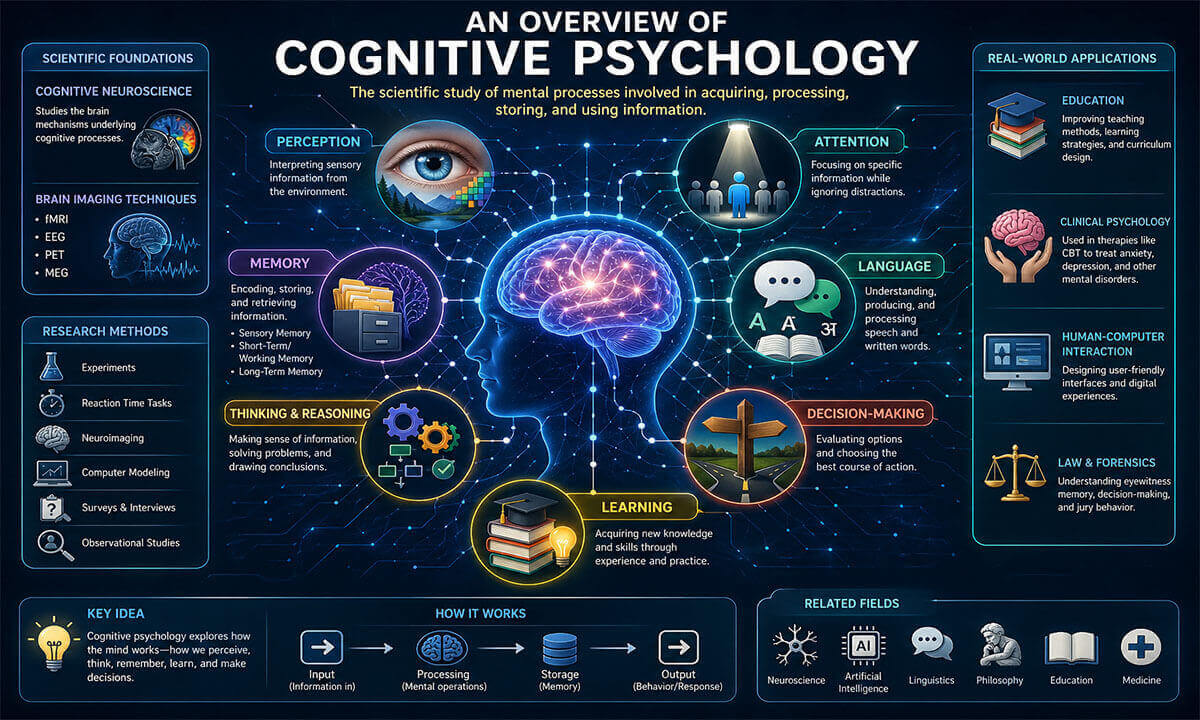
Cognitive psychology is the scientific study of mental processes, including perception, attention, memory, language, reasoning, problem-solving, learning, and decision-making. Unlike earlier psychological traditions that focused mainly on observable behavior, cognitive psychology examines the internal mechanisms through which humans acquire, process, store, and use information. The field seeks to understand how people think, interpret experiences, remember events, solve problems, and interact with their environments. The rise of cognitive psychology in the mid-twentieth century marked a major transformation in psychological science. Before the cognitive revolution, behaviorism dominated psychology, emphasizing observable actions while largely rejecting the study of internal mental states. However, researchers increasingly recognized that human behavior could not be fully explained without understanding the mind itself. Advances in linguistics, neuroscience, computer science, and information theory helped establish cognition as a legitimate scientific subject (Neisser, 1967). Today, cognitive psychology is one of the most influential branches of psychology. It contributes not only to academic research but also to education, psychotherapy, medicine, artificial intelligence, human-computer interaction, organizational behavior, and neuroscience. Contemporary cognitive psychology integrates experimental methods with brain imaging technologies and computational modeling to explore how cognition operates across different contexts and stages of life (Eysenck & Brysbaert, 2024). This article provides an overview of cognitive psychology, including its historical development, major theoretical perspectives, core cognitive processes, research methods, practical applications, contemporary developments, criticisms, and future directions.
1. Historical Development of Cognitive Psychology:
1.1 Early Philosophical Foundations: The origins of cognitive psychology can be traced back to ancient philosophical debates about the nature of knowledge and consciousness. Philosophers such as Plato and Aristotle explored questions concerning memory, reasoning, perception, and learning. Later, René Descartes proposed that the mind and body were separate entities, while empiricists such as John Locke argued that knowledge arises through experience.
These philosophical discussions laid the groundwork for scientific investigations into cognition. However, psychology did not emerge as an independent scientific discipline until the late nineteenth century.
1.2 Structuralism and Functionalism: Wilhelm Wundt established the first psychological laboratory in 1879 in Leipzig, Germany. Wundt used introspection to study conscious experience systematically. Structuralists attempted to identify the basic elements of consciousness, while functionalists such as William James focused on the adaptive functions of mental processes.
Although introspection had methodological limitations, these early approaches helped legitimize the scientific study of the mind.
1.3 The Dominance of Behaviorism: During the early twentieth century, behaviorism became the dominant psychological paradigm. Researchers such as John B. Watson and B. F. Skinner argued that psychology should study only observable behavior because mental states could not be measured objectively.
Behaviorism contributed rigorous experimental methods but largely ignored internal mental processes. Over time, this limitation became increasingly problematic. Researchers found that language, reasoning, and memory could not be adequately explained through stimulus-response associations alone.
1.4 The Cognitive Revolution: The cognitive revolution emerged during the 1950s and 1960s as psychologists began reconsidering the role of internal mental processes. Several developments contributed to this shift:
- Noam Chomsky criticized behaviorist explanations of language acquisition.
- George Miller demonstrated limitations in short-term memory capacity.
- Advances in computer science introduced information-processing models of the mind.
- Research in artificial intelligence suggested that cognition could be modeled computationally.
Ulric Neisser’s book Cognitive Psychology (1967) formally established the field and defined cognition as all processes through which sensory input is transformed, reduced, elaborated, stored, recovered, and used.
2. Major Theoretical Perspectives in Cognitive Psychology:
Cognitive psychology is shaped by several major theoretical perspectives that attempt to explain how humans perceive, process, store, and use information. These perspectives provide different frameworks for understanding mental processes such as attention, memory, language, reasoning, learning, and decision-making. Rather than competing completely against one another, many of these approaches complement each other and contribute collectively to modern cognitive science. Theoretical perspectives are important because they guide research questions, experimental methods, and interpretations of cognitive behavior. Over time, cognitive psychology has evolved from simple information-processing models to highly integrated approaches involving neuroscience, artificial intelligence, and embodied interaction with the environment (Eysenck & Brysbaert, 2024). Each perspective highlights different dimensions of cognition and offers unique insights into how the human mind operates.
2.1 Information Processing Theory: Information Processing Theory is one of the foundational perspectives in cognitive psychology. This approach compares the human mind to a computer system that receives information, processes it, stores it, and retrieves it when necessary. According to this perspective, cognition involves a sequence of mental operations that transform sensory input into meaningful responses.
The information-processing model became especially influential during the cognitive revolution of the 1950s and 1960s. Researchers sought scientific explanations for internal mental processes that behaviorism had largely ignored. Inspired partly by developments in computer science, psychologists began conceptualizing the mind as a system capable of encoding, storing, manipulating, and retrieving information (Neisser, 1967).
At the core of this theory is the idea that information flows through multiple stages:
- Sensory input enters the system through perception.
- Attention selects relevant information.
- Information is encoded into memory.
- Stored information is retrieved when needed.
- Cognitive processes generate responses or decisions.
One of the major contributions of information-processing theory is its explanation of memory systems. Models such as the Atkinson-Shiffrin multi-store model proposed separate memory stages, including sensory memory, short-term memory, and long-term memory. Later, Baddeley and Hitch’s working memory model expanded this framework by emphasizing active manipulation of information rather than passive storage (Baddeley, 2012).
7±2
George Miller’s influential concept of the “magical number seven, plus or minus two” suggested limits in short-term memory capacity, although later research proposed even smaller limits depending on task complexity (Miller, 1956).
Information-processing theory has significantly influenced:
- Educational psychology
- Artificial intelligence
- Cognitive neuroscience
- Human-computer interaction
- Problem-solving research
Despite its strengths, critics argue that the theory can oversimplify human cognition by treating the mind too mechanically. Human thinking is often influenced by emotion, culture, social interaction, and embodiment, factors that early information-processing models sometimes neglected.
2.2 Cognitive Neuroscience Perspective: The cognitive neuroscience perspective examines the relationship between cognitive processes and brain activity. This approach combines psychology, neuroscience, biology, and computer science to understand how neural mechanisms produce cognition.
The emergence of brain imaging technologies revolutionized this perspective. Researchers can now observe brain activity during cognitive tasks using methods such as:
- Functional magnetic resonance imaging (fMRI)
- Electroencephalography (EEG)
- Positron emission tomography (PET)
- Magnetoencephalography (MEG)
These technologies allow scientists to investigate which brain regions are associated with specific cognitive functions.
For example:
- The hippocampus is heavily involved in memory formation.
- The prefrontal cortex supports executive functions such as planning and decision-making.
- The amygdala contributes to emotional processing.
- The occipital lobe is central to visual perception.
- Broca’s and Wernicke’s areas are important for language production and comprehension.
Modern cognitive neuroscience emphasizes that cognition results from interconnected neural networks rather than isolated brain regions (Bortfeld & Bunge, 2024). For instance, memory retrieval involves coordination among multiple cortical and subcortical systems.
This perspective has contributed substantially to understanding neurological and psychological disorders, including:
- Alzheimer’s disease
- ADHD
- Dyslexia
- Schizophrenia
- Traumatic brain injury
Cognitive neuroscience also explores neuroplasticity, the brain’s ability to reorganize itself through learning and experience. Research demonstrates that repeated cognitive activities can physically alter neural pathways.
One important advantage of this perspective is its biological foundation. By linking mental processes to neural activity, cognitive neuroscience provides objective evidence for cognitive theories. However, critics note that identifying brain activation does not always explain the subjective experience or deeper mechanisms underlying cognition.
2.3 Connectionism: Connectionism is a theoretical perspective proposing that cognition arises from networks of interconnected processing units similar to neurons in the brain. Instead of relying on symbolic rules or sequential processing, connectionist models emphasize distributed processing and learning through patterns of activation.
This perspective became influential during the 1980s with the development of artificial neural networks. Connectionist researchers argued that cognition emerges from the interaction of many simple processing units working simultaneously.
A connectionist network typically includes:
- Input units
- Hidden processing units
- Output units
Learning occurs through adjustments in connection strengths between units, often called “weights.” When the system encounters repeated patterns, it gradually becomes better at recognizing and responding to similar inputs.
Connectionism explains several cognitive phenomena effectively, including:
- Pattern recognition
- Language learning
- Memory retrieval
- Categorization
- Skill acquisition
For example, humans can recognize faces rapidly even when lighting, angles, or expressions change. Connectionist models simulate this ability through distributed processing across multiple units.
The perspective also supports the idea that knowledge is not stored in a single location but distributed across networks. Damage to one part of the network may impair performance without completely destroying knowledge, resembling patterns observed in brain injuries.
Connectionism strongly influenced modern artificial intelligence and machine learning. Deep learning systems used in speech recognition, image processing, and natural language processing are partly inspired by connectionist principles (Binz & Schulz, 2023).
However, critics argue that connectionist models sometimes struggle to explain higher-level reasoning, abstract thinking, and symbolic logic. Some researchers believe that human cognition requires both neural network learning and symbolic representations.
2.4 Dual-Process Theories: Dual-process theories propose that human cognition operates through two distinct systems of thinking. These systems differ in speed, effort, awareness, and flexibility.
System 1 Thinking: System 1 is:
- Fast
- Automatic
- Intuitive
- Emotional
- Unconscious
This system allows individuals to make quick judgments with minimal effort. Examples include:
- Recognizing faces
- Reading simple words
- Driving familiar routes
- Making snap judgments
System 1 processing is highly efficient and essential for daily functioning.
System 2 Thinking: System 2 is:
- Slow
- Deliberate
- Analytical
- Conscious
- Effortful
This system is used for tasks requiring reasoning and careful analysis, such as:
- Solving mathematical problems
- Evaluating arguments
- Planning complex activities
- Learning unfamiliar concepts
System 2 consumes more cognitive resources and attention.
Dual-process theories help explain why humans often rely on heuristics or mental shortcuts. Although heuristics can improve efficiency, they may also produce cognitive biases.
For example:
- Confirmation bias causes people to seek information supporting existing beliefs.
- Availability heuristics lead people to judge likelihood based on easily recalled examples.
- Framing effects influence decisions depending on how information is presented.
Research on dual-process cognition has been especially influential in behavioral economics, decision science, and social cognition.
One major strength of this perspective is its ability to explain both rational and irrational aspects of human thinking. However, critics argue that dividing cognition into only two systems may oversimplify the complexity of mental processes.
2.5 Constructivist Perspective: The constructivist perspective argues that individuals actively construct knowledge rather than passively receiving information. Cognition is shaped by prior experiences, beliefs, expectations, and interactions with the environment.
Jean Piaget was one of the most influential constructivist theorists. He proposed that children develop cognitive structures called schemas, which help organize knowledge and interpret experiences.
According to Piaget, cognitive development occurs through two key processes:
Assimilation: Assimilation occurs when new information is integrated into existing schemas.
Example: A child who knows what a dog looks like may initially call all four-legged animals “dogs.”
Accommodation: Accommodation occurs when schemas are modified to incorporate new information.
Example: The child eventually learns the difference between dogs and cats and adjusts their schema accordingly.
Constructivism emphasizes active learning and discovery. Learners are viewed as participants who interpret and reorganize information rather than passive recipients.
This perspective has strongly influenced educational psychology. Teaching methods based on constructivism often encourage:
- Problem-solving
- Exploration
- Collaborative learning
- Critical thinking
- Inquiry-based education
Modern constructivist approaches also emphasize social interaction. Lev Vygotsky argued that cognitive development is deeply influenced by culture and communication. His concept of the “zone of proximal development” highlights how guidance from more knowledgeable individuals supports learning.
Constructivism remains highly influential in modern education and developmental psychology.
2.6 Sociocultural Perspective: The sociocultural perspective emphasizes that cognition develops through social interaction and cultural context. According to this approach, thinking cannot be fully understood without considering the cultural tools, language, traditions, and relationships that shape mental processes.
Lev Vygotsky was a central figure in this perspective. He argued that higher mental functions originate in social activities before becoming internalized psychologically.
Language plays a particularly important role in sociocultural theory. Vygotsky believed that inner speech develops from social communication and becomes a tool for self-regulation and problem-solving.
This perspective highlights several important ideas:
- Cognitive development varies across cultures.
- Learning occurs through guided participation.
- Social interaction supports cognitive growth.
- Cultural tools influence thinking styles.
Research shows that cultural experiences affect:
- Memory strategies
- Attention patterns
- Reasoning styles
- Perception
- Problem-solving approaches
The sociocultural perspective challenged earlier assumptions that cognition develops universally in the same way across all societies.
2.7 Ecological and Embodied Cognition Perspectives: Traditional cognitive theories often viewed cognition as occurring entirely within the brain. In contrast, ecological and embodied cognition perspectives argue that cognition is deeply connected to bodily action and environmental interaction.
Embodied cognition suggests that:
- Physical movement influences thinking.
- Sensory experiences shape concepts.
- Cognitive processes are grounded in bodily experiences.
For example:
- Gestures can improve memory and communication.
- Physical actions may influence emotional states.
- Spatial experiences contribute to abstract reasoning.
Ecological psychology, associated with James J. Gibson, emphasizes direct perception and environmental affordances. Affordances are opportunities for action provided by the environment.
For example:
- A chair affords sitting.
- A staircase affords climbing.
- A handle affords grasping.
These perspectives challenge purely computational models of cognition by emphasizing real-world interaction.
Embodied cognition has become increasingly influential in:
- Robotics
- Human-computer interaction
- Education
- Sports psychology
- Rehabilitation science
Researchers now recognize that cognition is not isolated from the body and environment but emerges through dynamic interaction.
2.8 Evolutionary Cognitive Perspective: The evolutionary perspective examines cognition through the lens of natural selection. According to this approach, many cognitive abilities evolved because they enhanced survival and reproduction.
Evolutionary cognitive psychologists investigate how mental processes may have developed to solve ancestral adaptive problems.
Examples include:
- Fear responses to dangerous stimuli
- Social cooperation mechanisms
- Language development
- Facial recognition abilities
- Mate selection preferences
This perspective argues that cognition reflects evolutionary pressures experienced throughout human history.
For instance, humans tend to detect threats quickly because rapid threat detection improved survival chances. Similarly, memory systems may prioritize emotionally significant events because remembering dangers or opportunities aided adaptation.
Evolutionary perspectives have contributed to understanding:
- Emotion
- Social cognition
- Decision-making
- Parenting behavior
- Moral reasoning
Critics argue that some evolutionary explanations are difficult to test empirically and may rely too heavily on speculation about ancestral environments.
2.9 Predictive Processing Perspective: Predictive processing is a modern theoretical framework suggesting that the brain continuously generates predictions about incoming sensory information. Instead of passively receiving stimuli, the brain actively anticipates what will happen next.
According to this perspective:
- The brain creates predictions based on prior knowledge.
- Sensory input is compared with predictions.
- Prediction errors occur when expectations differ from reality.
- The brain updates its internal models accordingly.
This framework explains perception, learning, and decision-making as processes of minimizing prediction error.
Predictive processing has gained increasing attention in contemporary cognitive science because it integrates:
- Perception
- Attention
- Action
- Learning
- Emotion
Researchers argue that predictive mechanisms may underlie much of cognition, making the brain fundamentally a prediction-generating system.
3. Core Areas of Cognitive Psychology:
Cognitive psychology encompasses several interconnected domains that collectively explain how humans acquire, process, store, and use information. These core areas focus on the mental processes underlying everyday experiences such as perceiving the environment, remembering information, understanding language, solving problems, making decisions, and learning from experience. Each area contributes uniquely to understanding human cognition, yet they are deeply interrelated. For example, attention influences memory formation, memory affects decision-making, and language shapes reasoning and social interaction. Modern cognitive psychology investigates these areas using experimental research, neuroscience, computational modeling, and applied psychological methods. Together, these domains form the foundation of cognitive science and have broad applications in education, clinical psychology, artificial intelligence, communication, and neuroscience (Eysenck & Brysbaert, 2024).
3.1 Perception: Perception refers to the process through which individuals organize, interpret, and make sense of sensory information from the environment. Rather than passively recording sensory input, the brain actively constructs meaningful experiences based on incoming stimuli, prior knowledge, expectations, and contextual information.
Perception begins with sensory input through vision, hearing, touch, taste, and smell. However, cognitive psychologists emphasize that perception involves more than sensation alone. Two people may experience the same sensory information differently depending on their experiences, attention, emotions, and beliefs.
3.1.1 Visual Perception: Visual perception is one of the most extensively studied areas in cognitive psychology because humans rely heavily on vision to interact with the world. The visual system transforms light entering the eyes into neural signals interpreted by the brain.
Researchers study various aspects of visual perception, including:
- Object recognition
- Face perception
- Motion detection
- Color perception
- Depth perception
- Visual illusions
The brain organizes visual information according to Gestalt principles, which suggest that humans naturally perceive patterns as unified wholes rather than isolated elements.
Some important Gestalt principles include:
- Proximity
- Similarity
- Continuity
- Closure
- Figure-ground organization
For example, individuals tend to group nearby objects together or perceive incomplete shapes as complete figures.
Visual illusions demonstrate that perception is constructive rather than purely objective. Illusions occur because the brain interprets sensory information using assumptions and shortcuts that sometimes produce errors.
3.1.2 Auditory Perception: Auditory perception involves interpreting sounds, speech, music, and environmental noises. Cognitive psychologists investigate how individuals recognize speech sounds, distinguish voices, localize sounds, and understand language in noisy environments.
Speech perception is especially complex because spoken language occurs rapidly and continuously. The brain must segment sounds into meaningful units and interpret them almost instantly.
Research has shown that perception is influenced by top-down processing, meaning expectations and prior knowledge affect interpretation. For example, people can often understand partially obscured speech because the brain predicts missing information.
3.1.3 Top-Down and Bottom-Up Processing: Perception involves two major processes:
- Bottom-Up Processing: Bottom-up processing begins with raw sensory input. Information moves from sensory receptors to higher cognitive systems.
Example: Recognizing a shape by analyzing its individual features.
- Top-Down Processing: Top-down processing involves interpreting information using prior knowledge, expectations, and context.
Example: Reading poorly written handwriting because contextual clues help interpretation.
Modern cognitive psychology recognizes that perception usually involves interaction between both processes.
3.2 Attention: Attention refers to the cognitive process of selectively concentrating on certain information while ignoring other stimuli. Since humans cannot process all environmental information simultaneously, attention helps allocate limited cognitive resources efficiently.
Attention is fundamental to cognition because nearly all mental processes depend on selective focus.
3.2.1 Selective Attention: Selective attention involves focusing on relevant stimuli while filtering out irrelevant information.
Classic studies such as dichotic listening experiments demonstrated that individuals can attend to one auditory message while ignoring another. However, some unattended information may still receive partial processing, especially emotionally significant stimuli like one’s own name.
Selective attention is essential in everyday situations, such as:
- Listening during conversations
- Driving in traffic
- Studying in noisy environments
- Searching for objects
- Divided Attention
Divided attention refers to managing multiple tasks simultaneously.
Although people often believe they can multitask effectively, research consistently shows that performing several demanding tasks at once reduces efficiency and accuracy. Cognitive resources are limited, and task switching imposes mental costs.
For example:
- Texting while driving impairs attention and reaction time.
- Studying while frequently checking social media reduces comprehension.
Automatic tasks require fewer attentional resources than novel or difficult tasks.
3.2.2 Sustained Attention: Sustained attention involves maintaining focus over extended periods.
This type of attention is crucial in activities requiring vigilance, including:
- Air traffic control
- Security monitoring
- Long-distance driving
- Medical observation
Fatigue, stress, and distractions can impair sustained attention.
3.2.3 Executive Attention: Executive attention refers to controlling attention deliberately, especially when managing conflicting information or resisting distractions.
Executive control is associated strongly with the prefrontal cortex and plays an important role in:
- Self-regulation
- Decision-making
- Problem-solving
- Inhibitory control
Difficulties in executive attention are associated with disorders such as ADHD.
3.3 Memory: Memory refers to the processes involved in encoding, storing, and retrieving information. It allows humans to retain experiences, acquire knowledge, and maintain continuity across time.
Memory is not a single system but a collection of interconnected systems serving different cognitive functions.
3.3.1 Sensory Memory: Sensory memory briefly retains sensory impressions after stimuli disappear.
Types include:
- Iconic memory (visual)
- Echoic memory (auditory)
Sensory memory has extremely short duration but helps create continuity in perception.
Example: A sparkler appears as a continuous light trail because visual information briefly persists.
3.3.2 Short-Term Memory: Short-term memory temporarily stores limited amounts of information for brief periods.
George Miller proposed that short-term memory capacity averages around:
7±2
items, although later studies suggest capacity may often be closer to four chunks of information (Miller, 1956).
Without rehearsal, information in short-term memory fades quickly.
3.3.3 Working Memory: Working memory extends beyond temporary storage by involving active manipulation of information.
Baddeley’s influential working memory model includes:
- Central executive
- Phonological loop
- Visuospatial sketchpad
- Episodic buffer
Working memory is essential for:
- Reading comprehension
- Mathematical reasoning
- Problem-solving
- Decision-making
- Learning
Individuals with stronger working memory often perform better academically and professionally (Baddeley, 2012).
3.3.4 Long-Term Memory: Long-term memory stores information over extended periods, potentially for a lifetime. Long-term memory is divided into several categories.
3.3.4.1 Explicit (Declarative) Memory: Explicit memory involves conscious recollection.
- Episodic Memory: Stores personal experiences and events. Example: Remembering a birthday celebration.
- Semantic Memory: Stores general knowledge and facts. Example: Knowing that Dhaka is the capital of Bangladesh.
3.3.4.2 Implicit (Nondeclarative) Memory: Implicit memory influences behavior unconsciously.
- Procedural Memory: Stores skills and habits. Example: Riding a bicycle or typing.
- Priming: Exposure to one stimulus influences responses to another.
- Conditioning: Learned associations affect behavior automatically.
- Forgetting: Cognitive psychologists study why forgetting occurs. Major explanations include:
- Decay theory
- Interference theory
- Retrieval failure
- Motivated forgetting
Research also demonstrates that memory is reconstructive rather than perfectly accurate. False memories can emerge due to suggestion, misinformation, or expectations.
3.4 Language: Language is a highly sophisticated cognitive ability involving communication through symbols, sounds, and grammatical structures. Cognitive psychologists study how people acquire, understand, produce, and use language.
Language involves several interconnected components:
- Phonology (sound structure)
- Semantics (meaning)
- Syntax (grammar)
- Pragmatics (social use)
3.4.1 Language Acquisition: Children acquire language rapidly during early development. One major debate concerns whether language learning is primarily innate or learned through experience.
Noam Chomsky argued that humans possess an innate language acquisition device and universal grammatical structures underlying all languages.
In contrast, learning-based perspectives emphasize environmental interaction and reinforcement.
Modern research suggests language development involves interaction between biological predispositions and social experience.
3.4.2 Speech Perception and Production: Speech perception involves recognizing spoken language despite variations in accents, speed, and pronunciation.
Speech production requires:
- Conceptualizing messages
- Selecting words
- Constructing grammar
- Coordinating motor movements
These processes occur remarkably quickly and efficiently in everyday communication.
3.4.3 Reading and Comprehension: Reading requires complex cognitive coordination involving:
- Visual recognition
- Attention
- Working memory
- Semantic interpretation
Comprehension depends heavily on prior knowledge and contextual understanding.
Research in psycholinguistics examines how the brain processes words and sentences during real-time communication.
3.5 Learning: Learning refers to relatively lasting changes in knowledge or behavior resulting from experience.
Cognitive psychologists emphasize that learning involves mental processes, expectations, and understanding rather than simple behavioral conditioning alone.
3.5.1 Classical Conditioning: Classical conditioning occurs when a neutral stimulus becomes associated with a meaningful stimulus. Example: A student may develop anxiety toward exams after repeated stressful testing experiences.
3.5.2 Operant Conditioning: Operant conditioning involves learning through consequences.
Behaviors followed by rewards are more likely to recur, while punished behaviors tend to decrease.
3.5.3 Observational Learning: People also learn by observing others.
Albert Bandura’s social cognitive theory demonstrated that modeling influences behavior, attitudes, and emotional responses.
Observational learning is important in:
- Child development
- Social behavior
- Media influence
- Skill acquisition
3.5.4 Cognitive Learning Processes: Cognitive psychologists emphasize:
- Insight learning
- Metacognition
- Concept formation
- Problem-solving strategies
Metacognition refers to thinking about one’s own thinking and learning processes.
Students with strong metacognitive skills often learn more effectively because they can monitor and regulate their understanding.
3.6 Problem-Solving: Problem-solving involves identifying solutions to obstacles or challenges.
Cognitive psychologists examine how individuals:
- Define problems
- Generate strategies
- Evaluate alternatives
- Reach solutions
3.6.1 Algorithms: Algorithms are systematic procedures guaranteeing solutions when followed correctly. Example: Long division formulas in mathematics. Algorithms are reliable but can be time-consuming.
3.6.2 Heuristics: Heuristics are mental shortcuts simplifying decision-making and problem-solving. Common heuristics include:
- Availability heuristic
- Representativeness heuristic
- Anchoring heuristic
Although heuristics improve efficiency, they may also produce cognitive biases and errors.
3.6.3 Insight: Insight occurs when solutions emerge suddenly after a period of difficulty. Example: Experiencing an “aha” moment while solving a puzzle.
Research suggests insight involves unconscious restructuring of problems.
3.7 Decision-Making and Judgment: Decision-making refers to selecting among alternatives based on goals, information, and expectations.
Human decisions are often influenced by:
- Emotions
- Cognitive biases
- Social influences
- Risk perception
3.7.1 Rational Decision-Making: Traditional theories assumed humans make rational decisions by carefully evaluating costs and benefits.
However, cognitive research demonstrates that human judgment is often imperfect and influenced by shortcuts and biases.
- Cognitive Biases: Important cognitive biases include:
- Confirmation Bias: Seeking information supporting existing beliefs.
- Framing Effect: Decisions change depending on wording or presentation.
- Overconfidence Bias: Overestimating one’s accuracy or knowledge.
- Availability Heuristic: Judging frequency based on easily recalled examples.
Research by Kahneman and Tversky revolutionized understanding of human judgment under uncertainty.
3.8 Reasoning: Reasoning involves drawing conclusions and making inferences from information.
3.8.1 Deductive Reasoning: Deductive reasoning moves from general principles to specific conclusions. Example:
- All humans are mortal.
- Sara is human.
- Therefore, Sara is mortal.
3.8.2 Inductive Reasoning: Inductive reasoning moves from specific observations to general conclusions. Example: Observing many birds flying and concluding that birds generally fly.
Inductive reasoning is probabilistic rather than certain.
3.9 Cognitive Development: Cognitive development examines how thinking changes across the lifespan.
Jean Piaget proposed stages of development:
- Sensorimotor
- Preoperational
- Concrete operational
- Formal operational
Modern cognitive developmental research emphasizes:
- Brain maturation
- Social interaction
- Cultural influences
- Educational experience
Development continues throughout adulthood rather than ending in adolescence.
3.10 Emotion and Cognition: Modern cognitive psychology recognizes that cognition and emotion are deeply interconnected.
Emotions influence:
- Attention
- Memory
- Decision-making
- Perception
- Learning
Emotionally significant experiences are often remembered more vividly due to activation of the amygdala and related neural systems.
Stress and anxiety may impair working memory and concentration, while positive emotions can enhance creativity and flexible thinking.
Contemporary research increasingly examines how emotional and cognitive systems interact dynamically rather than functioning independently.
3.11 Consciousness and Metacognition: Consciousness refers to awareness of thoughts, sensations, and experiences.
Metacognition involves awareness and regulation of one’s own cognitive processes.
Examples include:
- Monitoring comprehension while reading
- Evaluating memory accuracy
- Adjusting learning strategies
Metacognitive abilities are essential for effective learning, self-regulation, and problem-solving.
4. Research Methods in Cognitive Psychology:
Research methods in cognitive psychology refer to the scientific techniques and procedures used to investigate mental processes such as perception, attention, memory, language, learning, reasoning, problem-solving, and decision-making. Because cognitive processes are often internal and cannot be directly observed, cognitive psychologists rely on carefully designed experimental methods, behavioral measurements, computational tools, and neuroscientific techniques to infer how the mind operates. The development of rigorous research methods was essential to the emergence of cognitive psychology as a scientific discipline. Early psychologists relied heavily on introspection, but this method was criticized for lacking objectivity and reliability. During the cognitive revolution of the mid-twentieth century, researchers began using experimental designs, reaction-time measures, information-processing models, and later neuroimaging technologies to study cognition more systematically (Neisser, 1967). Modern cognitive psychology uses interdisciplinary methods drawn from psychology, neuroscience, computer science, linguistics, statistics, and artificial intelligence. Researchers aim to produce reliable, valid, and replicable findings that explain both normal and abnormal cognitive functioning. Advances in technology, particularly in brain imaging and computational modeling, have dramatically expanded the ability to study cognition in increasingly sophisticated ways (Eysenck & Brysbaert, 2024).
4.1 The Scientific Method in Cognitive Psychology: Cognitive psychology relies heavily on the scientific method, which involves:
- Developing research questions
- Formulating hypotheses
- Designing studies
- Collecting data
- Analyzing results
- Drawing conclusions
- Replicating findings
Researchers attempt to study cognition objectively through systematic observation and controlled experimentation. Because mental processes cannot usually be observed directly, psychologists infer cognitive operations from measurable indicators such as:
- Reaction times
- Accuracy rates
- Verbal responses
- Eye movements
- Brain activity
- Behavioral performance
The scientific approach helps reduce bias and improve reliability in cognitive research.
4.2 Experimental Methods: Experimental research is the most widely used method in cognitive psychology. Experiments allow researchers to establish causal relationships by manipulating variables under controlled conditions.
- Key Features of Experiments: In a typical cognitive experiment:
- The independent variable is manipulated.
- The dependent variable is measured.
- Extraneous variables are controlled.
For example, a researcher studying memory may manipulate study time and measure recall performance.
4.2.2 Laboratory Experiments: Laboratory experiments occur in highly controlled settings where researchers can isolate specific cognitive variables.
Advantages include:
- High control over conditions
- Precise measurement
- Replicability
- Ability to establish causation
Example: Researchers may present words on a computer screen and measure how quickly participants recognize them.
Reaction time is especially important in cognitive psychology because it provides clues about underlying mental processes.
4.2.3 Reaction Time Studies: Reaction-time experiments measure the speed of cognitive processing. Reaction time can help estimate:
- Attention allocation
- Decision-making speed
- Memory retrieval
- Perceptual processing
For example, the Stroop task measures cognitive interference by asking participants to name ink colors while ignoring conflicting written words.
The delay in response time indicates competition between automatic and controlled processing.
4.2.4 The Stroop Effect: One classic example in cognitive psychology is the Stroop effect.
RT incongruent > RTcongruent
This relationship demonstrates that reaction time for incongruent stimuli is typically slower than for congruent stimuli because automatic reading interferes with color naming.
Stroop experiments provide insight into:
- Selective attention
- Cognitive control
- Executive functioning
4.2.5 Advantages of Experimental Methods: Experimental methods offer several strengths:
- Strong internal validity
- Precise measurement
- Ability to identify cause-and-effect relationships
- Replicability
These strengths make experiments central to cognitive psychology.
4.2.6 Limitations of Experimental Methods: Despite their usefulness, experiments also have limitations:
- Artificial laboratory settings may reduce ecological validity.
- Participants may behave differently under observation.
- Complex real-world cognition can be difficult to reproduce experimentally.
Researchers increasingly attempt to balance experimental control with real-world relevance.
4.3 Observational Methods: Observational methods involve studying behavior in natural or semi-natural settings without direct experimental manipulation. These methods are especially useful when:
- Experimental manipulation is impractical
- Ethical concerns exist
- Researchers want ecologically valid data
4.3.1 Naturalistic Observation: Naturalistic observation examines cognition and behavior in everyday environments.
Example: Researchers may observe how people use memory aids in daily life or how children solve problems during play.
Advantages include:
- Real-world relevance
- Reduced artificiality
- Rich contextual information
However, naturalistic studies provide less experimental control and cannot establish causation as strongly as experiments.
4.3.2 Structured Observation: Structured observation involves observing behavior under predefined conditions using systematic coding procedures.
Researchers may record:
- Eye contact
- Attention shifts
- Problem-solving strategies
- Verbal responses
Structured observation increases reliability compared with purely informal observation.
4.4 Self-Report Methods: Self-report methods involve participants describing their own thoughts, experiences, or cognitive processes. Common self-report tools include:
- Questionnaires
- Interviews
- Think-aloud protocols
- Rating scales
4.4.1 Think-Aloud Protocols: In think-aloud studies, participants verbalize their thoughts while performing tasks.
Example: A participant solving a puzzle may describe each reasoning step aloud.
This method provides insight into:
- Problem-solving strategies
- Decision-making processes
- Cognitive planning
However, verbal reports may not fully capture unconscious processes and can sometimes alter performance.
4.5 Psychophysical Methods: Psychophysics studies relationships between physical stimuli and sensory experiences.
This approach examines how individuals detect and discriminate sensory information.
Researchers investigate:
- Absolute thresholds
- Difference thresholds
- Signal detection
- Sensory sensitivity
4.5.1 Signal Detection Theory: Signal detection theory examines how people distinguish meaningful stimuli from background noise.
It considers:
- Sensory sensitivity
- Decision criteria
- Uncertainty
Applications include:
- Medical diagnosis
- Radar monitoring
- Auditory perception research
Signal detection theory demonstrates that perception involves both sensory processes and decision-making biases.
4.6 Cognitive Neuropsychology: Cognitive neuropsychology studies cognitive functioning by examining individuals with brain injuries or neurological disorders.
This approach assumes that damaged cognitive systems can reveal how normal cognition operates.
4.6.1 Case Studies: Case studies involve detailed examination of individual patients.
One famous example is patient H.M., who developed severe memory impairment after hippocampal surgery. Research on H.M. demonstrated that short-term and long-term memory involve separate systems.
Case studies have contributed substantially to understanding:
- Language disorders
- Memory systems
- Attention deficits
- Executive dysfunction
4.6.2 Double Dissociation: Double dissociation is an important neuropsychological method.
It occurs when:
- Damage to area A affects function X but not Y.
- Damage to area B affects function Y but not X.
This pattern suggests that the two functions rely on distinct cognitive systems.
Example: One patient may lose speech production but retain comprehension, while another shows the opposite pattern.
Double dissociation provides strong evidence for specialized cognitive functions.
4.7 Cognitive Neuroscience Methods: Cognitive neuroscience combines psychological methods with brain imaging technologies to investigate neural mechanisms underlying cognition.
4.7.1 Functional Magnetic Resonance Imaging (fMRI): fMRI measures changes in blood oxygenation associated with neural activity.
Researchers use fMRI to identify brain regions involved in:
- Memory
- Language
- Emotion
- Decision-making
- Attention
Advantages:
- Excellent spatial resolution
- Noninvasive measurement
- Whole-brain imaging
Limitations:
- Expensive equipment
- Relatively slow temporal resolution
- Artificial scanning environments
4.7.2 Electroencephalography (EEG): EEG records electrical activity generated by neurons using electrodes placed on the scalp.
EEG is especially valuable because it provides excellent temporal resolution.
Researchers use EEG to study:
- Attention
- Perception
- Language processing
- Sleep
- Decision-making
4.7.3 Event-Related Potentials (ERPs): ERPs are specific patterns of brain activity associated with cognitive events.
For example:
- The P300 component is associated with attention and stimulus evaluation.
- The N400 component relates to semantic processing.
ERPs help researchers study the timing of cognitive processes precisely.
4.7.4 Positron Emission Tomography (PET): PET scans measure metabolic activity in the brain using radioactive tracers.
PET contributed significantly to early cognitive neuroscience but is used less frequently today because fMRI provides safer and more detailed imaging.
4.7.5 Magnetoencephalography (MEG): MEG measures magnetic fields produced by neural activity.
Advantages include:
- Excellent temporal resolution
- Improved spatial localization compared with EEG
MEG is particularly useful for studying rapid cognitive processes such as language comprehension.
4.8 Eye-Tracking Methods: Eye-tracking technology records eye movements during cognitive tasks.
Researchers analyze:
- Fixations
- Saccades
- Pupil dilation
- Gaze patterns
Eye-tracking helps investigate:
- Reading processes
- Visual attention
- Decision-making
- Face perception
- Consumer behavior
For example, reading studies reveal how eye movements change when readers encounter difficult or unexpected words.
4.8.1 Computational Modeling: Computational modeling involves creating mathematical or computer-based simulations of cognitive processes.
Researchers use models to test theories about:
- Memory
- Learning
- Language
- Attention
- Decision-making
4.8.2 Artificial Neural Networks: Artificial neural networks simulate interconnected processing units resembling neurons.
These models have been influential in:
- Pattern recognition
- Language learning
- Machine learning
- Cognitive simulation
Deep learning systems in artificial intelligence are partly inspired by cognitive and neural principles (Binz & Schulz, 2023).
4.8.3 Cognitive Architectures: Cognitive architectures are computational frameworks attempting to model general cognitive functioning.
Examples include:
- ACT-R
- SOAR
These systems simulate human reasoning, memory, and problem-solving.
Computational modeling allows researchers to evaluate whether theoretical assumptions can reproduce observed behavior.
4.9 Cross-Sectional and Longitudinal Methods: Developmental cognitive psychology often uses cross-sectional and longitudinal designs.
4.9.1 Cross-Sectional Studies: Cross-sectional studies compare different age groups at one point in time.
Advantages:
- Faster data collection
- Cost-effective
Limitations:
- Cohort effects
- Difficulty separating age from generational influences
4.9.2 Longitudinal Studies: Longitudinal studies follow the same individuals over time.
Advantages:
- Tracks developmental change directly
- Reduces cohort effects
Limitations:
- Expensive
- Time-consuming
- Participant dropout
These methods help researchers understand cognitive development across the lifespan.
4.10 Qualitative Methods in Cognitive Psychology: Although cognitive psychology traditionally emphasizes quantitative research, qualitative methods are increasingly used to explore subjective experiences and complex cognitive phenomena.
Qualitative approaches include:
- Interviews
- Narrative analysis
- Phenomenological methods
- Discourse analysis
These methods are useful for studying:
- Conscious experience
- Metacognition
- Problem-solving strategies
- Educational experiences
Qualitative research provides rich contextual data that may complement experimental findings.
4.11 Mixed Methods Research: Mixed methods combine quantitative and qualitative approaches within a single study.
Example: A researcher may measure memory performance quantitatively while also interviewing participants about their learning strategies.
Mixed methods provide:
- Broader understanding
- Triangulation of findings
- Greater ecological validity
This approach is becoming increasingly popular in applied cognitive research.
4.12 Ethical Considerations in Cognitive Research: Cognitive psychologists must follow ethical guidelines protecting participants.
Important ethical principles include:
- Informed consent
- Confidentiality
- Right to withdraw
- Protection from harm
- Debriefing
Special care is required when studying:
- Children
- Neurological patients
- Vulnerable populations
Neuroimaging research also raises concerns regarding privacy and interpretation of brain data.
4.13 Reliability and Validity: Researchers must ensure that studies produce reliable and valid findings.
4.13.1 Reliability: Reliability refers to consistency of measurement.
Types include:
- Test-retest reliability
- Inter-rater reliability
- Internal consistency
4.13.2 Validity: Validity refers to whether a study measures what it intends to measure.
Important forms include:
- Internal validity
- External validity
- Construct validity
- Ecological validity
Balancing control with realism remains a central challenge in cognitive research.
4.14 Emerging Technologies and Modern Innovations: Modern cognitive psychology increasingly incorporates advanced technologies.
4.14.1 Virtual Reality (VR): VR allows researchers to study cognition in immersive environments while maintaining experimental control.
Applications include:
- Spatial navigation
- Attention research
- Social cognition
- Rehabilitation
4.14.2 Artificial Intelligence and Big Data: AI and machine learning help analyze large cognitive datasets and simulate mental processes.
Researchers increasingly compare human cognition with artificial systems.
4.14.3 Mobile Cognitive Assessment: Smartphones and wearable devices allow cognitive assessment in real-world settings.
These technologies improve ecological validity and enable large-scale data collection.
4.15 Challenges in Cognitive Research: Despite methodological advances, cognitive psychology faces ongoing challenges.
These include:
- Replication concerns
- Complexity of mental processes
- Individual differences
- Cultural variability
- Ethical limitations
- Interpretation of brain imaging data
Researchers continue improving transparency, statistical rigor, and open science practices to strengthen reliability.
5. Applications of Cognitive Psychology:
Cognitive psychology is not only concerned with understanding how the human mind works but also with applying that knowledge to solve practical problems in real-world settings. Since the cognitive revolution of the mid-twentieth century, findings from cognitive psychology have influenced numerous professional fields, including education, healthcare, psychotherapy, artificial intelligence, business, law, sports, human-computer interaction, and rehabilitation. By studying processes such as perception, attention, memory, reasoning, language, problem-solving, and decision-making, cognitive psychologists have developed evidence-based approaches that improve human performance, well-being, communication, and learning. The practical value of cognitive psychology lies in its ability to explain how people process information and how cognitive functioning can be enhanced or impaired. For example, understanding working memory limitations has helped educators design more effective teaching methods, while research on cognitive biases has improved decision-making in medicine and business. Similarly, cognitive principles play a central role in therapies for depression and anxiety disorders, especially cognitive-behavioral therapy (CBT) (Beck, 2020). Modern applications of cognitive psychology continue expanding due to advances in neuroscience, artificial intelligence, and digital technologies. Cognitive science now contributes to the design of intelligent systems, adaptive educational tools, virtual reality environments, and brain-computer interfaces. These applications demonstrate that cognitive psychology is not only a theoretical discipline but also a highly practical science with significant social, technological, educational, and clinical importance (Eysenck & Brysbaert, 2024).
5.1 Applications in Education: Education is one of the most important areas influenced by cognitive psychology. Research on memory, learning, attention, and problem-solving has transformed instructional methods, classroom practices, and educational technologies.
5.1.2 Learning and Memory Enhancement: Cognitive psychology has shown that effective learning depends heavily on how information is encoded, organized, and retrieved. Research demonstrates that active learning strategies improve long-term retention more effectively than passive memorization.
Important evidence-based learning techniques include:
- Retrieval practice
- Spaced repetition
- Elaboration
- Interleaving
- Dual coding
For example, retrieval practice strengthens memory by encouraging students to actively recall information rather than simply rereading material.
Spaced repetition improves retention because reviewing information over distributed intervals enhances long-term memory consolidation.
Research on working memory has also influenced educational design. Since working memory has limited capacity, instructional materials should avoid excessive cognitive load (Baddeley, 2012).
5.1.3 Cognitive Load Theory: Cognitive Load Theory explains how instructional design affects learning efficiency. According to this theory, learning becomes difficult when cognitive demands exceed working memory capacity.
Cognitive Load = Intrinsic Load + Extraneous Load + Germane Load
Educators use this framework to:
- Simplify instructional materials
- Reduce unnecessary distractions
- Organize information clearly
- Scaffold complex concepts gradually
Cognitive load research has strongly influenced online learning, textbook design, and multimedia instruction.
5.1.4 Metacognition in Education: Metacognition refers to awareness and regulation of one’s own thinking processes.
Students with strong metacognitive skills can:
- Monitor understanding
- Identify learning difficulties
- Adjust study strategies
- Evaluate performance
Educational programs increasingly teach metacognitive strategies to improve academic success.
5.1.5 Educational Technology: Cognitive psychology contributes significantly to educational technology and digital learning environments.
Applications include:
- Adaptive learning systems
- Intelligent tutoring systems
- Personalized feedback tools
- Gamified learning platforms
These systems use cognitive principles to adjust instruction based on learners’ performance and cognitive needs.
5.2 Applications in Clinical Psychology and Mental Health: Cognitive psychology has profoundly influenced clinical psychology, psychotherapy, and mental health treatment.
5.2.1 Cognitive-Behavioral Therapy (CBT): One of the most important applications is cognitive-behavioral therapy (CBT), developed largely through the work of Aaron Beck and Albert Ellis.
CBT is based on the principle that dysfunctional thoughts influence emotions and behavior.
The basic cognitive model can be represented as:
Thoughts → Emotions → Behaviors
CBT helps individuals:
- Identify distorted thinking patterns
- Challenge irrational beliefs
- Develop healthier cognitive responses
- Improve emotional regulation
CBT is highly effective for:
- Depression
- Anxiety disorders
- PTSD
- Obsessive-compulsive disorder
- Eating disorders
- Insomnia
Modern research consistently supports CBT as one of the most evidence-based psychotherapeutic approaches (Beck, 2020).
5.2.2 Cognitive Rehabilitation: Cognitive psychology contributes to rehabilitation programs for individuals with:
- Brain injuries
- Stroke
- Dementia
- ADHD
- Learning disabilities
Cognitive rehabilitation aims to restore or compensate for impaired cognitive functions such as:
- Attention
- Memory
- Executive functioning
- Language abilities
Therapists may use memory exercises, attentional training, and compensatory strategies to improve daily functioning.
5.2.3 Neuropsychological Assessment: Cognitive assessment tools help clinicians evaluate mental functioning.
Neuropsychological tests measure:
- Intelligence
- Working memory
- Attention
- Processing speed
- Executive functioning
- Language skills
These assessments assist in diagnosing neurological and psychological disorders.
5.3 Applications in Artificial Intelligence (AI): Cognitive psychology has strongly influenced artificial intelligence and machine learning.
AI researchers often model systems based on human cognition, including:
- Memory systems
- Pattern recognition
- Language processing
- Decision-making
- Learning mechanisms
Conversely, AI models help cognitive psychologists simulate and test theories of human cognition (Binz & Schulz, 2023).
5.3.1 Human-Like Learning Systems: Machine learning algorithms are partly inspired by cognitive and neural principles.
Artificial neural networks simulate interconnected processing units similar to neurons in the brain.
Applications include:
- Speech recognition
- Image classification
- Language translation
- Recommendation systems
Deep learning models increasingly resemble aspects of human pattern recognition and learning.
5.3.2 Natural Language Processing: Cognitive research on language has contributed substantially to natural language processing (NLP).
Applications include:
- Virtual assistants
- Chatbots
- Speech recognition software
- Automated translation systems
Understanding how humans process syntax, semantics, and context helps improve language technologies.
5.3.3 Cognitive Modeling: Cognitive psychology uses computational models to simulate reasoning, learning, and decision-making processes.
These models help researchers test theories about:
- Attention
- Memory
- Problem-solving
- Language comprehension
Cognitive architectures such as ACT-R attempt to simulate general human cognition.
5.4 Applications in Human-Computer Interaction (HCI): Human-computer interaction examines how people interact with technological systems.
Cognitive psychology contributes to designing technology that aligns with human cognitive abilities and limitations.
5.4.1 User Interface Design: Understanding perception and attention helps designers create more effective interfaces.
Good interface design:
- Minimizes cognitive load
- Enhances usability
- Improves navigation
- Reduces user errors
For example:
- Clear visual hierarchy improves attention.
- Consistent layouts reduce memory demands.
- Immediate feedback supports learning.
5.4.2 Usability Testing: Cognitive psychologists conduct usability testing to evaluate how users interact with products and systems.
Researchers measure:
- Task completion time
- Error rates
- Eye movements
- User satisfaction
Applications include:
- Websites
- Mobile apps
- Medical software
- Educational platforms
5.4.3 Virtual Reality and Augmented Reality: Cognitive psychology informs the development of immersive technologies.
Researchers study how attention, perception, and spatial cognition operate in virtual environments.
Applications include:
- Training simulations
- Therapy
- Education
- Rehabilitation
- Military instruction
5.5 Applications in Healthcare and Medicine: Cognitive psychology contributes substantially to healthcare, medicine, and patient care.
5.5.1 Medical Decision-Making: Research on judgment and decision-making helps improve diagnostic accuracy.
Physicians, like all humans, are vulnerable to cognitive biases such as:
- Confirmation bias
- Availability heuristic
- Anchoring bias
Understanding these biases can reduce medical errors and improve clinical reasoning.
5.5.2 Pain Perception and Cognitive Factors: Cognitive processes strongly influence pain perception.
Factors affecting pain include:
- Attention
- Expectations
- Emotions
- Beliefs
Cognitive interventions such as distraction and reframing can help manage chronic pain.
5.5.3 Health Behavior Change: Cognitive psychology contributes to promoting healthier behaviors.
Researchers study how beliefs, motivation, and decision-making affect:
- Exercise adherence
- Smoking cessation
- Medication compliance
- Dietary habits
Behavioral interventions often target cognitive factors to encourage lasting lifestyle changes.
5.6 Applications in Organizational and Industrial Psychology: Cognitive psychology plays an important role in workplace performance and organizational functioning.
5.6.1 Employee Training: Cognitive principles improve training effectiveness.
Organizations use evidence-based learning strategies such as:
- Spaced learning
- Simulation training
- Feedback systems
- Skill chunking
Understanding memory and attention helps optimize workforce education.
5.6.2 Decision-Making in Organizations: Research on cognitive biases has important implications for leadership and management.
Organizations apply cognitive psychology to improve:
- Strategic planning
- Risk assessment
- Team communication
- Problem-solving
For example, awareness of groupthink can help teams avoid poor collective decisions.
5.6.3 Attention and Workplace Productivity: Workplace environments influence cognitive functioning.
Factors affecting attention include:
- Noise
- Multitasking
- Stress
- Fatigue
- Digital distractions
Employers increasingly use cognitive research to design healthier and more productive work environments.
5.7 Applications in Marketing and Consumer Behavior: Cognitive psychology significantly influences advertising, branding, and consumer decision-making.
5.7.1 Attention in Advertising: Advertisers use cognitive principles to capture attention and enhance memory.
Strategies include:
- Emotional imagery
- Repetition
- Visual salience
- Simplicity
Research on selective attention helps marketers design effective advertisements.
5.7.2 Consumer Decision-Making: Consumers often rely on heuristics when making purchasing decisions.
Examples include:
- Brand familiarity
- Social proof
- Anchoring effects
- Framing effects
Understanding cognitive biases allows marketers to predict and influence consumer behavior.
5.7.3 Memory and Branding: Repeated exposure strengthens memory for brands and products.
Cognitive research explains how:
- Associations form
- Brand recognition develops
- Emotional memories influence purchasing behavior
5.8 Applications in Legal and Forensic Settings: Cognitive psychology contributes to legal systems and forensic investigations.
5.8.1 Eyewitness Testimony: Research shows that memory is reconstructive and vulnerable to distortion.
Factors affecting eyewitness accuracy include:
- Stress
- Suggestive questioning
- Misinformation
- Time delays
Elizabeth Loftus’s research demonstrated how false memories can be implanted through misleading information. This research has influenced legal procedures concerning witness interviews and identification.
5.8.2 Jury Decision-Making: Cognitive psychology examines how jurors process evidence and make judgments.
Researchers study:
- Biases
- Persuasion
- Emotional influence
- Group decision-making
Understanding these factors helps improve fairness within legal systems.
5.9 Applications in Sports Psychology: Cognitive psychology contributes to athletic performance and mental training.
5.9.1 Attention and Performance: Athletes must maintain focused attention while filtering distractions.
Cognitive training improves:
- Concentration
- Reaction time
- Decision-making under pressure
5.9.2 Mental Imagery: Visualization techniques help athletes rehearse movements cognitively before physical performance.
Research suggests mental imagery activates neural pathways similar to actual physical practice.
5.9.3 Expertise and Skill Acquisition: Cognitive psychologists study how expert performers develop automaticity and efficient decision-making through practice.
This research informs coaching and performance enhancement programs.
5.10 Applications in Military and Aviation Psychology: High-risk professions require exceptional cognitive functioning.
Cognitive psychology helps improve:
- Situational awareness
- Decision-making
- Attention management
- Stress resilience
Applications include:
- Pilot training
- Combat simulations
- Emergency response systems
Human factors psychology uses cognitive principles to reduce accidents and improve safety.
5.11 Applications in Rehabilitation and Aging: Cognitive psychology contributes significantly to aging research and rehabilitation.
5.11.1 Dementia and Cognitive Decline: Researchers study memory loss and cognitive decline associated with aging and neurodegenerative disorders.
Cognitive interventions may help:
- Maintain mental functioning
- Slow cognitive decline
- Improve quality of life
5.11.2 Cognitive Training Programs: Programs targeting memory, attention, and reasoning aim to strengthen cognitive functioning in older adults.
Although findings are mixed, some interventions show benefits for everyday functioning.
5.12 Applications in Everyday Life: Cognitive psychology also helps individuals improve daily functioning.
People apply cognitive principles to:
- Study more effectively
- Improve memory
- Make better decisions
- Manage attention
- Reduce stress
- Solve problems efficiently
Public understanding of cognitive biases and memory limitations can improve critical thinking and self-awareness.
5.13 Emerging Applications and Future Directions: Modern technologies continue expanding applications of cognitive psychology.
Emerging areas include:
- Brain-computer interfaces
- Adaptive AI systems
- Neuroeducation
- Digital mental health tools
- Cognitive enhancement technologies
Researchers increasingly integrate neuroscience, artificial intelligence, and wearable technology to create personalized cognitive interventions.
Ethical concerns are also becoming increasingly important, particularly regarding privacy, cognitive manipulation, and AI decision-making.
6. Contemporary Trends in Cognitive Psychology:
Cognitive psychology has evolved significantly since the cognitive revolution of the 1950s and 1960s. Early cognitive research primarily focused on understanding internal mental processes such as memory, attention, language, and problem-solving through information-processing models. While these foundational approaches remain important, modern cognitive psychology has expanded into a highly interdisciplinary and technologically advanced field. Contemporary researchers now integrate findings from neuroscience, artificial intelligence, genetics, education, linguistics, computer science, philosophy, and social sciences to better understand the complexity of human cognition. Recent advances in neuroimaging, computational modeling, machine learning, and digital technology have transformed how cognition is studied. Researchers can now examine brain activity in real time, analyze massive behavioral datasets, and simulate aspects of human cognition using artificial intelligence systems. At the same time, cognitive psychologists increasingly recognize that cognition is influenced not only by internal mental processes but also by emotions, social interaction, bodily experiences, cultural context, and environmental factors (Eysenck & Brysbaert, 2024). Contemporary cognitive psychology also addresses practical societal challenges, including mental health disorders, aging populations, digital overload, misinformation, educational inequality, and ethical concerns surrounding artificial intelligence. As a result, modern cognitive psychology is more integrative, applied, and technologically sophisticated than ever before.
6.1 Cognitive Neuroscience and Brain Imaging: One of the most influential contemporary trends in cognitive psychology is the rapid growth of cognitive neuroscience. This field combines cognitive psychology with neuroscience to examine how brain activity supports mental processes.
Earlier cognitive theories often described mental functions without directly observing neural mechanisms. Modern brain imaging technologies now allow researchers to investigate cognition biologically.
Important neuroimaging methods include:
- Functional magnetic resonance imaging (fMRI)
- Electroencephalography (EEG)
- Magnetoencephalography (MEG)
- Positron emission tomography (PET)
These technologies have transformed understanding of:
- Memory systems
- Attention networks
- Language processing
- Emotional regulation
- Decision-making
- Consciousness
For example, researchers have identified the role of:
- The hippocampus in memory consolidation
- The prefrontal cortex in executive functioning
- The amygdala in emotional processing
- Neural networks involved in attention and self-regulation
Modern neuroscience increasingly emphasizes network-based brain functioning rather than isolated brain regions. Cognitive functions emerge through dynamic interactions among multiple neural systems (Bortfeld & Bunge, 2024).
6.2 Neuroplasticity Research: Contemporary research strongly emphasizes neuroplasticity, the brain’s ability to reorganize and adapt through experience.
Neuroplasticity research demonstrates that:
- Learning changes neural pathways.
- Cognitive training can alter brain activity.
- Recovery is possible after certain brain injuries.
- Environmental experiences shape cognitive development.
Studies show that activities such as meditation, musical training, bilingualism, and physical exercise may influence brain structure and cognitive performance.
This trend has important implications for:
- Education
- Rehabilitation
- Mental health treatment
- Aging research
6.3 Artificial Intelligence and Cognitive Modeling: Artificial intelligence (AI) has become deeply interconnected with cognitive psychology.
Originally, cognitive psychology inspired AI development by modeling systems after human cognition. Today, AI systems also help psychologists understand human thought processes.
6.4 Machine Learning and Human Cognition: Modern machine learning models simulate aspects of:
- Pattern recognition
- Language processing
- Decision-making
- Learning
Deep neural networks are loosely inspired by the structure and functioning of the human brain.
Researchers increasingly compare large language models and human cognition to explore:
- Reasoning abilities
- Memory processes
- Language comprehension
- Problem-solving strategies
Studies suggest that AI systems may reproduce certain cognitive patterns while differing fundamentally from human understanding (Binz & Schulz, 2023).
6.5 Cognitive Architectures: Cognitive architectures are computational frameworks designed to simulate general cognitive functioning.
Examples include:
- ACT-R
- SOAR
These models attempt to explain how attention, memory, learning, and decision-making interact during cognition.
Computational modeling has become increasingly important because it allows researchers to test whether cognitive theories can realistically simulate observed human behavior.
6.6 Human-AI Interaction: Another emerging trend involves studying how humans interact cognitively with AI systems.
Researchers examine:
- Trust in automated systems
- Cognitive dependence on AI
- Human decision-making with AI assistance
- Ethical implications of AI-generated information
As AI technologies become integrated into daily life, cognitive psychology increasingly contributes to designing systems that align with human cognitive strengths and limitations.
6.7 Embodied Cognition: Embodied cognition challenges the traditional view that cognition occurs solely within the brain. Instead, this perspective argues that cognition is deeply connected to bodily experiences, movement, and interaction with the environment.
According to embodied cognition:
- Physical actions influence thought processes.
- Sensory experiences shape conceptual understanding.
- The body contributes actively to cognition.
For example:
- Gestures may improve learning and memory.
- Physical posture can influence emotional experience.
- Motor activity affects language processing.
Research suggests that abstract thinking is often grounded in bodily metaphors and sensory experiences.
Embodied cognition has influenced:
- Education
- Robotics
- Rehabilitation
- Human-computer interaction
- Sports psychology
This trend reflects a broader movement away from purely computational models toward more dynamic understandings of cognition.
6.8 Predictive Processing and Predictive Coding: Predictive processing is one of the most influential modern theories in cognitive science. It proposes that the brain functions as a prediction-generating system.
According to this framework:
- The brain continuously generates predictions about incoming sensory information.
- Sensory input is compared against expectations.
- Prediction errors occur when reality differs from expectations.
- The brain updates its internal models accordingly.
The basic predictive relationship can be expressed as:
Prediction Error = Sensory Input − Predicted Input
This theory suggests that perception is not passive reception but active interpretation.
Predictive processing has been applied to:
- Perception
- Attention
- Learning
- Emotion
- Motor control
- Social cognition
Researchers argue that minimizing prediction error may be a central organizing principle of cognition.
Predictive frameworks also contribute to understanding psychiatric conditions such as:
- Schizophrenia
- Anxiety disorders
- Autism spectrum conditions
6.9 Emotion-Cognition Integration: Earlier cognitive theories often treated emotion and cognition as separate systems. Contemporary research increasingly emphasizes their deep interdependence.
Researchers now recognize that emotions strongly influence:
- Attention
- Memory
- Learning
- Risk perception
- Decision-making
For example:
- Emotional events are remembered more vividly.
- Anxiety may impair working memory.\Positive emotions can enhance creativity and flexible thinking.
Neuroscientific findings demonstrate extensive interaction between emotional and cognitive brain systems.
This trend has influenced:
- Clinical psychology
- Educational psychology
- Consumer behavior
- Decision science
Modern theories increasingly describe cognition as emotionally embedded rather than purely rational.
6.10 Social and Cultural Cognition: Contemporary cognitive psychology increasingly acknowledges that cognition is shaped by social interaction and cultural context.
Earlier research often relied heavily on Western populations, leading to concerns regarding limited generalizability.
Modern cross-cultural research investigates how culture influences:
- Attention
- Memory
- Perception
- Reasoning
- Self-concept
For example:
- Western cultures often emphasize analytical thinking.
- East Asian cultures may show greater holistic processing.
Researchers also study social cognition, including:
- Theory of mind
- Empathy
- Stereotypes
- Social decision-making
- Group behavior
This trend reflects growing recognition that cognition cannot be fully understood without considering social and cultural environments.
6.11 Digital Cognition and Technology Use: The widespread use of digital technology has created major new research areas within cognitive psychology.
Researchers examine how smartphones, social media, and digital multitasking affect cognition.
6.12 Attention and Digital Distraction: Studies show that constant digital notifications may impair:
- Sustained attention
- Working memory
- Deep processing
- Academic performance
Digital multitasking often increases cognitive load and reduces efficiency.
Researchers increasingly investigate:
- Screen-time effects
- Information overload
- Attention fragmentation
- Media consumption habits
6.13 Memory in the Digital Age: Technology changes how people store and retrieve information.
The “Google effect” suggests that people are less likely to memorize information they believe can easily be accessed online.
This trend raises questions regarding:
- Cognitive offloading
- Dependence on technology
- Long-term memory changes
6.14 Virtual Reality and Immersive Cognition: Virtual reality (VR) technologies allow researchers to study cognition in highly immersive yet controlled environments.
Applications include:
- Spatial navigation research
- Social cognition studies
- Rehabilitation programs
- Educational simulations
VR improves ecological validity while maintaining experimental control.
6.15 Cognitive Aging and Lifespan Research: Aging populations have increased interest in cognitive aging research.
Researchers investigate:
- Memory decline
- Attention changes
- Neurodegenerative disorders
- Protective cognitive factors
Contemporary research emphasizes both cognitive decline and cognitive resilience.
6.16 Cognitive Reserve: The concept of cognitive reserve suggests that mentally stimulating activities may help protect against cognitive decline.
Factors associated with stronger cognitive reserve include:
- Education
- Social engagement
- Physical activity
- Lifelong learning
This research has important implications for aging and dementia prevention.
6.17 Open Science and Replication: Contemporary psychology has experienced a “replication crisis,” in which some influential findings failed to replicate consistently.
As a result, cognitive psychologists increasingly emphasize:
- Open data practices
- Preregistration
- Transparent reporting
- Larger sample sizes
- Reproducibility
Open science initiatives aim to strengthen reliability and scientific integrity.
This movement has improved methodological rigor across cognitive research.
6.18 Ecological Validity and Real-World Cognition: Traditional laboratory experiments sometimes lacked ecological validity because highly controlled settings may not reflect everyday cognition accurately.
Modern researchers increasingly study cognition in real-world contexts using:
- Mobile devices
- Wearable sensors
- Virtual environments
- Experience sampling methods
This shift helps bridge the gap between laboratory findings and everyday human behavior.
6.19 Interdisciplinary Integration: Contemporary cognitive psychology is highly interdisciplinary.
The field increasingly collaborates with:
- Neuroscience
- Artificial intelligence
- Linguistics
- Philosophy
- Anthropology
- Economics
- Genetics
This interdisciplinary integration has created broader cognitive science frameworks that examine cognition from multiple perspectives simultaneously.
6.20 Cognitive Genetics and Individual Differences: Researchers increasingly study how genetics influence cognitive abilities and vulnerabilities.
Areas of interest include:
- Intelligence
- Memory capacity
- Attention regulation
- Learning disorders
- Cognitive aging
Modern research explores interactions between genes and environment rather than assuming cognition is determined solely biologically.
6.21 Consciousness Research: Consciousness has become a growing topic in contemporary cognitive science.
Researchers investigate:
- Awareness
- Self-consciousness
- Subjective experience
- Attention and consciousness
- Neural correlates of awareness
Advances in neuroscience and computational theory have made consciousness research more scientifically accessible than in earlier decades.
6.22 Cognitive Enhancement and Neurotechnology: Emerging technologies increasingly aim to enhance cognitive functioning.
Examples include:
- Brain stimulation techniques
- Neurofeedback
- Cognitive training apps
- Brain-computer interfaces
Researchers study whether these interventions improve:
- Memory
- Attention
- Learning
- Decision-making
Ethical concerns regarding fairness, privacy, and cognitive inequality are becoming increasingly important.
6.23 Environmental and Ecological Cognition: Researchers increasingly study how physical environments influence cognition and mental functioning.
Factors under investigation include:
- Urban noise
- Natural environments
- Climate stress
- Architectural design
- Environmental overload
Studies suggest exposure to natural settings may improve attention restoration and psychological well-being.
6.24 Mental Health and Cognitive Vulnerabilities: Contemporary cognitive psychology increasingly investigates cognitive mechanisms underlying mental disorders.
Researchers examine:
- Rumination in depression
- Attentional biases in anxiety
- Cognitive distortions
- Emotional regulation difficulties
Research supports development of targeted therapeutic interventions.
6.25 Ethical Issues in Contemporary Cognitive Psychology: Modern developments raise important ethical concerns.
Key issues include:
- AI decision-making
- Cognitive privacy
- Brain data security
- Neuroenhancement ethics
- Digital addiction
- Manipulation through persuasive technologies
Cognitive psychologists increasingly collaborate with ethicists and policymakers to address these challenges responsibly.
6.26 Future Directions: Future trends in cognitive psychology will likely include:
- Greater integration of AI and neuroscience
- Personalized cognitive interventions
- Advanced brain-computer interfaces
- Real-world cognitive monitoring
- Cross-cultural cognitive science
- Improved computational simulations of cognition
Researchers are also likely to focus more heavily on diversity, ecological validity, and ethical responsibility.
7. Criticisms and Limitations of Cognitive Psychology:
Cognitive psychology has played a central role in understanding how humans perceive, think, remember, learn, and make decisions. Since the cognitive revolution, it has provided powerful models such as information processing theory, working memory systems, dual-process theories, and cognitive neuroscience frameworks. These contributions have significantly advanced psychology, education, artificial intelligence, and clinical practice. However, despite its influence, cognitive psychology is not without limitations. Over time, researchers have raised important criticisms regarding its theoretical assumptions, research methods, cultural scope, ecological validity, and overreliance on laboratory-based experimentation. Some critics argue that cognitive psychology sometimes oversimplifies human thought by treating it like a computational system, while others highlight its neglect of emotion, social context, and lived experience. Modern cognitive science continues to refine these issues, but understanding the limitations is essential for a balanced and realistic view of the field.
7.1 Overemphasis on the Computer Metaphor: One of the most widely discussed criticisms of cognitive psychology is its reliance on the computer metaphor of the mind. Early cognitive theories often described human cognition as an information-processing system similar to a computer, involving input, processing, storage, and output.
While this analogy was useful for developing early models of memory and reasoning, critics argue that it oversimplifies human cognition in several ways:
- Humans are not passive processors of information.
- Emotions strongly influence thinking and decision-making.
- Conscious experience cannot be fully captured by computational models.
- Human cognition is flexible, context-dependent, and often irrational.
Unlike computers, human minds are shaped by biology, culture, motivation, and emotional states. As a result, critics argue that treating cognition as purely computational may ignore important qualitative aspects of human experience (Neisser, 1967).
7.2 Neglect of Emotion and Motivation: Early cognitive psychology primarily focused on “cold cognition” (mental processes such as memory, attention, and problem-solving) while largely ignoring emotion and motivation.
However, modern research shows that emotion plays a fundamental role in cognition. Emotional states influence:
- Attention
- Memory encoding and retrieval
- Decision-making
- Risk perception
- Reasoning
For example, emotionally charged events are often remembered more vividly than neutral ones. Anxiety can impair working memory performance, while positive mood can enhance creativity.
Critics argue that separating cognition from emotion creates an incomplete model of the human mind. Contemporary cognitive science is now addressing this limitation by integrating affective neuroscience and emotional cognition, but earlier models were often too reductionist.
7.3 Artificiality of Laboratory Experiments: Another major criticism concerns the heavy reliance on laboratory-based experiments.
Cognitive psychology experiments are often conducted in highly controlled environments to isolate specific variables. While this increases internal validity, it can reduce ecological validity; the extent to which findings reflect real-world cognition.
In laboratory settings:
- Tasks are simplified
- Stimuli are artificial
- Time pressure is controlled
- Context is limited
However, real-life cognition is:
- Complex
- Multitasked
- Emotionally influenced
- Socially embedded
For example, studying memory using word lists in a laboratory may not accurately reflect how memory works in real-world situations such as remembering conversations or personal experiences.
As a result, critics argue that laboratory findings may not always generalize to everyday cognitive functioning.
7.4 Cultural Bias and Limited Generalizability: A significant limitation of cognitive psychology is its historical reliance on Western, educated, industrialized, rich, and democratic (WEIRD) populations.
Most classical cognitive studies were conducted on:
- University students
- Western societies
- English-speaking participants
This raises concerns about cultural bias because cognitive processes may vary across cultures.
Research in cultural psychology shows that:
- Western cultures tend to emphasize analytical thinking.
- Eastern cultures often emphasize holistic thinking.
- Memory strategies and attention patterns differ across societies.
Because of this, critics argue that cognitive psychology has sometimes overgeneralized findings from narrow populations to all humans.
Modern research increasingly emphasizes cross-cultural cognitive studies, but the issue of limited diversity remains an important concern.
7.5 Reductionism in Explaining Human Cognition: Cognitive psychology is often criticized for reductionism; the tendency to explain complex mental processes in overly simplified terms.
Reductionist approaches may:
- Break cognition into isolated components
- Ignore interactions between cognitive, emotional, and social systems
- Overlook holistic aspects of human experience
For example, memory may be studied as a system of encoding and retrieval processes, but this approach may neglect the influence of identity, culture, or emotional meaning.
Critics argue that while reductionism is useful for scientific analysis, it may fail to capture the full complexity of human thought.
7.6 Difficulty in Measuring Internal Mental Processes: One of the core challenges in cognitive psychology is that mental processes are not directly observable.
Researchers must rely on indirect measures such as:
- Reaction times
- Accuracy rates
- Self-reports
- Brain imaging data
However, these measures have limitations:
- Reaction times may not fully reflect cognitive complexity.
- Self-reports can be biased or inaccurate.
- Brain activity does not always explain mental meaning.
For example, increased brain activation in an fMRI scan does not necessarily indicate understanding or awareness.
This creates a measurement problem: cognitive processes must be inferred rather than directly observed, which can lead to interpretative uncertainty.
7.7 Limitations of the Information Processing Model: The information-processing model has been highly influential but also criticized for its limitations.
Key criticisms include:
- Oversimplification of cognition as linear stages
- Underestimation of parallel processing in the brain
- Limited consideration of emotion and context
- Insufficient explanation of creativity and insight
Human cognition is not strictly sequential like a computer program. Instead, it involves dynamic interactions between multiple systems that operate simultaneously.
Modern neuroscience suggests that cognition is distributed, parallel, and adaptive rather than strictly linear.
7.8 Replication Crisis and Methodological Concerns: Like many areas of psychology, cognitive psychology has been affected by concerns about replicability.
The replication crisis refers to the finding that some well-known psychological results fail to reproduce consistently in later studies.
Major issues include:
- Small sample sizes
- Publication bias
- Selective reporting of results
- Statistical weaknesses
Large-scale replication efforts have shown that some cognitive findings are robust, while others are less reliable than originally believed (Open Science Collaboration, 2015).
This has led to increased emphasis on:
- Open data sharing
- Pre-registration of studies
- Transparent methodologies
- Larger and more diverse samples
Despite improvements, replication remains an ongoing challenge.
7.9 Overreliance on Statistical Models: Cognitive psychology often depends heavily on statistical analysis to interpret data.
However, critics argue that:
- Statistical significance does not always imply meaningful cognitive insight.
- Complex cognitive processes may be oversimplified into numerical values.
- P-values and correlations may not fully capture mental mechanisms.
There is growing recognition that statistical results must be combined with theoretical and computational understanding rather than being interpreted alone.
7.10 Limited Understanding of Conscious Experience: Cognitive psychology has made significant progress in studying memory, attention, and perception, but consciousness remains a major unresolved issue.
Questions include:
- How does subjective experience arise from brain activity?
- Why do certain neural processes correspond to awareness?
- Can consciousness be fully explained computationally?
This “hard problem of consciousness” highlights a gap between objective cognitive measures and subjective experience.
While neuroscience has identified neural correlates of consciousness, explaining subjective awareness remains a major theoretical limitation.
7.11 Individual Differences and Variability: Early cognitive models often assumed that cognitive processes are relatively uniform across individuals. However, research shows significant variability in cognition due to:
- Intelligence differences
- Age
- Education
- Culture
- Neurological conditions
- Personality traits
For example:
- Working memory capacity varies widely across individuals.
- Attention control differs based on cognitive development.
- Memory performance is influenced by expertise and experience.
This variability makes it difficult to develop universal models of cognition.
Modern research increasingly incorporates individual differences, but early models often overlooked this complexity.
7.12 Overemphasis on Normal Cognition: Cognitive psychology historically focused on studying healthy individuals, which limits understanding of:
- Neurological disorders
- Psychiatric conditions
- Developmental differences
Although neuropsychology has addressed some of these gaps, critics argue that studying only “typical” cognition may not fully represent the diversity of human mental functioning.
Conditions such as:
- ADHD
- Dyslexia
- Schizophrenia
- Dementia
reveal important insights into cognitive mechanisms that are not always captured in standard models.
7.13 Technological and Neuroimaging Limitations: While neuroimaging techniques like fMRI and EEG have advanced cognitive neuroscience, they also have limitations.
For example:
- fMRI has low temporal resolution.
- EEG has limited spatial accuracy.
- Brain activation does not always explain function.
- Correlation does not imply causation.
Interpreting brain data requires caution because neural activity alone cannot fully explain cognitive processes.
7.14 Ethical Concerns: Cognitive psychology research raises several ethical concerns, particularly with modern technologies.
These include:
- Privacy issues in brain imaging
- Ethical use of AI in cognitive modeling
- Data security in cognitive assessments
- Potential misuse of cognitive enhancement technologies
- Psychological risks in experimental studies
As cognitive psychology becomes more technologically advanced, ethical considerations are becoming increasingly important.
7.15 Limited Integration of Real-World Complexity: Although cognitive psychology aims to explain human cognition, critics argue that it sometimes fails to capture real-world complexity.
Real-life cognition involves:
- Social interaction
- Emotional context
- Cultural meaning
- Environmental unpredictability
- Moral and ethical considerations
Laboratory-based models may not fully account for these dynamic factors.
As a result, some researchers advocate for more ecological and applied approaches to cognitive science.
8. The Relationship Between Cognitive Psychology and Other Disciplines:
Cognitive psychology is inherently an interdisciplinary field because the study of the mind cannot be fully understood from a single scientific perspective. Human cognition involves biological processes in the brain, computational mechanisms of information processing, linguistic structures, social interactions, cultural influences, and environmental contexts. As a result, cognitive psychology continuously interacts with multiple disciplines to develop more complete explanations of how people think, learn, perceive, remember, and make decisions. Since the cognitive revolution, cognitive psychology has expanded beyond traditional experimental psychology and has become a core component of cognitive science. It now integrates knowledge and methods from neuroscience, artificial intelligence, linguistics, philosophy, anthropology, education, economics, medicine, and computer science. This interdisciplinary nature allows researchers to examine cognition at multiple levels of analysis; from neural activity to behavior and from individual thinking to social interaction. Understanding the relationship between cognitive psychology and other disciplines is essential because it shows how psychological theories are applied, tested, and expanded in real-world contexts. It also demonstrates how advances in other fields continuously reshape cognitive psychology itself (Eysenck & Brysbaert, 2024).
8.1 Cognitive Psychology and Neuroscience: One of the strongest and most influential relationships is between cognitive psychology and neuroscience. This integration has led to the development of cognitive neuroscience, a field that studies how brain structures and neural activity support mental processes.
Shared Goals: Both disciplines aim to understand:
- Memory formation and retrieval
- Attention and perception
- Language processing
- Decision-making
- Learning mechanisms
- Emotional regulation
Cognitive psychology explains what mental processes occur, while neuroscience explains how they are implemented in the brain.
8.1.1 Brain Imaging and Cognitive Processes: Neuroscience provides tools such as:
- fMRI (functional magnetic resonance imaging)
- EEG (electroencephalography)
- PET scans
- MEG (magnetoencephalography)
These tools allow researchers to link cognitive functions to specific brain regions and networks.
For example:
- The hippocampus is critical for memory formation.
- The prefrontal cortex supports executive functioning and planning.
- The amygdala plays a key role in emotional processing.
Modern research emphasizes that cognition arises from distributed neural networks rather than isolated brain areas (Bortfeld & Bunge, 2024).
8.1.2 Neuropsychology: Neuropsychology studies individuals with brain injuries or neurological disorders to understand normal cognitive functioning.
This relationship helps cognitive psychology by:
- Identifying specialized brain functions
- Understanding cognitive deficits
- Testing cognitive models through brain damage cases
For example, studying patients with memory impairment has revealed that short-term and long-term memory rely on different systems.
8.2 Cognitive Psychology and Artificial Intelligence: Cognitive psychology has a deeply interconnected relationship with artificial intelligence (AI) and computer science.
8.2.1 Cognitive Inspiration for AI: Early AI systems were inspired by cognitive theories, especially:
- Information processing models
- Human memory systems
- Problem-solving strategies
- Pattern recognition mechanisms
Researchers attempted to model human thinking using computational systems.
8.2.2 AI as a Tool for Cognitive Psychology: Today, AI is not only inspired by cognitive psychology but also used as a tool to study it.
Machine learning models help researchers:
- Simulate human learning
- Analyze cognitive patterns
- Test theories of perception and memory
- Model decision-making processes
Artificial neural networks resemble simplified versions of brain processing systems.
8.2.3 Natural Language Processing: Cognitive psychology contributes to understanding language processing, which directly supports:
- Speech recognition systems
- Machine translation
- Chatbots
- Virtual assistants
These technologies rely on models of how humans comprehend and produce language.
8.2.4 Cognitive Modeling: Computational models such as ACT-R and SOAR simulate human cognition in tasks involving memory, attention, and reasoning.
AI systems and cognitive psychology mutually influence each other, creating a feedback loop of development.
8.3 Cognitive Psychology and Linguistics: The relationship between cognitive psychology and linguistics is especially strong in the study of language.
8.3.1 Psycholinguistics: Psycholinguistics examines how humans:
- Acquire language
- Understand speech
- Produce sentences
- Process grammar and meaning
Cognitive psychology provides models of:
- Memory systems involved in language
- Attention during comprehension
- Mental representation of meaning
Linguistics contributes structural understanding of language, while cognitive psychology explains mental processing mechanisms.
8.3.2 Language Acquisition: One major area of overlap is language development in children.
Key debates include:
- Innate language ability vs. learned behavior
- Universal grammar (Chomsky)
- Role of environment and reinforcement
Modern research supports an interaction between biological predispositions and environmental input.
8.4 Cognitive Psychology and Philosophy: Philosophy has played a foundational role in shaping cognitive psychology.
8.4.1 Philosophy of Mind: Key philosophical questions include:
- What is consciousness?
- How does the mind relate to the brain?
- Can mental states be reduced to physical processes?
These questions guide cognitive theories of:
- Consciousness
- Representation
- Perception
- Reasoning
8.4.2 Dualism vs. Physicalism: Philosophical debates influence cognitive psychology:
- Dualism: mind and body are separate
- Physicalism: mental processes are brain-based
Modern cognitive science largely supports physicalist perspectives, but philosophical questions remain unresolved.
8.4.3 Epistemology and Knowledge: Cognitive psychology also connects to epistemology, the study of knowledge.
It examines:
- How knowledge is formed
- How beliefs are justified
- How humans make judgments and inferences
8.5 Cognitive Psychology and Anthropology: Anthropology contributes to understanding how culture shapes cognition.
8.5.1 Cultural Cognition: Cognitive processes vary across cultures in areas such as:
- Attention patterns
- Memory strategies
- Problem-solving approaches
- Social cognition
For example:
- Western cultures often emphasize analytical thinking.
- Eastern cultures often emphasize holistic thinking.
8.5.2 Evolutionary Anthropology: Anthropology also examines how cognition evolved in human history.
This includes:
- Language development
- Social cooperation
- Tool use
- Survival-based reasoning
Cognitive abilities are seen as adaptive traits shaped by evolutionary pressures.
8.6 Cognitive Psychology and Education: Education is one of the most important applied fields connected to cognitive psychology.
8.6.1 Learning Theories: Cognitive psychology informs educational practices through:
- Memory research
- Attention studies
- Cognitive load theory
- Metacognition
Cognitive Load = Intrinsic + Extraneous + Germane
This framework helps educators design effective learning materials.
8.6.2 Instructional Design: Educational methods based on cognitive psychology include:
- Retrieval practice
- Spaced repetition
- Elaboration strategies
- Dual coding techniques
These methods improve long-term learning outcomes.
8.6.3 Educational Technology: Cognitive psychology supports:
- Adaptive learning systems
- Intelligent tutoring systems
- Personalized feedback tools
These systems adjust instruction based on learner performance and cognitive needs.
8.7 Cognitive Psychology and Economics: Cognitive psychology has strongly influenced economics through behavioral economics.
8.7.1 Decision-Making and Biases: Traditional economic theory assumes rational decision-making, but cognitive psychology shows that humans often rely on heuristics.
Common biases include:
- Anchoring bias
- Availability heuristic
- Loss aversion
- Confirmation bias
8.7.2 Behavioral Economics: Daniel Kahneman and Amos Tversky’s work demonstrated that economic decisions are influenced by cognitive limitations and emotional factors.
This led to the development of:
- Prospect theory
- Nudge theory
- Behavioral finance
These frameworks integrate psychological insights into economic models.
8.8 Cognitive Psychology and Medicine: Cognitive psychology plays a major role in healthcare and medicine.
8.8.1 Clinical Decision-Making: Medical professionals rely on cognitive processes such as:
- Pattern recognition
- Diagnostic reasoning
- Attention control
However, cognitive biases can lead to diagnostic errors.
8.8.2 Health Psychology: Cognitive psychology contributes to understanding:
- Pain perception
- Stress response
- Health behaviors
- Treatment adherence
Cognitive interventions help improve patient outcomes.
8.8.3 Neuropsychological Disorders: Cognitive psychology is essential for understanding:
- Alzheimer’s disease
- ADHD
- Autism spectrum disorder
- Schizophrenia
These conditions provide insight into how cognition can break down.
8.9 Cognitive Psychology and Sociology: Sociology examines how social structures influence cognition.
8.9.1 Social Cognition: Cognitive psychology studies:
- Stereotypes
- Attitudes
- Group decision-making
- Social perception
Human thinking is strongly influenced by social environments.
8.9.2 Group Behavior: Cognitive processes in groups include:
- Conformity
- Groupthink
- Collective reasoning
These phenomena show how cognition operates in social contexts.
8.10 Cognitive Psychology and Law: Cognitive psychology has important applications in legal systems.
8.10.1 Eyewitness Memory: Research shows memory is reconstructive and can be influenced by:
- Suggestion
- Stress
- Misinformation
This affects reliability of eyewitness testimony.
8.10.2 Jury Decision-Making: Cognitive psychology studies how jurors:
- Interpret evidence
- Form judgments
- Experience bias
This research improves legal fairness and procedures.
8.11 Cognitive Psychology and Computer Science: Computer science and cognitive psychology share a bidirectional relationship.
8.11.1 Shared Concepts: Both fields study:
- Information processing
- Algorithms
- Memory systems
- Problem-solving
8.11.2 Human-Computer Interaction: Cognitive psychology informs:
- Interface design
- Usability testing
- User experience (UX)
Designs are optimized based on attention, memory, and perception principles.
8.12 Cognitive Psychology and Sports Science: Cognitive psychology contributes to athletic performance.
8.12.1 Mental Processes in Sports: Athletes rely on:
- Attention control
- Reaction time
- Decision-making
- Motor planning
Mental training improves performance under pressure.
8.12.2 Motor Cognition: Research shows that cognitive processes influence physical movement and coordination.
8.13 Cognitive Psychology and Environmental Science: Environmental psychology explores how surroundings affect cognition.
Environmental Effects: Factors such as:
- Noise
- Urban design
- Natural environments
- Pollution
can influence:
- Attention
- Memory
- Stress levels
Natural environments often improve cognitive restoration and mental well-being.
8.14 Cognitive Psychology and Ethics: Cognitive psychology also intersects with ethics.
Ethical Concerns: Modern cognitive research raises issues regarding:
- Brain data privacy
- AI manipulation
- Cognitive enhancement
- Behavioral nudging
Ethical frameworks are increasingly important as cognitive technologies advance.
9. Future Directions of Cognitive Psychology:
Cognitive psychology has developed from early information-processing theories into a highly interdisciplinary and technologically advanced field. Today, it sits at the intersection of neuroscience, artificial intelligence, education, linguistics, medicine, philosophy, and data science. While the field has already explained many core mental processes such as attention, memory, perception, language, and decision-making, it is still evolving rapidly due to new scientific discoveries and technological innovations. The future of cognitive psychology is shaped by increasing integration with brain science, computational modeling, digital technology, and real-world applications. Researchers are moving beyond simplified laboratory tasks toward more naturalistic, data-driven, and biologically grounded approaches to understanding cognition. At the same time, ethical, cultural, and methodological challenges are pushing the field toward greater transparency, inclusivity, and scientific rigor.
9.1 Integration with Cognitive Neuroscience and Brain Mapping: One of the most important future directions is the deeper integration of cognitive psychology with neuroscience. This trend will continue to strengthen as brain imaging technologies become more advanced, precise, and accessible.
9.1.1 From Localization to Networks: Earlier neuroscience focused on identifying specific brain regions responsible for specific functions. However, future research increasingly emphasizes brain networks rather than isolated regions.
Cognitive functions such as memory, attention, and reasoning are now understood as products of dynamic interactions between multiple brain systems.
Future developments will likely include:
- High-resolution mapping of brain networks
- Real-time brain activity tracking
- Better understanding of neural connectivity
- Integration of structural and functional brain data
9.1.2 Predictive Brain Models: Modern theories suggest the brain operates as a prediction-generating system.
Prediction Error = Sensory Input − Expected Input
Future research will focus on refining predictive processing models to explain:
- Perception
- Learning
- Conscious experience
- Mental disorders
9.2 Artificial Intelligence and Cognitive Simulation: Artificial intelligence (AI) will continue to be one of the most influential forces shaping cognitive psychology.
9.2.1 AI as a Model of Human Cognition: Future AI systems will increasingly serve as models for understanding human cognition. Researchers will compare:
- Human reasoning vs machine reasoning
- Human memory vs machine learning systems
- Human creativity vs generative AI systems
Large language models and deep learning systems already provide new ways to simulate aspects of human thinking.
9.2.2 Cognitive-AI Hybrid Systems: Future developments may include hybrid systems where:
- Human cognition is augmented by AI
- AI adapts based on human cognitive patterns
- Real-time cognitive assistance systems are used in education, healthcare, and decision-making
9.2.3 Explainable AI and Cognitive Theory: A major future direction is explainable AI (XAI), which aims to make machine learning systems transparent and understandable. Cognitive psychology will play a key role in developing models that explain how both human and artificial systems make decisions.
9.3 Brain–Computer Interfaces (BCIs): Brain–computer interfaces represent one of the most transformative future directions in cognitive psychology.
BCIs allow direct communication between the brain and external devices.
9.3.1 Potential Applications: Future applications include:
- Restoring movement in paralyzed individuals
- Controlling prosthetic limbs
- Enhancing memory and attention
- Direct brain-to-device communication
- Communication for patients with neurological disorders
9.3.2 Cognitive Implications: BCIs will allow researchers to:
- Measure cognition in real time
- Decode neural signals related to thought and intention
- Understand how mental commands are formed
This will significantly expand understanding of cognition at both biological and functional levels.
9.4 Personalized and Precision Cognitive Psychology: Future cognitive psychology will move toward personalized models of cognition.
9.4.1 Individual Cognitive Profiles: Instead of general theories, researchers will develop individualized cognitive models based on:
- Genetics
- Brain structure
- Cognitive performance data
- Learning history
- Environmental influences
This approach will help explain why individuals differ in:
- Memory capacity
- Attention control
- Problem-solving ability
- Learning speed
9.4.2 Applications in Education and Healthcare: Personalized cognition will lead to:
- Adaptive learning systems tailored to each student
- Personalized mental health interventions
- Customized rehabilitation programs
- Cognitive training based on individual needs
9.5 Ecological and Real-World Cognitive Research: Traditional cognitive psychology relied heavily on laboratory experiments. Future research will increasingly focus on real-world cognition.
9.5.1 Naturalistic Methods: New methods include:
- Mobile cognitive testing
- Wearable sensors
- Eye-tracking in real environments
- Virtual reality simulations
- Experience sampling methods
These approaches will improve ecological validity and provide a more accurate understanding of everyday cognition.
9.5.2 Cognitive Ecology: Cognitive psychology will increasingly study how cognition interacts with:
- Environment
- Technology
- Social systems
- Cultural contexts
This shift moves the field closer to real-life complexity.
9.6 Advances in Memory and Learning Research: Future research will deepen understanding of memory and learning systems.
9.6.1 Memory Reconsolidation: New studies suggest that memories are not fixed but can be modified after retrieval. This has implications for:
- Trauma therapy
- Addiction treatment
- Learning enhancement
9.6.2 Lifelong Learning Models: As societies age and technology evolves, cognitive psychology will focus on:
- Lifelong cognitive development
- Brain plasticity across the lifespan
- Strategies for cognitive maintenance in aging populations
9.6.3 Neuroeducation: Education will increasingly integrate neuroscience findings to design more effective learning systems based on:
- Attention optimization
- Memory consolidation
- Motivation and engagement
9.7 Expansion of Cognitive Neuroscience Techniques: Future cognitive neuroscience will benefit from more advanced technologies.
9.7.1 High-Resolution Brain Imaging: Emerging tools will provide:
- Faster imaging
- Higher spatial resolution
- Real-time brain mapping
9.7.2 Multimodal Brain Data: Researchers will combine:
- fMRI
- EEG
- MEG
- Genetic data
- Behavioral data
This integrated approach will provide a more complete picture of cognition.
9.8 Cognitive Psychology and Mental Health Innovations: Mental health will remain a key application area for cognitive psychology.
9.8.1 Digital Mental Health Tools: Future developments include:
- AI-based therapy assistants
- Smartphone-based cognitive monitoring
- Real-time mood tracking systems
- Virtual reality exposure therapy
9.8.2 Early Detection of Disorders: Cognitive psychology will contribute to early diagnosis of:
- Alzheimer’s disease
- Depression
- Anxiety disorders
- Schizophrenia
by identifying cognitive markers and behavioral patterns.
9.9 Open Science and Research Transparency: The future of cognitive psychology strongly emphasizes scientific transparency.
Key Trends:
- Pre-registration of studies
- Open data sharing
- Reproducibility initiatives
- Large-scale collaborative studies
- Reduction of publication bias
These practices aim to improve reliability and trust in psychological research (Open Science Collaboration, 2015).
9.10 Cultural and Global Cognitive Psychology: Future cognitive psychology will become more globally inclusive.
9.10.1 Cross-Cultural Research Expansion: Researchers will study cognition across:
- Diverse cultural groups
- Non-Western populations
- Multilingual environments
- Indigenous knowledge systems
This will reduce bias and improve the generalizability of theories.
9.10.2 Global Cognitive Models: Future theories will attempt to integrate:
- Cultural influences
- Environmental conditions
- Social systems
into unified models of cognition.
9.11 Cognitive Enhancement and Neurotechnology: Cognitive enhancement technologies will become increasingly important.
9.11.1 Types of Enhancement: Future possibilities include:
- Non-invasive brain stimulation
- Cognitive training apps
- Pharmacological enhancement
- Neurofeedback systems
These technologies aim to improve:
- Memory
- Attention
- Learning speed
- Decision-making
9.11.2 Ethical Considerations: Enhancement technologies raise concerns about:
- Fairness
- Access inequality
- Cognitive manipulation
- Long-term safety
9.12 Ethics and Responsible Cognitive Science: As cognitive psychology becomes more technologically integrated, ethical issues will become central.
Key Ethical Challenges:
- Privacy of brain data
- Use of AI in decision-making
- Manipulation through cognitive technologies
- Consent in neuroresearch
- Data security in digital cognition studies
Future cognitive psychology will require stronger collaboration with ethicists, policymakers, and legal experts.
9.13 Integration with Big Data and Computational Science: The future of cognitive psychology will rely heavily on big data analytics.
9.13.2 Large-Scale Cognitive Data: Researchers will analyze:
- Millions of behavioral responses
- Digital interaction data
- Neural recordings
- Social media behavior patterns
9.13.2 Computational Cognitive Science: Advanced simulations will help test cognitive theories at scale, enabling:
- More precise modeling of human cognition
- Predictive models of behavior
- Real-time cognitive analytics
9.14 Emotion-Cognition Integration: Future research will further integrate emotion and cognition into unified models.
Key Developments:
- Understanding emotional regulation systems
- Studying emotion-based decision-making
- Mapping emotional brain networks
- Modeling affective cognition computationally
This reflects a shift away from earlier views that separated emotion and cognition.
9.15 Future of Consciousness Research: Consciousness remains one of the most challenging areas in cognitive psychology.
Future research will focus on:
- Neural correlates of awareness
- Computational models of consciousness
- Subjective experience and brain activity links
- States of altered consciousness
Advances in neuroscience and AI may provide new insights into this complex phenomenon.
In conclusion, cognitive psychology is a foundational discipline dedicated to understanding how humans think, perceive, remember, learn, and solve problems. Since emerging during the cognitive revolution of the mid-twentieth century, the field has transformed psychological science by emphasizing the scientific study of internal mental processes.
Modern cognitive psychology integrates experimental research, neuroscience, computational modeling, and interdisciplinary collaboration to explain the complexities of human cognition. Its influence extends far beyond academic psychology into education, clinical practice, artificial intelligence, organizational behavior, healthcare, and technology design.
The field continues to evolve rapidly as advances in neuroimaging, machine learning, and cognitive neuroscience deepen understanding of the human mind. Although cognitive psychology faces ongoing methodological and theoretical challenges, it remains central to explaining human behavior and mental functioning.
Finally, cognitive psychology not only helps explain how humans process information but also provides valuable insights into improving learning, mental health, communication, decision-making, and technological innovation in an increasingly complex world.
Frequently Asked Questions (FAQs):
What is cognitive psychology?
Cognitive psychology is the branch of psychology that studies internal mental processes such as perception, attention, memory, language, thinking, problem-solving, and decision-making. It focuses on how people acquire, process, store, and use information to understand and interact with the world.
Why is cognitive psychology important?
Cognitive psychology is important because it helps explain how humans think and behave. Its findings are applied in:
- Education (learning and memory strategies)
- Clinical psychology (CBT and mental health treatment)
- Artificial intelligence (machine learning models)
- Human-computer interaction (interface design)
- Law (eyewitness memory reliability)
It provides scientific insights that improve real-world decision-making and problem-solving.
What are the main areas of cognitive psychology?
The main areas include:
- Attention
- Perception
- Memory
- Language processing
- Learning
- Reasoning
- Problem-solving
- Decision-making
Each area focuses on a specific aspect of mental functioning.
How does cognitive psychology study the mind?
Since mental processes cannot be observed directly, cognitive psychology uses indirect methods such as:
- Experiments (reaction time and accuracy)
- Neuroimaging (fMRI, EEG)
- Computer simulations
- Behavioral observations
- Self-report techniques
These methods help infer how cognitive processes work.
What is the difference between cognitive psychology and behaviorism?
Behaviorism focuses only on observable behavior, while cognitive psychology studies internal mental processes.
In simple terms:
- Behaviorism: “What people do”
- Cognitive psychology: “What people think and how they think”
Cognitive psychology emerged partly as a response to the limitations of behaviorism.
What is the cognitive revolution?
The cognitive revolution was a major shift in psychology during the mid-20th century that moved focus from behavior alone to internal mental processes. It introduced the idea that the mind processes information similarly to a computer system.
What are cognitive processes?
Cognitive processes are mental activities involved in acquiring and using knowledge, such as:
- Paying attention
- Remembering information
- Understanding language
- Solving problems
- Making decisions
These processes help humans interpret and respond to their environment.
What is the role of memory in cognitive psychology?
Memory is a central concept in cognitive psychology. It involves:
- Encoding (taking in information)
- Storage (maintaining information)
- Retrieval (accessing information)
Types of memory include:
- Sensory memory
- Short-term/working memory
- Long-term memory
Memory research helps improve learning and treat memory-related disorders.
How is cognitive psychology used in education?
Cognitive psychology improves education by explaining how students learn best. It contributes to:
- Study strategies (spaced repetition, retrieval practice)
- Curriculum design
- Reducing cognitive load
- Enhancing attention and memory
It helps teachers design more effective learning environments.
What is cognitive-behavioral therapy (CBT)?
CBT is a psychological treatment based on cognitive psychology. It focuses on changing negative thought patterns to improve emotions and behavior.
It is widely used to treat:
- Depression
- Anxiety disorders
- PTSD
- OCD
CBT is one of the most evidence-based forms of psychotherapy.
What is the computer metaphor in cognitive psychology?
The computer metaphor suggests that the human mind works like an information-processing system:
- Input (stimuli)
- Processing (thinking)
- Storage (memory)
- Output (behavior)
Although useful, this metaphor is criticized for oversimplifying human emotions and consciousness.
What are the limitations of cognitive psychology?
Some limitations include:
- Overreliance on laboratory experiments
- Cultural bias in research samples
- Difficulty studying unconscious processes
- Oversimplification of emotions
- Challenges in measuring internal mental states
Despite these limitations, the field continues to evolve.
What is cognitive neuroscience?
Cognitive neuroscience combines cognitive psychology and brain science to study how brain activity supports mental processes. It uses tools like:
- fMRI
- EEG
- PET scans
It helps link thoughts and behaviors to brain functions.
How does cognitive psychology relate to artificial intelligence?
Cognitive psychology and AI are closely connected:
- Cognitive psychology inspires AI models of thinking.
- AI helps simulate and test human cognition.
Both fields study how information is processed, learned, and used.
What are cognitive biases?
Cognitive biases are systematic errors in thinking that affect judgment and decision-making. Examples include:
- Confirmation bias (favoring information that supports beliefs)
- Anchoring bias (relying too heavily on initial information)
- Availability heuristic (judging based on easily recalled examples)
These biases show that human thinking is not always rational.
Is cognitive psychology still relevant today?
Yes, cognitive psychology is highly relevant today because it contributes to:
- Artificial intelligence development
- Mental health treatment
- Educational improvement
- Neuroscience research
- Human-computer interaction
It continues to grow with new technologies and scientific discoveries.
What tools do cognitive psychologists use?
They use a variety of tools, including:
- Reaction-time experiments
- Eye-tracking devices
- Brain imaging technologies
- Computer simulations
- Behavioral tests
- Surveys and interviews
These tools help study both behavior and brain activity.
What is working memory?
Working memory is a system that temporarily holds and manipulates information needed for complex tasks like reasoning, learning, and comprehension. It has limited capacity and plays a crucial role in problem-solving and decision-making.
What is the future of cognitive psychology?
The future of cognitive psychology includes:
- Integration with artificial intelligence
- Advances in brain–computer interfaces
- Personalized cognitive models
- Real-world cognitive research using digital tools
- Stronger focus on ethics and open science
It is becoming more interdisciplinary and technology-driven.
Why is cognitive psychology called an interdisciplinary field?
Cognitive psychology is interdisciplinary because it overlaps with many fields such as:
- Neuroscience (brain and cognition)
- Computer science (AI and modeling)
- Linguistics (language processing)
- Education (learning methods)
- Philosophy (mind and consciousness)
- Medicine (mental health and diagnosis)
This integration helps provide a more complete understanding of the human mind.
References:
- Baddeley, A. D. (2012). Working memory: Theories, models, and controversies. Annual Review of Psychology, 63, 1–29. https://doi.org/10.1146/annurev-psych-120710-100422
- Beck, J. S. (2020). Cognitive behavior therapy: Basics and beyond (3rd ed.). Guilford Press.
- Binz, M., & Schulz, E. (2023). Using cognitive psychology to understand GPT-3. Proceedings of the National Academy of Sciences, 120(6), e2218523120. https://doi.org/10.1073/pnas.2218523120
- Bortfeld, H., & Bunge, S. A. (2024). Fundamentals of developmental cognitive neuroscience. Cambridge University Press. https://doi.org/10.1017/9781108595827
- Chomsky, N. (1959). Verbal behavior. By B. F. Skinner. (The Century Psychology Series.) Pp. viii, 478. New York: Appleton-Century-Crofts, Inc., 1957. Language, 35(1), 26–58. https://doi.org/10.2307/411334
- Craik, F. I. M., & Lockhart, R. S. (1972). Levels of processing: A framework for memory research. Journal of Verbal Learning and Verbal Behavior, 11(6), 671–684. https://doi.org/10.1016/S0022-5371(72)80001-X
- Eysenck, M., & Brysbaert, M. (2024). Fundamentals of cognition (4th ed.). Routledge.
- Kahneman, D. (2011). Thinking, fast and slow. Farrar, Straus and Giroux.
- Loftus, E. F. (2005). Planting misinformation in the human mind: A 30-year investigation of the malleability of memory. Learning & Memory, 12(4), 361–366. https://doi.org/10.1101/lm.94705
- Miller, G. A. (1956). The magical number seven, plus or minus two: Some limits on our capacity for processing information. Psychological Review, 63(2), 81–97. https://doi.org/10.1037/h0043158
- Neisser, U. (1967). Cognitive psychology. Appleton-Century-Crofts.
- Newell, A., & Simon, H. A. (1972). Human problem solving. Prentice-Hall.
- Open Science Collaboration (2015). PSYCHOLOGY. Estimating the reproducibility of psychological science. Science (New York, N.Y.), 349(6251), aac4716. https://doi.org/10.1126/science.aac4716
- Paivio, A. (1986). Mental representations: A dual coding approach. Oxford University Press.
- Piaget, J. (1952). The origins of intelligence in children. (M. Cook, Trans.). W. W. Norton & Company. https://doi.org/10.1037/11494-000
- Posner, M. I. (2012). Imaging attention networks. NeuroImage, 61(2), 450–456. https://doi.org/10.1016/j.neuroimage.2011.12.040
- Rumelhart, D.E. and McClelland, J.L. (1986) Parallel Distributed Processing, Explorations in the Microstructure of Cognition I and II. MIT Press, Cambridge. https://doi.org/10.7551/mitpress/5236.001.0001
- Sternberg, R. J., & Sternberg, K. (2016). Cognitive psychology (7th ed.). Cambridge University Press.
- Sweller, J. (2011). Cognitive load theory. Psychology of Learning and Motivation, 55, 37–76. https://doi.org/10.1016/B978-0-12-387691-1.00002-8
- Tulving, E. (1972). Episodic and semantic memory. In E. Tulving & W. Donaldson (Eds.), Organization of memory (pp. 381–403). Academic Press.
- Tversky, A., & Kahneman, D. (1974). Judgment under uncertainty: Heuristics and biases. Science, 185(4157), 1124–1131. https://doi.org/10.1126/science.185.4157.1124
- Vygotsky, L. S. (1978). Mind in society: The development of higher psychological processes. Harvard University Press.

Meta Psychological Education focuses on the foundational, higher-order skills (meta-skills) that allow individuals to “learn how to learn,” manage their own cognitive processes, and adapt to new situations, often termed meta-learning. It bridges psychological research with practical application in learning and development.