How to Use Self-Compassion Anchor Cards:
Self-compassion is not about being self-indulgent. It means treating yourself with the same kindness, care, and understanding that you would offer a friend (Neff, 2011). However, being kind to yourself can be difficult, especially for people who are often caring toward others but very critical of themselves. Self-compassion takes regular practice, and building it into daily life can be challenging. Self-Compassion Anchor Cards can make this practice easier by providing simple, practical, and evidence-based tools. They help turn the idea of self-compassion into small daily actions that can be used whenever support and kindness are needed. In this article, we will explore how to use self-compassion anchor cards.
Why Is Self-Compassion So Important?
Self-compassion is an important part of emotional health and overall well-being. Research shows that self-compassion can play a major role in helping people feel better and cope with life’s challenges (Ferrari et al., 2019). For people who are often hard on themselves, learning to respond with kindness and understanding can make a meaningful difference in their lives.
Self-compassion does not mean ignoring mistakes or avoiding responsibility. Instead, it helps people respond to their difficulties in a healthier way. When people treat themselves with patience and understanding, they may become better able to manage difficult emotions and learn from challenging experiences.
Regular self-compassion practice can provide several important benefits:
- Fewer self-critical thoughts and less perfectionism: Self-compassion can reduce the habit of constantly judging or criticizing oneself. It may also help people become less concerned with being perfect and more accepting of their strengths and weaknesses (Benedetto et al., 2024).
- Better emotional control during stressful times: Difficult situations can create strong emotions such as fear, sadness, anger, or frustration. Self-compassion can help people respond to these emotions in a calmer and more balanced way (Paucsik et al., 2023).
- A healthier response to mistakes: Everyone makes mistakes. Self-compassion can help people see mistakes as opportunities to learn and grow instead of reasons to feel ashamed or give up. This can encourage people to face challenges rather than avoid them (Zhang & Chen, 2016).
Even though self-compassion has many benefits, it may not feel natural at first. Some people find it difficult to understand how to practice it, while others may struggle to treat themselves kindly. The good news is that self-compassion is a skill that can be learned and developed through regular practice. Over time, it can support greater happiness, emotional strength, and overall well-being (Neff, 2023).
How Do You Know if You Need to Work on Your Self-Compassion?
Low self-compassion can become so familiar that people may not even notice it. When being hard on yourself has been part of your life for a long time, it can feel normal. Sometimes, it may even look like something positive, such as having high standards, working hard, or being ambitious. However, constantly judging yourself can make it difficult to accept mistakes, recognize progress, and feel good about yourself.
There are several common signs that may show a need for greater self-compassion:
- A strong inner critic: You may often speak to yourself in a harsh and negative way. Thoughts such as “I always mess up” or “I should be better than this” can become a regular part of your thinking.
- Thinking about mistakes for too long: You may continue to think about something you did wrong even after the situation has ended. Repeatedly going over past mistakes can increase feelings of guilt, shame, or disappointment.
- Difficulty accepting kindness from others: You may feel uncomfortable when someone offers help, care, encouragement, or a compliment. You might find it easier to support others than to accept support yourself.
Practitioners can also look for similar patterns when working with clients. Self-compassion may be worth discussing when a client:
- Frequently blames themselves: They may immediately assume that everything is their fault when something goes wrong. They may also expect the worst instead of looking at the situation fairly.
- Struggles to recognize personal progress: They may ignore their achievements, positive qualities, or improvements and focus mainly on what they believe is still wrong.
- Sets unrealistic standards: They may expect themselves to meet standards that they would never expect from a friend, family member, or someone they care about.
Recognizing these patterns is an essential first step. Once people notice how they speak to and treat themselves, they can begin to replace harsh self-criticism with greater kindness and understanding. With regular practice, self-compassion can become a natural part of everyday life rather than just an idea.
Self-Compassion Anchor Cards can support this process by providing practical, science-backed exercises that can be used in daily life. The cards offer simple ways to practice self-compassion and can be kept nearby for easy access. They can be useful for personal practice or for practitioners who want to use practical self-compassion activities with their clients.
What Are the Self-Compassion Anchor Cards?
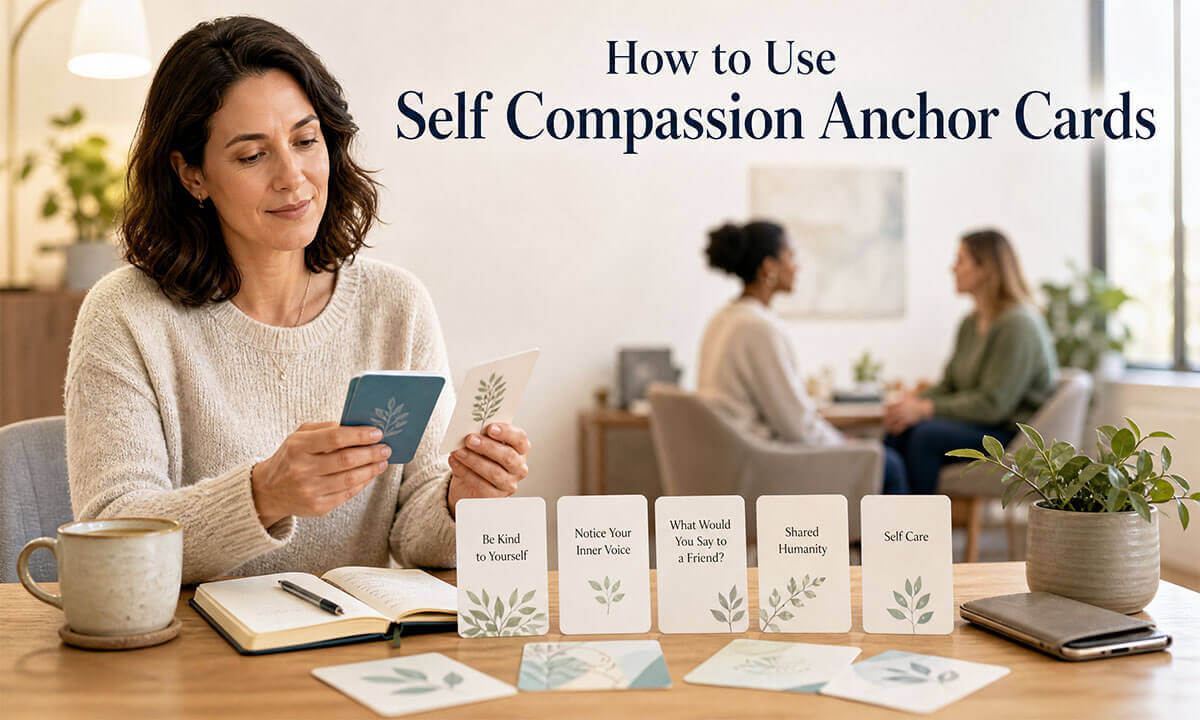
Self-Compassion Anchor Cards are a set of small and portable cards designed to make self-compassion easier to understand and practice. Each card provides a simple, evidence-based activity that can be used in everyday situations. The cards help people develop a kinder and more caring relationship with themselves. They can also be useful for practitioners who want to introduce practical self-compassion exercises to their clients. Here is what the deck includes:
- Visualizing Compassion: The first card helps people understand what self-compassion means and how it can feel. It uses values exploration and a simple visualization exercise to help people connect with compassion on a personal level.
This can be especially helpful for people who understand self-compassion as an idea but find it difficult to experience it in real life. The activity helps them think about what kindness, care, and understanding toward themselves could look like.
For practitioners, this card can provide a gentle way to help clients who understand self-compassion intellectually but have difficulty connecting with it emotionally.
- Inner Voice Awareness: The Inner Voice Awareness card helps people notice their inner critic. It introduces a simple two-step process for recognizing harsh self-talk and changing it into a more balanced and helpful message.
This card can be particularly useful for people who regularly criticize themselves. It encourages them to notice negative thoughts when they appear and then consider a fairer and kinder way to respond.
For practitioners, the card can also be given as a homework activity. Clients can use it between sessions to observe their inner critic and practice responding to it in a healthier way.
- What Would You Say to a Friend? The third card helps people compare the way they speak to themselves with the way they speak to someone they care about. Many people are supportive and understanding toward their friends but much more critical of themselves.
This exercise helps people notice this difference. It encourages them to ask an important question: “What would I say to a friend who was going through the same situation?” The answer can help them develop a kinder and more balanced inner voice.
For therapists, this card can be especially useful when clients believe that self-compassion is self-indulgent. Thinking about how they would treat a friend can make the idea of self-compassion easier to understand and accept.
- Shared Humanity: The Shared Humanity card reminds people that difficult, embarrassing, and imperfect experiences are a normal part of being human. Everyone makes mistakes, experiences disappointment, and faces personal struggles.
This card can help people who feel alone or ashamed of their problems. Instead of seeing difficulties as proof that something is wrong with them, they can begin to understand that challenges are part of the shared human experience.
For practitioners, this card can be helpful for clients who withdraw from others because of shame. The relatable examples can help clients feel less alone and recognize that other people also experience similar difficulties.
- Self-Care: The final card helps turn self-compassion into practical action. It encourages people to think about how well they are caring for themselves across four different areas of self-care. Self-Care Wheel
This card can be especially helpful for people who often put other people’s needs before their own. It helps them identify the areas of self-care that are already going well and notice where they may need more attention.
For professionals, this card can help clients move beyond simply saying that they need to take better care of themselves. It encourages them to create a clear and personal self-care plan that they can begin using in their daily lives.
How to Use the Self-Compassion Anchor Cards:
There is no single correct way to use the Self-Compassion Anchor Cards. They are flexible tools that can be used in different situations. You can use them for your own personal growth or use them with clients in a professional setting. The main goal is to find a way of using the cards that feels useful and comfortable for you.
Here are some simple ways to use the cards:
For Personal Practice:
- Start your day with a card: At the beginning of the day, choose one card from the deck. Read the message or complete the activity. Use it to set an intention to treat yourself with more kindness and understanding throughout the day.
- Use a card during difficult moments: When you are being very hard on yourself or dealing with a mistake, disappointment, or setback, choose a card that matches what you are experiencing. The activity can help you pause negative self-talk and respond to yourself in a more caring way.
- Keep a card somewhere visible: Place a card on your desk, beside your computer, or somewhere you will see it regularly. You can also keep one in the photo sleeve of your wallet. Seeing the card during the day can remind you to return to self-compassion when you need it.
For Therapists and Practitioners:
The cards can also be used as simple tools during therapy sessions, coaching sessions, groups, or other professional settings. They can make it easier to introduce the topic of self-compassion and help clients explore how they treat themselves.
- Start a conversation about the inner critic: Use a card to begin a discussion about the client’s inner critic. Ask the client what kinds of thoughts they have when they make a mistake or face a difficult situation. This can help them recognize their self-critical patterns and begin to question whether those thoughts are fair or helpful.
- Give a card as between-session practice: A practitioner can give a client one card to use between sessions. The client can spend a few minutes reading the prompt and thinking about how it relates to their life. In the next session, the practitioner can ask what the client noticed, learned, or found difficult.
- Use the cards in groups and workshops: The cards can be used as discussion prompts in group sessions, classes, or workshops. Participants can reflect on the questions and share their experiences if they feel comfortable. This can help people understand that struggles with self-compassion are common and that they are not alone in having them.
Generally, the Self-Compassion Anchor Cards can turn self-compassion from an abstract idea into a practical daily activity. They can be used for a few minutes at the start of the day, during difficult moments, or as part of a structured professional session. With regular use, they can help make kindness and understanding toward oneself a more natural part of everyday life.
Helpful Tips for Building a Self-Compassion Practice:
Like any other skill, self-compassion becomes stronger with regular practice. You do not need to make major changes all at once. Even small moments of kindness and understanding toward yourself can make a difference. The important thing is to practice intentionally and make self-compassion a part of your daily life.
Here are some helpful tips for developing a stronger self-compassion practice:
- Remember that self-kindness is not selfish: Being kind to yourself does not mean ignoring your responsibilities or putting yourself above others. It means recognizing your own needs and treating yourself with honesty, care, and understanding. When you take better care of yourself, you may also become more responsible and better able to deal with your responsibilities over time.
- Notice when you use a double standard: Pay attention to the way you speak to yourself after making a mistake or facing a difficult situation. Ask yourself whether you would speak to a close friend in the same way. If you would offer your friend patience and encouragement but criticize yourself harshly, you may be using a double standard. Simply noticing this difference can be the first step toward treating yourself more kindly.
- Accept imperfection and struggle: Nobody has a perfect life. Everyone makes mistakes, experiences failure, and goes through difficult periods. These experiences do not mean that you are weak or inadequate. Understanding that struggle is a normal part of being human can help you respond to yourself with greater compassion.
Building self-compassion takes time. There may be days when it feels easy and other days when it feels difficult. What matters is continuing to practice and giving yourself permission to learn along the way.
Whether you are developing your own personal set of emotional tools or looking for practical resources to support your clients, Self Compassion Anchor Cards can be a useful part of the process. They can provide simple reminders and activities that help turn self-compassion into a regular and meaningful practice.
In conclusion, self-compassion is a simple but powerful practice that can improve the way people treat themselves. It helps people respond to mistakes, stress, and difficult emotions with greater kindness and understanding. The Self-Compassion Anchor Cards provide practical ways to make this practice part of everyday life.
With regular use, these simple exercises can help people become more aware of their inner voice, accept their imperfections, care for their needs, and recognize that struggle is a normal part of being human. Self-compassion takes time to develop, but every small step can help build a kinder and healthier relationship with oneself.
References:
- Benedetto, L., Macidonio, S., & Ingrassia, M. (2024). Well-being and perfectionism: Assessing the mediational role of self-compassion in emerging adults. European Journal of Investigation in Health, Psychology and Education, 14(5), 1383–1395. https://doi.org/10.3390/ejihpe14050091
- Ferrari, M., Hunt, C., Harrysunker, A., Abbott, M. J., Beath, A. P., & Einstein, D. A. (2019). Self-compassion interventions and psychosocial outcomes: A meta-analysis of RCTs. Mindfulness, 10(8), 1455–1473. https://doi.org/10.1007/s12671-019-01134-6
- Neff, K. (2011). Self-compassion: The proven power of being kind to yourself. Hachette UK.
- Neff, K. D. (2023). Self-compassion: Theory, method, research, and intervention. Annual Review of Psychology, 74(1), 193–218. https://doi.org/10.1146/annurev-psych-032420-031047
- Paucsik, M., Nardelli, C., Bortolon, C., Shankland, R., Leys, C., & Baeyens, C. (2023). Self-compassion and emotion regulation: Testing a mediation model. Cognition and Emotion, 37(1), 49–61. https://doi.org/10.1080/02699931.2022.2143328
- Zhang, J. W., & Chen, S. (2016). Self-compassion promotes personal improvement from regret experiences via acceptance. Personality and Social Psychology Bulletin, 42(2), 244–258. https://doi.org/10.1177/0146167215623271

Meta Psychological Education focuses on the foundational, higher-order skills (meta-skills) that allow individuals to “learn how to learn,” manage their own cognitive processes, and adapt to new situations, often termed meta-learning. It bridges psychological research with practical application in learning and development.