Building Empathy in Relationships: Strategies and Examples
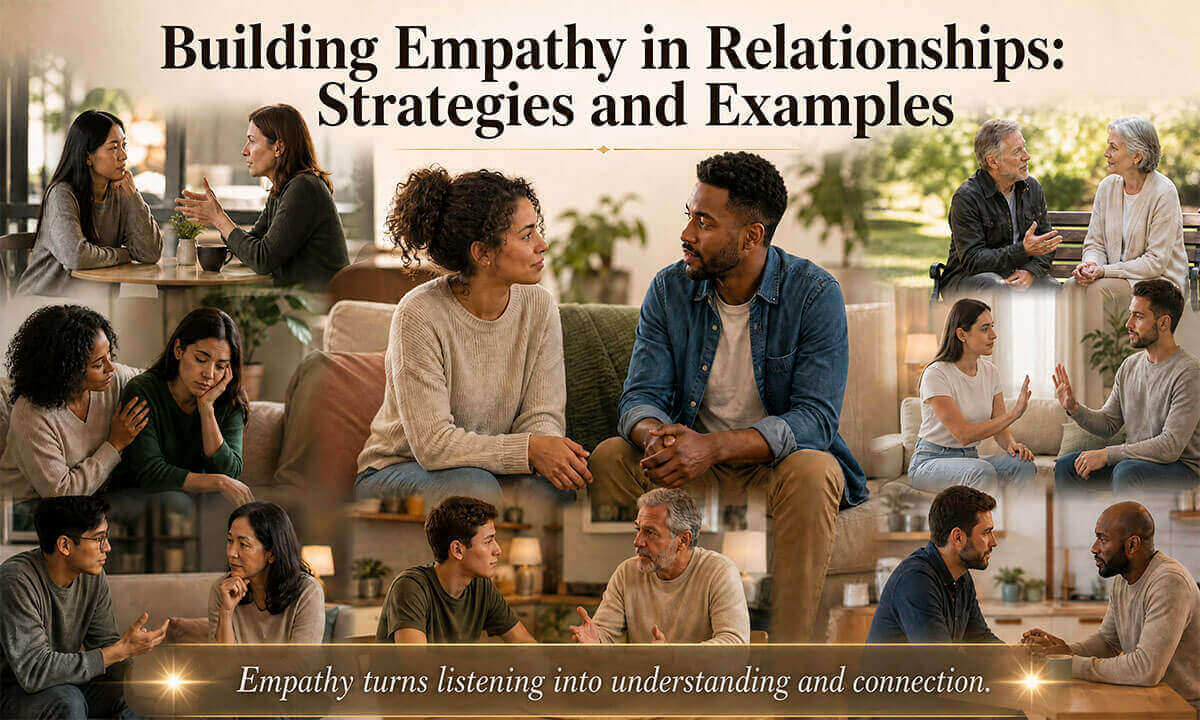
Empathy helps us understand what another person is feeling and thinking, even when we do not agree with them. It plays an important role in building trust, closeness, and healthy relationships. Research shows that empathy can strengthen intimacy and help people feel more satisfied and loved in their relationships (Arican-Dinc & Gable, 2023). Although empathy may come more naturally to some people, it is also a skill that can be developed through practice. Listening carefully, asking questions, and validating another person’s feelings are simple ways to build empathy in relationships (Winter et al., 2020).
What Does Empathy Look Like in a Relationship?
Empathy means trying to understand another person’s feelings, thoughts, and point of view. It involves both understanding their emotional experience and responding to it with care (Hall & Schwartz, 2019). Cognitive empathy focuses on understanding what another person may be thinking or feeling. Affective empathy involves sharing or responding to their emotional experience.
In relationships, empathy can look like:
- Noticing that a friend is quieter than usual and asking if something is wrong
- Listening to a partner’s frustration without becoming defensive
- Trying to understand why a family member sees a situation differently
Research suggests that understanding another person is more helpful when it is combined with empathetic concern (Winczewski et al., 2016). Empathy means paying attention to another person’s feelings and responding with understanding and care.
But empathy does not mean knowing exactly what someone is thinking. Empathetic accuracy refers to how well we understand another person’s thoughts and feelings (Sened et al., 2017). Even people who know each other well can misunderstand each other. So, it is better to ask questions than to make assumptions.
In a relationship, empathy means making an effort to understand the other person while staying open to their feelings and experiences.
Why Building Empathy in Relationships Matters:
Feeling understood is an important part of a healthy relationship. When people feel understood, validated, and cared for, they are more likely to feel close and satisfied in their relationships (Arican-Dinc & Gable, 2023).
Empathy is useful in everyday situations, such as making decisions together, sharing responsibilities, or helping each other with tasks. It becomes even more important during disagreements and conflict.
Empathy changes the focus from “Who is right?” to “What is happening here?” Two people may experience the same situation in different ways. Trying to understand each other can help both people feel heard and respected.
Generally, empathy can help people understand each other better, strengthen their connection, and handle conflicts more calmly.
How to Build Empathy in Close Relationships:
Empathy can be difficult when we feel criticized, disagree with someone, or believe we already understand their intentions. But a few simple habits can help us better understand another person’s point of view.
- Listen to Understand: Give the other person time to explain how they feel. Listen before giving advice or defending yourself.
- Ask Rather Than Assume: Do not assume you already know what the other person is feeling. Ask questions such as, “How did that feel for you?”
- Check Your Understanding: Repeat what you heard in your own words. Then ask if you understood them correctly. This can prevent misunderstandings.
- Validate Their Emotions: Acknowledge the other person’s feelings. You do not have to agree with their opinion to recognize how they feel.
- Stay Curious: Try to understand their experience instead of judging it. Ask yourself, “What are they experiencing?” or “What might I be missing about their point of view?”
Empathy-Building Scenarios and Scripts:
Being empathetic is often easier when everything is going well. But it can be harder during conflict or difficult conversations. We may focus on our own feelings or feel the need to protect ourselves.
Small changes in the way we communicate can make a real difference. The following examples show how simple responses can help build understanding and connection.
1. When Your Partner Feels Ignored:
Your partner says, “You barely spoke to me at the party. I felt like you didn’t even want me there.”
Instead of saying:
“That’s not true. I was just talking to people I haven’t seen in ages.”
Try saying:
“I didn’t realize you were feeling left out. I can understand why it hurt if it seemed like I was ignoring you. What was going on for you at the time?”
The first response focuses on your intention. The second focuses on how your actions affected your partner. Recognizing their feelings does not mean you agree with their interpretation. It shows that you care about their experience.
2. When You Disagree With a Family Member’s Decision:
Your sister tells you that she wants to leave a secure job without having another job arranged.
Instead of saying:
“That’s a terrible idea. You shouldn’t do that.”
Try saying:
“What makes leaving feel like the right choice for you?”
This gives your sister a chance to explain her reasons. After listening, you might say:
“That helps me understand why you want to leave. Can I share what I’m worried about?”
This approach keeps the conversation open instead of turning it into an argument.
3. When a Friend Keeps Talking About the Same Problem:
A friend keeps talking about problems in their relationship.
Instead of saying:
“I’ve already told you what to do. Just stop seeing them.”
Try saying:
“It sounds like you’re still struggling with this. Do you want me to listen, or would you like to talk about some options?”
Sometimes people do not want advice. They may simply need someone to listen. Asking what they need can help you give the right kind of support.
4. When Someone’s Reaction Does Not Make Sense to You:
A friend or family member becomes very upset about something that seems small to you.
Instead of saying:
“Stop overreacting. It’s not such a big deal.”
Try saying:
“I can see that you’re really upset. Do you want to tell me what is bothering you about it?”
People can react differently to the same situation. Empathy means trying to understand what the situation means to them instead of judging their reaction based on your own feelings.
5. When You Feel Defensive:
A friend says, “You never make time for me.” You feel criticized because you have been very busy with work.
Instead of saying:
“That’s completely unfair. You have no idea how busy I am!”
Try saying:
“I can hear that you’re feeling neglected. I’ve been feeling really overwhelmed lately, but I want to understand how this has made you feel. Can we talk about it?”
Empathy does not mean ignoring your own feelings. A healthy relationship gives both people space to explain their experiences.
6. When Someone Shares a Problem You Cannot Fix:
A family member tells you they were rejected for a job they really wanted.
Instead of saying:
“Don’t worry. Something better will come along.”
Try saying:
“That’s really disappointing. I know how much you wanted that job. Do you want to talk about it?”
Sometimes people do not need solutions. They simply need someone to listen and understand their disappointment.
7. When You Need to Set a Boundary:
A friend asks you to come over because they are having a difficult evening. But you are exhausted and need some time alone.
Instead of saying:
“I can’t just drop everything whenever you’re upset.”
Try saying:
“I’m sorry you’re having a difficult night. I understand that you need some company, but I’m really exhausted and need to stay home tonight. I’ll check in with you tomorrow.”
Setting a boundary does not mean ignoring another person’s feelings. You can understand what someone needs while also respecting your own limits. Empathy means making space for both people’s needs and experiences.
In conclusion, empathy does not require perfect words or a complete understanding of another person’s feelings. What matters most is listening with care, asking questions, and checking that you have understood correctly. These simple habits can help people feel heard, respected, and supported. When you are unsure, simply ask, “Please help me understand what it feels like for you.” This can open the door to better communication and stronger relationships.
References:
- Arican-Dinc, B., & Gable, S. L. (2023). Responsiveness in romantic partners’ interactions. Current Opinion in Psychology, 53, Article 101652. https://doi.org/10.1016/j.copsyc.2023.101652
- Hall, J. A., & Schwartz, R. (2019). Empathy present and future. The Journal of Social Psychology, 159(3), 225–243. https://doi.org/10.1080/00224545.2018.1477442
- Sened, H., Lavidor, M., Lazarus, G., Bar-Kalifa, E., Rafaeli, E., & Ickes, W. (2017). Empathic accuracy and relationship satisfaction: A meta-analytic review. Journal of Family Psychology, 31(6), 742–752. https://doi.org/10.1037/fam0000320
- Singer, T., & Klimecki, O. M. (2014). Empathy and compassion. Current Biology, 24(18), R875–R878. https://doi.org/10.1016/j.cub.2014.06.054
- Winczewski, L. A., Bowen, J. D., & Collins, N. L. (2016). Is Empathic Accuracy Enough to Facilitate Responsive Behavior in Dyadic Interaction? Distinguishing Ability From Motivation. Psychological Science, 27(3), 394–404. https://doi.org/10.1177/0956797615624491
- Winter, R., Issa, E., Roberts, N., Norman, R. I., & Howick, J. (2020). Assessing the effect of empathy-enhancing interventions in health education and training: A systematic review of randomised controlled trials. BMJ Open, 10(9), e036471. https://doi.org/10.1136/bmjopen-2019-036471

Meta Psychological Education focuses on the foundational, higher-order skills (meta-skills) that allow individuals to “learn how to learn,” manage their own cognitive processes, and adapt to new situations, often termed meta-learning. It bridges psychological research with practical application in learning and development.