Key Stages of Qualitative Analysis for Psychological Research:
Qualitative analysis plays a central role in psychological research by enabling scholars to explore human experiences, meanings, and social processes in depth. Unlike quantitative approaches that focus on numerical data, qualitative methods emphasize rich, descriptive data collected through interviews, observations, and textual materials. One of the most widely used frameworks for qualitative analysis in psychology is thematic analysis, particularly the approach developed by Braun and Clarke. This method provides a systematic yet flexible way to identify patterns (themes) within qualitative data while acknowledging the active role of the researcher in interpreting meaning (Braun & Clarke, 2019). Qualitative analysis is not a strictly linear process; instead, it is iterative and reflexive, meaning researchers often move back and forth between stages as their understanding evolves (McLeod, 2024). In the rest of this article, we will explore the key stages of qualitative analysis for psychological research.
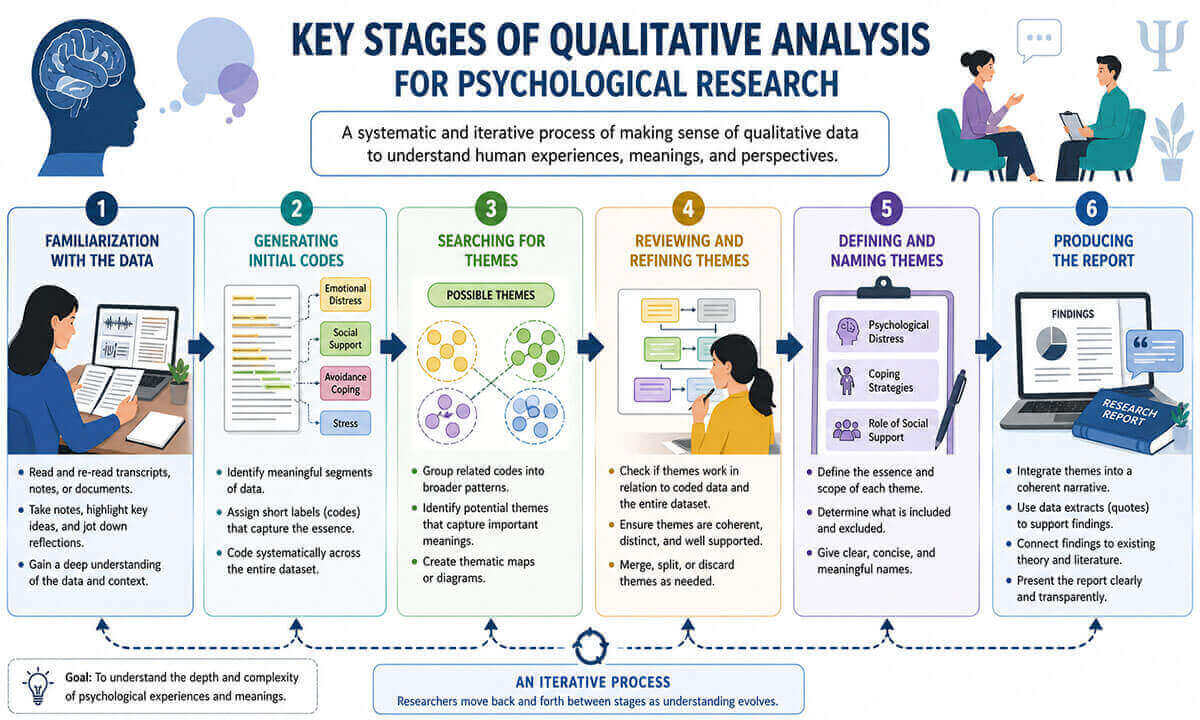
1. Familiarization with the Data: Familiarization is the foundational stage of qualitative analysis, where the researcher becomes deeply immersed in the collected data. In psychological research, this often involves repeatedly reading interview transcripts, listening to audio recordings, or reviewing observational notes to gain a holistic understanding of participants’ experiences. The goal is not just to “read” the data, but to actively engage with it, paying attention to tone, emotional expressions, pauses, and context, all of which can carry psychological meaning.
For example, imagine a psychological study exploring coping strategies among university students experiencing academic stress. After conducting semi-structured interviews, the researcher transcribes each conversation verbatim. During familiarization, they read the transcripts multiple times, noting recurring expressions such as “I feel overwhelmed,” “I can’t sleep,” or “I talk to my friends to feel better.” They may also jot down reflective notes like “strong emotional distress” or “social support appears important.”
This stage often includes memo writing, where researchers document their early impressions, questions, and potential patterns. These memos are critical because they capture the researcher’s evolving understanding and help guide later stages of analysis.
Familiarization is not passive; it is an interpretive act. Researchers begin to notice subtle meanings; for instance, a participant saying “I’m fine” in a hesitant tone may suggest emotional suppression rather than genuine well-being. Such insights are particularly important in psychology, where underlying meanings often differ from surface-level statements.
According to Braun and Clarke (2019), thorough familiarization ensures that subsequent coding and theme development are grounded in a deep and accurate understanding of the data. Without this stage, analysis risks becoming superficial or disconnected from participants’ lived experiences.
2. Generating Initial Codes: Once the researcher is thoroughly familiar with the data, the next step is to generate initial codes. Coding involves identifying meaningful segments of the data and labeling them in a way that captures their essence. In psychological research, codes often reflect emotions, behaviors, cognitive processes, or social interactions.
Returning to the example of students coping with academic stress, the researcher begins systematically examining each transcript line by line. They might assign codes such as:
- “feeling overwhelmed” → emotional distress
- “I stay up all night studying” → sleep disruption
- “I talk to my friends” → seeking social support
- “I just ignore the problem” → avoidance coping
Coding can be inductive, where codes emerge directly from the data, or deductive, where codes are guided by existing psychological theories (e.g., Lazarus and Folkman’s coping theory). Often, researchers use a combination of both approaches.
A key feature of this stage is that coding is inclusive and comprehensive. Researchers aim to capture all relevant aspects of the data rather than focusing only on what seems immediately important. This prevents bias and ensures that less obvious but significant patterns are not overlooked.
For instance, in a study on adolescent identity development, a researcher might initially code statements like “I don’t know who I am” as identity confusion and “I feel different at home and school” as role conflict. Even if these codes seem unrelated at first, they may later contribute to a broader theme.
Coding is also iterative. As researchers progress, they may refine, merge, or split codes. For example, the code emotional distress might later be divided into anxiety, frustration, and burnout to better reflect the nuances in the data.
Naeem et al. (2023) emphasize that coding is not just a mechanical process but an interpretive one, requiring researchers to actively decide what is meaningful and relevant to the research question.
3. Searching for Themes: After generating initial codes, researchers move to the stage of searching for themes. A theme is a broader pattern that captures something significant about the data in relation to the research question. This stage involves organizing and grouping related codes into meaningful clusters.
- Continuing the academic stress study, the researcher examines all the codes and begins to identify patterns. For example:
- Codes like emotional distress, anxiety, and feeling overwhelmed may be grouped into a theme called “Psychological Burden of Academic Pressure.”
- Codes such as seeking social support and talking to friends might form the theme “Interpersonal Coping Mechanisms.”
- Codes like avoidance coping and procrastination could contribute to a theme such as “Maladaptive Coping Strategies.”
This stage often involves creating visual tools like thematic maps or diagrams to explore relationships between themes and subthemes. For instance, the researcher might notice that maladaptive coping strategies are linked to higher levels of psychological burden, suggesting a deeper interpretive insight.
In another psychological example, a study on patients living with chronic illness might generate themes such as loss of identity, adaptation and resilience, and dependence on caregivers. These themes go beyond individual statements and provide a structured understanding of the overall experience.
Prominently, themes are not simply “found” in the data; they are actively constructed by the researcher through careful interpretation. This reflects the subjective and analytical nature of qualitative research. As Morriss (2024) notes, theme development involves both organizing data and making sense of it in a way that answers the research question.
At this stage, themes are still provisional. They will be refined and validated in later stages, but they already represent a significant step in transforming raw qualitative data into meaningful psychological insights.
4. Reviewing and Refining Themes: Once initial themes have been identified, the next step is to review and refine them to ensure they accurately represent the data. This stage is essential for maintaining the credibility and rigor of qualitative psychological research. Researchers carefully examine whether the themes are coherent, internally consistent, and clearly distinct from one another.
This process typically occurs at two levels. First, researchers check whether the coded data within each theme form a meaningful and consistent pattern. If certain data extracts do not quite fit, they may be re-coded or moved to a different theme. Second, researchers consider whether the themes as a whole adequately reflect the entire dataset. This may involve re-reading the full dataset to confirm that no important insights have been overlooked.
For example, in the academic stress study, the researcher initially created a theme called “Maladaptive Coping Strategies” that included codes such as avoidance, procrastination, and excessive social media use. Upon reviewing the data, they may realize that procrastination sometimes functions as a temporary emotional relief rather than purely maladaptive behavior. As a result, the researcher might refine the theme into two subthemes: “Short-term Relief Strategies” and “Long-term Dysfunctional Coping.”
Similarly, in a psychological study on depression among adolescents, a theme like “Social Withdrawal” may initially include both voluntary isolation and feelings of rejection. During refinement, the researcher may separate these into two distinct themes, “Self-imposed Isolation” and “Perceived Social Exclusion,” to better capture the nuanced experiences of participants.
This stage is inherently iterative. Researchers often move back and forth between themes, codes, and the original data. Some themes may be merged if they overlap significantly, while others may be discarded if they lack sufficient supporting evidence.
According to McLeod (2024), this recursive process strengthens the validity of qualitative findings by ensuring that themes are firmly grounded in the data rather than imposed prematurely.
5. Defining and Naming Themes: After refining the themes, researchers move to clearly defining and naming them. This stage involves identifying the core essence of each theme and articulating what aspect of the data it captures. A well-defined theme should tell a clear and meaningful story about the data in relation to the research question.
In this stage, researchers write detailed descriptions for each theme, explaining:
- What the theme represents
- What is included and excluded
- How it relates to other themes
- Why it is important for understanding the phenomenon
For instance, in the academic stress example, the theme “Psychological Burden of Academic Pressure” might be defined as:
“The emotional and cognitive strain experienced by students due to academic demands, characterized by anxiety, self-doubt, and feelings of being overwhelmed.”
The researcher may also include subthemes such as performance anxiety and fear of failure, each with its own definition.
Naming themes is equally important. Names should be concise, engaging, and reflective of the underlying meaning. Instead of vague labels like “Feelings,” a more precise name such as “Emotional Exhaustion and Burnout” provides clearer insight into the data.
In a psychological study on trauma survivors, a theme initially labeled “Recovery” might be renamed “Reconstructing a Sense of Self” to better capture the depth and complexity of participants’ experiences.
Braun and Clarke (2019) emphasize that this stage transforms themes from simple categories into analytical concepts, allowing researchers to move beyond description toward interpretation.
6. Producing the Report: The final stage of qualitative analysis involves producing a well-structured and compelling report that presents the findings. In psychological research, this is where the researcher tells the story of the data, integrating themes into a coherent narrative that addresses the research question and connects with existing theories and literature.
A strong qualitative report does more than list themes; it explains their significance and demonstrates how they contribute to understanding human behavior and experience. Researchers typically support each theme with direct quotes or excerpts from participants, which serve as evidence and enhance the credibility of the analysis.
For example, in the academic stress study, the theme “Psychological Burden of Academic Pressure” might be illustrated with a participant quote such as:
“I feel like I’m constantly drowning in assignments, and no matter how hard I try, it’s never enough.”
This quote not only supports the theme but also provides a vivid, human perspective that quantitative data cannot capture.
In another example, a study on coping among cancer patients might present a theme like “Finding Meaning in Suffering,” supported by narratives describing personal growth, spirituality, or changes in life priorities. The researcher would then link these findings to psychological theories such as meaning-making or resilience.
Clarity and transparency are crucial in this stage. Researchers must explain how the analysis was conducted, how themes were developed, and how interpretations were reached. This ensures the trustworthiness of the study and allows readers to evaluate its quality.
Naeem et al. (2023) highlight that a well-written qualitative report should be both analytical and accessible, balancing academic rigor with readability. It should clearly demonstrate how the findings contribute to psychological knowledge and practice.
In conclusion, Qualitative analysis in psychological research is a rigorous yet flexible process that enables researchers to explore complex human experiences and meanings. The key stages (familiarization, coding, theme development, review, definition, and reporting) provide a structured framework for transforming raw data into meaningful insights.
Importantly, this process is not linear but iterative, requiring continuous reflection and refinement. Researchers play an active role in interpreting data, constructing themes, and shaping the final narrative. When conducted systematically and transparently, qualitative analysis offers deep and nuanced understanding that complements quantitative findings and enriches psychological knowledge.
Overall, mastering these stages allows researchers to produce credible, insightful, and impactful qualitative studies that contribute significantly to the field of psychology.
Frequently Asked Questions (FAQs):
What is qualitative analysis in psychological research?
Qualitative analysis is a method used in psychology to explore and interpret non-numerical data such as interview transcripts, observations, and written texts. It focuses on understanding human experiences, emotions, and meanings rather than measuring variables statistically. This approach is especially useful for studying complex psychological phenomena like identity, trauma, coping, and relationships.
Why is qualitative analysis important in psychology?
Qualitative analysis allows researchers to gain deep, detailed insights into individuals’ lived experiences. It helps uncover meanings, beliefs, and social contexts that cannot be captured through quantitative methods alone. In psychology, it is particularly valuable for exploring sensitive or subjective topics such as mental health, personal development, and social interactions.
What is coding in qualitative research?
Coding is the process of identifying and labeling meaningful segments of data. These labels (codes) represent key ideas, emotions, or patterns in the data. For example, in a study on stress, statements like “I feel overwhelmed” might be coded as emotional distress. Coding helps organize large amounts of qualitative data into manageable and meaningful units.
What is a theme in qualitative analysis?
A theme is a broader pattern that captures something important about the data in relation to the research question. Themes are developed by grouping related codes together. For example, codes like anxiety, pressure, and burnout may form a theme such as psychological stress.
How do researchers ensure the quality of qualitative analysis?
Researchers use several strategies to ensure quality and trustworthiness, including:
- Credibility: Ensuring findings accurately reflect participants’ experiences
- Dependability: Maintaining consistency in the research process
- Confirmability: Minimizing researcher bias
- Transferability: Providing enough detail for findings to be applied in other contexts
They may also use techniques like member checking, peer review, and detailed documentation.
What is the difference between qualitative and quantitative analysis?
- Qualitative analysis focuses on meanings, experiences, and descriptions (e.g., interviews, narratives).
- Quantitative analysis focuses on numerical data and statistical relationships (e.g., surveys, experiments).
Both approaches are valuable in psychology and are often used together in mixed-methods research.
Is qualitative analysis subjective?
Qualitative analysis involves interpretation, so some level of subjectivity is inevitable. However, it is not arbitrary. Researchers follow systematic procedures, remain reflexive about their biases, and provide evidence (such as participant quotes) to support their interpretations. This ensures the analysis remains rigorous and credible.
What tools are used for qualitative data analysis?
Researchers may analyze data manually or use software such as NVivo, ATLAS.ti, or MAXQDA. These tools help organize, code, and manage large datasets but do not replace the researcher’s interpretive role.
Can qualitative findings be generalized?
Qualitative research does not aim for broad statistical generalization. Instead, it provides in-depth insights that may be transferable to similar contexts. The goal is to deepen understanding rather than produce universal laws.
How long does qualitative analysis take?
Qualitative analysis can be time-consuming because it involves detailed reading, coding, and interpretation. The duration depends on the size of the dataset and the complexity of the research question, but it often requires careful, iterative work over an extended period.
When should qualitative analysis be used in psychological research?
Qualitative analysis is most appropriate when researchers want to:
- Explore new or under-researched topics
- Understand personal experiences or perceptions
- Study complex social or psychological processes
- Gain rich, detailed insights rather than numerical results
References:
- Braun, V., & Clarke, V. (2019). Reflecting on reflexive thematic analysis. Qualitative Research in Sport, Exercise and Health, 11(4), 589–597. https://doi.org/10.1080/2159676X.2019.1628806
- McLeod, S. (2024). Thematic analysis: A step by step guide. ResearchGate. https://doi.org/10.13140/RG.2.2.13084.71048
- Naeem, M., Ozuem, W., Howell, K., & Ranfagni, S. (2023). A step-by-step process of thematic analysis to develop a conceptual model in qualitative research. International Journal of Qualitative Methods, 22, 1–18. https://doi.org/10.1177/16094069231205789
- Morriss, L. (2024). Themes do not emerge. An editor’s reflections on the use of Braun and Clarke’s thematic analysis. Qualitative Social Work, 23(5), 745-749. https://doi.org/10.1177/14733250241277355

Meta Psychological Education focuses on the foundational, higher-order skills (meta-skills) that allow individuals to “learn how to learn,” manage their own cognitive processes, and adapt to new situations, often termed meta-learning. It bridges psychological research with practical application in learning and development.