
Developmental Psychology Research Methods:
Developmental psychology seeks to understand how individuals grow and change across the lifespan (cognitively, emotionally, socially, and physically). To study such complex and long-term processes, researchers rely on a range of carefully designed methods. Each method offers unique strengths and limitations, and the choice of approach often depends on the research question, time frame, and ethical considerations. From observing children at a single point in time to tracking individuals over decades, developmental psychologists employ diverse strategies to uncover patterns of human development. This article explores developmental psychology research methods.
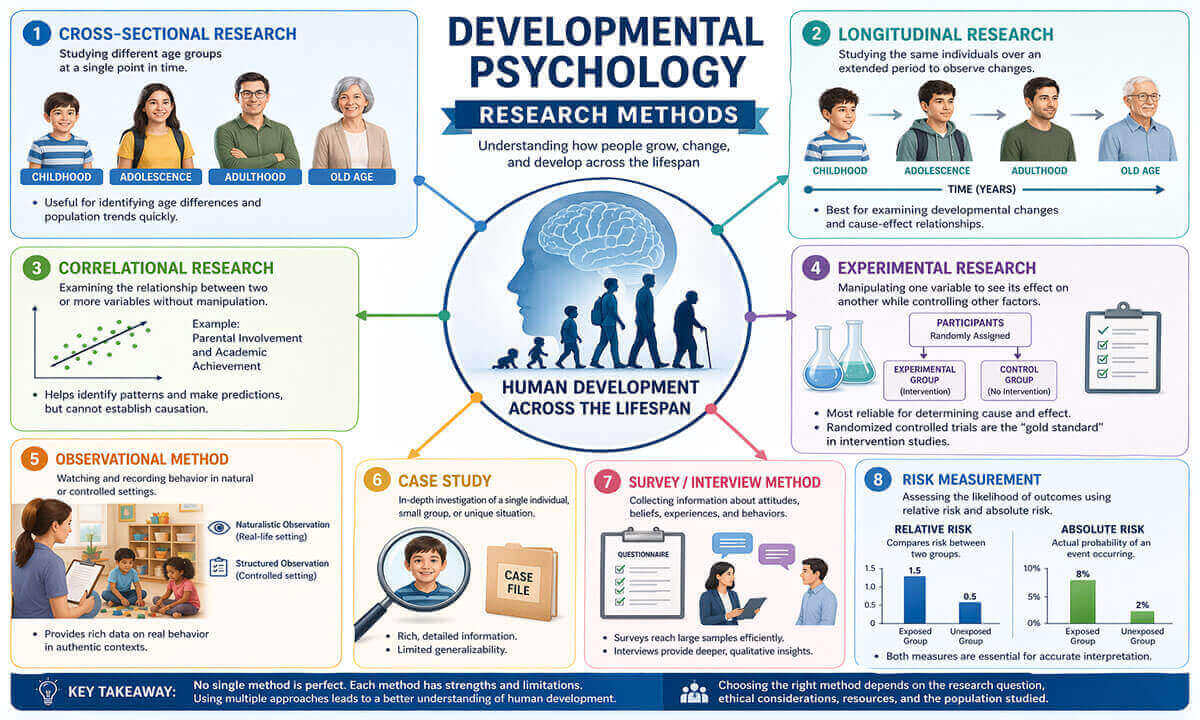
1. Cross-Sectional Research: Cross-sectional research is one of the most widely used methods in developmental psychology because of its efficiency and practicality. In this approach, researchers examine individuals from different age groups at a single point in time. For example, a study might compare language development in 5-year-olds, 10-year-olds, and 15-year-olds simultaneously to identify age-related differences.
One of the major advantages of cross-sectional research is that it allows researchers to gather data quickly without waiting for participants to age. This makes it especially useful in educational and clinical settings where timely insights are needed. Capili (2021) explains that cross-sectional studies are particularly effective for describing population characteristics and identifying patterns across groups. Similarly, Kesmodel (2018) notes that such studies are valuable for exploring associations between variables and generating hypotheses for future research.
Despite its strengths, cross-sectional research has important limitations. It cannot establish cause-and-effect relationships because it only captures a single moment in time. Additionally, it is vulnerable to cohort effects, where differences between age groups may be due to historical or cultural experiences rather than actual developmental changes. For instance, older participants may have had different educational opportunities compared to younger ones, which could influence the results.
2. Longitudinal Research: Longitudinal research involves studying the same group of individuals repeatedly over an extended period, sometimes spanning years or even decades. This method is particularly valuable in developmental psychology because it allows researchers to observe how individuals change and grow over time.
A classic example of longitudinal research is the Terman Study of the Gifted, which followed intellectually gifted individuals throughout their lives. This study provided deep insights into how early intelligence relates to later life outcomes, including career success and well-being (Kell & Wai, 2018).
The greatest strength of longitudinal research lies in its ability to track developmental trajectories and identify patterns of stability and change. Because the same individuals are studied over time, researchers can make stronger inferences about cause-and-effect relationships compared to cross-sectional studies.
However, longitudinal research also comes with significant challenges. It is time-consuming and expensive, often requiring long-term commitment and funding. Participant dropout, known as attrition, is another major issue; when participants leave the study, it can reduce the reliability and representativeness of the findings. Additionally, repeated testing may influence participants’ behavior, a phenomenon known as the practice effect.
3. Sequential Research (Cohort-Sequential Design): Sequential research, also known as cohort-sequential design, combines elements of both cross-sectional and longitudinal methods. In this approach, researchers study multiple age groups (cohorts) over time, allowing them to examine both age-related changes and cohort differences simultaneously.
For example, a researcher might begin by studying groups of 8-year-olds, 12-year-olds, and 16-year-olds, and then follow each group over several years. This design enables researchers to distinguish between three important factors:
- Age effects (changes due to aging)
- Cohort effects (differences due to generational experiences)
- Time-of-measurement effects (influences from historical events occurring during the study)
The major advantage of sequential research is that it provides a more comprehensive and accurate understanding of development. By combining the strengths of cross-sectional and longitudinal approaches, it helps overcome some of their individual limitations, particularly the issue of cohort effects.
However, this method is complex and resource-intensive. It requires careful planning, large samples, and long-term commitment, making it less commonly used despite its strong scientific value.
4. Correlational Research: Correlational research focuses on identifying relationships between variables without manipulating them. In developmental psychology, this method is especially useful when studying factors that cannot be ethically or practically controlled, such as family environment, socioeconomic status, or early childhood experiences. For example, a researcher might examine the relationship between parental involvement and a child’s academic performance.
One of the key strengths of correlational research is its ability to reveal patterns that exist in real-life settings. According to Curtis, Comiskey, and Dempsey (2016), correlational studies play a crucial role in understanding associations between variables and are often the first step in exploring new research areas. These findings can help researchers make predictions and guide further experimental investigations.
However, correlational research has an important limitation: it cannot establish causation. Even if two variables are strongly related, it does not mean that one causes the other. There may be a third variable influencing both, or the relationship may be coincidental. For instance, a correlation between screen time and lower academic performance does not necessarily mean that screen time causes poor performance; other factors such as study habits or parental supervision could be involved.
5. Experimental Research: Experimental research is considered the most rigorous method for determining cause-and-effect relationships. In this approach, researchers deliberately manipulate an independent variable to observe its effect on a dependent variable, while controlling other factors that might influence the outcome.
For example, a developmental psychologist might design an experiment to test whether a specific teaching method improves children’s problem-solving skills. Participants would be randomly assigned to different groups, ensuring that any observed differences are due to the intervention rather than pre-existing characteristics.
A particularly strong form of experimental design is the randomized double-blind placebo-controlled study, which minimizes bias by ensuring that neither participants nor researchers know who is receiving the treatment. Misra (2012) describes this type of design as the “gold standard” in intervention-based research because it enhances the reliability and validity of findings.
Despite its strengths, experimental research in developmental psychology often faces ethical and practical challenges. Researchers cannot manipulate certain variables (such as parenting style or early trauma) because doing so would be unethical. Additionally, laboratory settings may not fully reflect real-world conditions, which can limit the generalizability of results.
6. Observational Methods: Observational methods involve systematically watching and recording behavior as it occurs, either in natural environments or controlled settings. This approach is particularly valuable in developmental psychology, especially when studying infants and young children who may not be able to communicate their thoughts and feelings effectively.
There are two main types of observational research:
- Naturalistic observation, where behavior is observed in real-life settings such as homes, schools, or playgrounds
- Structured observation, where behavior is observed under controlled conditions designed by the researcher
The primary advantage of observational methods is that they provide rich, detailed data about actual behavior rather than relying on self-reports. This makes them highly useful for understanding social interactions, emotional expressions, and developmental milestones.
However, observational research also has limitations. The presence of an observer may influence participants’ behavior, a phenomenon known as reactivity. Additionally, observer bias can affect how behaviors are interpreted and recorded. Since researchers do not control variables in natural settings, it is also difficult to draw firm conclusions about cause-and-effect relationships.
7. Case Studies: Case studies involve an in-depth and detailed examination of a single individual, a small group, or a specific situation. In developmental psychology, this method is often used when researchers want to explore rare, unusual, or highly complex developmental patterns that cannot be easily studied using large samples. For example, a case study might focus on a child with exceptional cognitive abilities or a developmental disorder to understand unique aspects of growth and behavior.
The main strength of case studies is the richness and depth of information they provide. Researchers can collect data from multiple sources such as interviews, observations, medical records, and psychological tests. This allows for a comprehensive understanding of the individual’s developmental history and current functioning. Case studies are particularly valuable for generating new hypotheses and guiding future research in developmental psychology.
However, case studies also have significant limitations. Because they focus on one or a few individuals, the findings cannot be easily generalized to the wider population. There is also a risk of researcher bias, as interpretations may be influenced by subjective judgment. Despite these limitations, case studies remain an important method for exploring complex developmental phenomena in real-world contexts.
8. Survey and Interview Methods: Survey and interview methods are widely used in developmental psychology to collect information about individuals’ thoughts, experiences, beliefs, and behaviors. Surveys typically involve structured questionnaires distributed to large groups, while interviews allow for more in-depth, face-to-face or verbal data collection.
One of the major advantages of these methods is their ability to reach large and diverse populations efficiently. They are especially useful for studying attitudes, parenting styles, educational experiences, and social development. Surveys can also be standardized, making it easier to compare responses across groups. Interviews, on the other hand, provide richer qualitative data and allow researchers to explore answers in greater depth through follow-up questions.
However, both methods have limitations. Survey responses may be affected by social desirability bias, where participants answer in a way they believe is socially acceptable rather than truthful. Memory errors and misunderstanding of questions can also affect data accuracy. Interviews, while detailed, are time-consuming and may be influenced by the interviewer’s tone, wording, or expectations.
Despite these challenges, surveys and interviews remain essential tools for understanding developmental processes from the perspective of individuals and families.
9. Risk Measurement in Developmental Studies: Risk measurement is an important aspect of developmental psychology research, especially when examining factors that influence health, behavior, or long-term outcomes. Researchers often use statistical tools to understand how likely certain outcomes are under different conditions.
A key concept in this area is the distinction between relative risk and absolute risk. Relative risk compares the likelihood of an outcome between two groups, while absolute risk refers to the actual probability of an event occurring. Noordzij et al. (2017) emphasize that both measures must be interpreted together to avoid misleading conclusions. For example, a treatment might reduce relative risk significantly, but the absolute risk reduction may still be small in practical terms.
In developmental psychology, risk measurement is used to study issues such as the impact of early childhood adversity, exposure to stress, or educational disadvantages. Understanding risk helps researchers and practitioners identify vulnerable populations and design effective interventions. However, misinterpreting statistical risk can lead to incorrect assumptions about cause and effect, so careful analysis is essential.
In conclusion, research methods in developmental psychology are diverse and complementary. Cross-sectional studies provide quick snapshots of age differences, while longitudinal research reveals developmental changes over time. Experimental and correlational methods help uncover relationships and causal mechanisms, and observational and qualitative approaches offer rich, contextual insights. No single method is perfect. Each has its strengths and limitations, and researchers often combine multiple approaches to gain a more complete understanding of human development. By carefully selecting and applying these methods, developmental psychologists continue to deepen our understanding of how individuals grow and change throughout life.
Frequently Asked Questions (FAQs):
What are the main research methods used in developmental psychology?
Developmental psychology commonly uses cross-sectional, longitudinal, and sequential (cohort-sequential) designs, along with correlational, experimental, observational, case study, and survey/interview methods. Each method helps researchers understand different aspects of human growth and change over time.
Why is cross-sectional research widely used in developmental studies?
Cross-sectional research is popular because it is quick, cost-effective, and allows comparison between different age groups at one point in time. According to Capili (2021), it is especially useful for identifying population patterns, while Kesmodel (2018) highlights its value in generating hypotheses for further research.
What is the main limitation of cross-sectional research?
The biggest limitation is that it cannot determine cause-and-effect relationships. It is also affected by cohort effects, meaning differences between groups may be due to generational experiences rather than actual developmental changes.
Why is longitudinal research important in developmental psychology?
Longitudinal research tracks the same individuals over time, allowing researchers to observe real developmental changes. This makes it valuable for understanding how early experiences influence later life outcomes, such as education, personality, or health (Kell & Wai, 2018).
What are the challenges of longitudinal studies?
Longitudinal studies are expensive, time-consuming, and often face participant dropout (attrition). Repeated testing can also influence participants’ responses, which may affect the results.
How does correlational research differ from experimental research?
Correlational research identifies relationships between variables without manipulation, while experimental research involves controlling and manipulating variables to determine cause-and-effect relationships. Curtis et al. (2016) note that correlational studies are useful for identifying real-world patterns, but they cannot prove causation.
Why is experimental research considered the “gold standard”?
Experimental research, especially randomized controlled designs, is considered highly reliable because it reduces bias and allows clear conclusions about causality. Misra (2012) describes randomized double-blind placebo-controlled studies as the “gold standard” in intervention research.
What are observational methods used for?
Observational methods are used to study behavior in natural or controlled settings without interference. They are especially useful for studying children’s behavior, social interaction, and emotional development in real-life contexts.
What is the purpose of case studies in developmental psychology?
Case studies provide detailed, in-depth information about a single individual or small group. They are useful for studying rare conditions or unique developmental patterns, but their findings cannot be generalized to larger populations.
Why are surveys and interviews important in developmental research?
Surveys and interviews help researchers collect large amounts of data about attitudes, experiences, and behaviors. Surveys are efficient for large groups, while interviews provide deeper qualitative insights.
What is the difference between relative risk and absolute risk?
Relative risk compares the likelihood of an outcome between two groups, while absolute risk shows the actual probability of an event occurring. Noordzij et al. (2017) emphasize that both must be interpreted together for accurate understanding.
Can one research method explain all aspects of development?
No single method is sufficient on its own. Developmental psychology relies on multiple methods because each has strengths and limitations. Using a combination of approaches provides a more complete understanding of human development.
References:
- Capili, B. (2021). Cross-sectional studies. American Journal of Nursing, 121(10), 59–62. https://doi.org/10.1097/01.NAJ.0000794280.73744.fe
- Curtis, E. A., Comiskey, C., & Dempsey, O. (2016). Importance and use of correlational research. Nurse Researcher, 23(6), 20–25. https://doi.org/10.7748/nr.2016.e1382
- Kesmodel, U. S. (2018). Cross-sectional studies – what are they good for? Acta Obstetricia et Gynecologica Scandinavica, 97(4), 388–393. https://doi.org/10.1111/aogs.13331
- Kell, H. J., & Wai, J. (2018). Terman Study of the Gifted. In B. Frey (Ed.), The SAGE Encyclopedia of Educational Research, Measurement, and Evaluation (Vol. 4). SAGE Publications. https://doi.org/10.4135/9781506326139.n691
- Misra, S. (2012). Randomized double blind placebo control studies, the “gold standard” in intervention based studies. Indian Journal of Sexually Transmitted Diseases and AIDS, 33(2), 131–134. https://doi.org/10.4103/2589-0557.102130
- Noordzij, M., van Diepen, M., Caskey, F. C., & Jager, K. J. (2017). Relative risk versus absolute risk: One cannot be interpreted without the other. Nephrology Dialysis Transplantation, 32(Suppl 2), ii13–ii18. https://doi.org/10.1093/ndt/gfw465

Meta Psychological Education focuses on the foundational, higher-order skills (meta-skills) that allow individuals to “learn how to learn,” manage their own cognitive processes, and adapt to new situations, often termed meta-learning. It bridges psychological research with practical application in learning and development.