How to Improve Your Psychological Information Processing Skills:
In everyday life, we are constantly taking in information, interpreting it, storing it, and using it to make decisions. This entire mental activity is known as information processing, a concept rooted in Cognitive Psychology. Strong information processing skills help students learn faster, professionals solve problems more effectively, and individuals make better judgments in complex situations. However, these skills do not develop automatically. They require conscious effort, structured practice, and the use of effective strategies. By understanding how the mind works and applying practical techniques, anyone can significantly improve their ability to process information efficiently and accurately. Here, we are going to explore how to improve your psychological information processing skills.
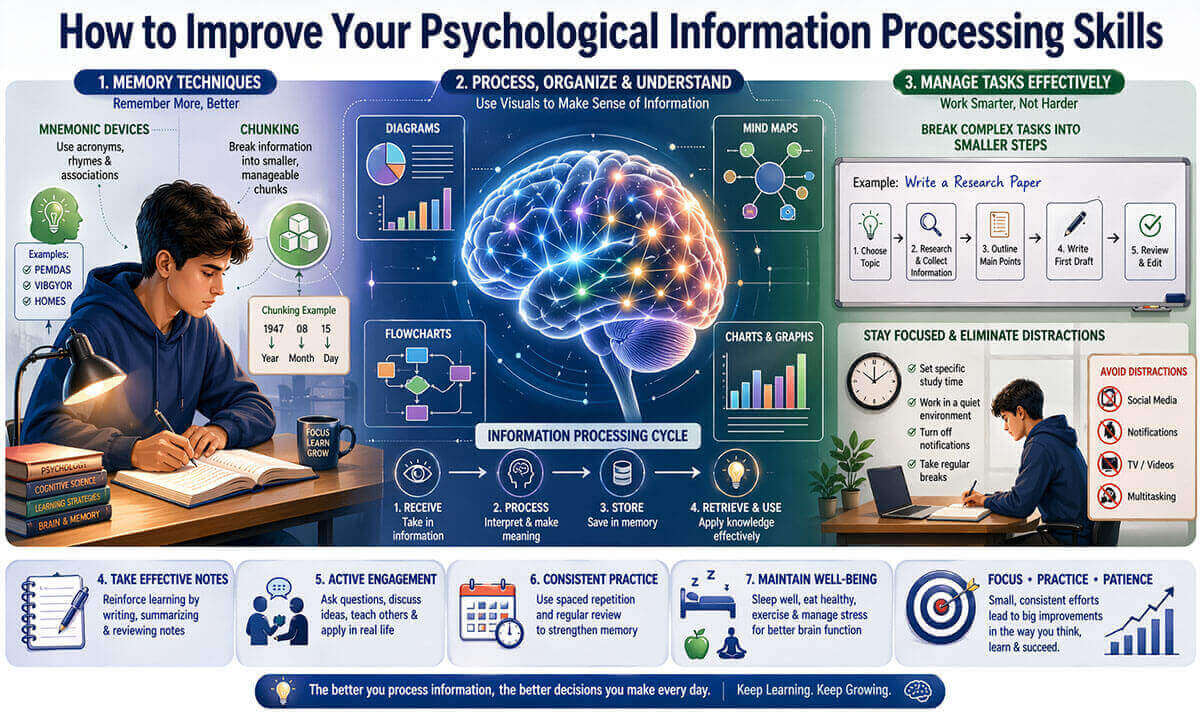
1. Use Memory Techniques for Better Retention: One of the most effective ways to improve information processing is by strengthening memory. Techniques such as mnemonic devices and chunking are particularly useful.
Mnemonic devices help transform complex information into simple, memorable patterns. For example, acronyms, rhymes, or associations can make abstract concepts easier to recall. Chunking, on the other hand, involves breaking large pieces of information into smaller units. This aligns with principles from Working Memory, which has a limited capacity.
By organizing information into manageable chunks, the brain can process and store it more efficiently, reducing cognitive overload.
2. Take Effective Notes to Reinforce Learning: Note-taking is more than just writing things down; it is an active learning strategy. When you take notes, you engage with the material, which strengthens understanding and retention.
Methods such as summarizing, paraphrasing, and organizing ideas into headings or bullet points help structure information logically. This process supports encoding, a key stage in Information Processing Theory.
Reviewing notes later further reinforces learning, helping transfer information from short-term to long-term memory.
3. Break Complex Tasks into Smaller Steps: Large or complicated tasks can overwhelm the brain, making it difficult to process information effectively. Breaking tasks into smaller, manageable steps reduces mental strain and increases clarity.
This approach improves focus and allows the brain to process one component at a time. It also aligns with problem-solving strategies used in both education and professional settings.
For example, instead of trying to understand an entire chapter at once, you can divide it into sections, summarize each part, and then integrate the information.
4. Use Visual Aids to Enhance Understanding: Visual tools such as charts, diagrams, and illustrations can significantly improve comprehension. The brain processes visual information faster than text, making complex ideas easier to grasp.
Concept maps, flowcharts, and info-graphics help organize relationships between ideas. This technique is especially useful when dealing with abstract or interconnected concepts.
Visual learning also supports dual coding, where information is processed both verbally and visually, leading to stronger memory retention.
5. Minimize Distractions and Improve Focus: Attention is an esssential component of information processing. Without focus, even simple information can be misunderstood or forgotten.
Creating a distraction-free environment is essential. This may include turning off notifications, choosing a quiet study space, and setting specific time blocks for focused work.
Practices like mindfulness and time management can further enhance concentration. Sustained attention allows deeper processing, which leads to better understanding and long-term retention.
6. Practice Active Engagement with Information: Passive reading or listening is often ineffective. Instead, actively engaging with material (by asking questions, discussing ideas, or teaching others) enhances processing.
Active engagement encourages deeper thinking and helps connect new information with existing knowledge. This strengthens neural pathways and improves recall.
For instance, after reading a topic, try explaining it in your own words or applying it to real-life situations.
7. Develop Consistent Study Habits: Consistency plays a major role in improving information processing skills. Regular study sessions help reinforce neural connections and prevent forgetting.
Spaced repetition, where information is reviewed over increasing intervals, is particularly effective. This technique strengthens long-term memory and reduces the need for last-minute cramming.
Over time, consistent practice leads to automaticity, where processing becomes faster and more efficient.
8. Maintain Mental and Physical Well-being: Cognitive performance is closely linked to overall health. Adequate sleep, proper nutrition, and regular physical activity all support brain function.
Sleep, in particular, is essential for memory consolidation. Without it, the brain struggles to organize and store information effectively.
Managing stress is equally important, as high stress levels can interfere with attention and memory.
In conclusion, improving psychological information processing skills is not a one-time effort but a continuous journey. By applying techniques such as memory strategies, effective note-taking, task breakdown, and visual learning, individuals can enhance their ability to understand and retain information.
Equally important are focus, active engagement, and consistent habits, all supported by a healthy lifestyle. Together, these strategies create a strong foundation for efficient thinking and learning.
In a world filled with information, the ability to process knowledge effectively is not just an academic skill; it is a vital life skill that empowers individuals to think clearly, learn continuously, and adapt successfully to new challenges.
Frequently Asked Questions (FAQs):
What are psychological information processing skills?
Psychological information processing skills refer to the mental abilities involved in receiving, interpreting, storing, and using information. These skills are studied within Cognitive Psychology and include attention, perception, memory, and problem-solving.
Why are information processing skills important?
These skills are essential for learning, decision-making, and everyday functioning. Strong processing abilities help individuals understand complex ideas, retain knowledge, and apply it effectively in real-life situations.
How can I improve my memory for better information processing?
You can improve memory by using techniques such as mnemonics, chunking, and repetition. These methods support the functioning of Working Memory and make it easier to retain and recall information.
Does note-taking really improve learning?
Yes, note-taking enhances learning by actively engaging the brain. It helps organize information, improves understanding, and supports long-term retention by reinforcing key concepts.
What is the best way to handle complex information?
Breaking complex information into smaller, manageable parts is highly effective. This reduces cognitive overload and allows the brain to process each component step by step.
How do visual aids help in information processing?
Visual aids such as diagrams, charts, and graphs make abstract or complex ideas easier to understand. They also improve memory by combining visual and verbal information, which strengthens learning.
Can distractions really affect information processing?
Yes, distractions significantly reduce attention and focus. Since attention is a key part of Information Processing Theory, minimizing distractions helps improve comprehension and retention.
How long does it take to improve these skills?
Improvement depends on consistency and practice. With regular use of effective strategies, noticeable progress can occur within a few weeks, while long-term mastery may take months.
Is multitasking helpful for processing information?
No, multitasking often reduces efficiency and increases errors. Focusing on one task at a time allows deeper processing and better understanding.
Does physical health affect information processing abilities?
Absolutely, proper sleep, nutrition, and exercise play a vital role in brain function. Poor health can negatively impact attention, memory, and overall cognitive performance.
Meta Psychological Education focuses on the foundational, higher-order skills (meta-skills) that allow individuals to “learn how to learn,” manage their own cognitive processes, and adapt to new situations, often termed meta-learning. It bridges psychological research with practical application in learning and development.