Types of Information Processing Theories in Psychology:
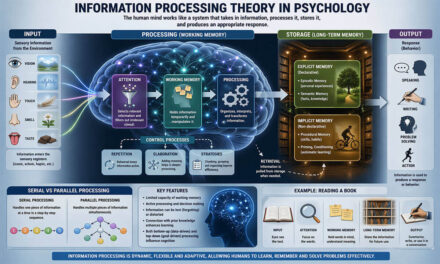
Information processing theories in psychology explain how humans perceive, encode, store, and retrieve information. Emerging from the cognitive revolution of the mid-20th century, these theories compare the human mind to a computer system that processes input, transforms it, and produces output. Early pioneers such as George A. Miller laid the foundation for understanding cognitive limits and memory capacity, while later developments incorporated neuroscientific evidence and computational models to refine these perspectives (Miller, 1956; Association for Psychological Science, 2012). Over time, different types of information processing theories have evolved, each offering unique insights into how cognition operates. This article explores the major types of information processing theories in psychology, integrating both classical and contemporary viewpoints.

1. Serial Processing Theory: Serial processing theory proposes that information is processed in a step-by-step, linear sequence, where one cognitive operation must be completed before the next begins. This model reflects early cognitive psychology’s attempt to understand the mind as an organized system with limited capacity. Each stage of processing (such as perception, attention, encoding, and response) occurs in a fixed order, and information flows in a controlled, structured manner.
A key piece of evidence supporting this theory comes from the work of George A. Miller, who demonstrated that human short-term memory has a limited capacity of about seven items, plus or minus two (Miller, 1956). This limitation suggests that individuals cannot process large amounts of information simultaneously, reinforcing the idea of sequential handling. For instance, when solving a complex mathematical problem, a person typically follows a series of logical steps rather than processing all components at once.
Serial processing is particularly evident in tasks requiring focused attention and conscious control, such as reading unfamiliar material, learning a new skill, or performing detailed analysis. In such cases, the brain prioritizes accuracy over speed, ensuring that each step is carefully executed. However, this theory has been criticized for being too rigid, as it does not fully account for the brain’s ability to handle multiple streams of information in real-world situations.
2. Parallel Processing Theory: Parallel processing theory offers a contrasting perspective, suggesting that the brain can process multiple pieces of information simultaneously. Rather than following a strict sequence, different cognitive processes occur at the same time, often across various regions of the brain. This allows for faster and more efficient handling of complex stimuli.
Research in cognitive neuroscience strongly supports this model. For example, studies on visual attention show that the brain processes different features of a stimulus (such as color, shape, and motion) at the same time rather than sequentially (Li et al., 2020). This explains how individuals can quickly recognize objects in their environment without consciously analyzing each feature step by step.
Furthermore, computational models of the brain, such as hierarchical neural networks, demonstrate that parallel processing can coexist with serial mechanisms. Agliari et al. (2015) found that neural systems are capable of dynamically switching between parallel and sequential processing depending on task complexity and cognitive demand. This flexibility makes parallel processing a more realistic representation of everyday cognition.
In practical terms, parallel processing is evident when people multitask, such as driving while listening to music or engaging in conversation. Although the brain can handle multiple tasks simultaneously, performance may decline if tasks compete for the same cognitive resources. Thus, while parallel processing enhances efficiency, it is not without limitations.
3. Stage Models of Information Processing: Stage models of information processing describe cognition as a system in which information passes through a series of distinct stages, each with specific functions and characteristics. These models are among the most influential frameworks in cognitive psychology and provide a structured way to understand how information is transformed and stored.
The classic stage model includes three main components:
- Sensory Memory: This is the initial stage where sensory information is briefly registered. It has a very short duration (milliseconds to a few seconds) and serves as a buffer for incoming stimuli.
- Short-Term (Working) Memory: Information that receives attention moves into this stage, where it is actively processed. However, its capacity is limited, as highlighted by Miller’s (1956) findings and later refined by Cowan (2015), who suggested that only a few items can be actively maintained at once.
- Long-Term Memory: Information that is sufficiently processed is stored in long-term memory, where it can remain for extended periods, potentially for a lifetime.
These stages are interconnected, and information must pass through each level to be effectively retained. For example, when a student studies for an exam, the material is first perceived (sensory memory), then actively rehearsed (working memory), and finally encoded into long-term memory.
Cowan (2015) further emphasized that working memory is not a separate system but rather a subset of activated long-term memory, highlighting the dynamic nature of these stages. Modern interpretations also suggest that the boundaries between stages are more flexible than originally thought, with continuous interaction and feedback occurring between them.
Generally, stage models provide a foundational framework for understanding how information is processed, stored, and retrieved, making them essential for both theoretical and practical applications in psychology and education.
4. Connectionist (Neural Network) Models: Connectionist models, also known as neural network models, represent a significant shift from earlier, rigid theories of information processing toward more flexible and biologically grounded approaches. These models simulate the structure and functioning of the human brain by using networks of interconnected units, often compared to neurons. Information is processed through patterns of activation across these networks rather than through fixed, step-by-step stages.
In this framework, learning occurs by strengthening or weakening the connections between units based on experience. This process is often referred to as “distributed processing,” meaning that information is not stored in a single location but across multiple interconnected nodes. As a result, knowledge is represented in patterns rather than discrete symbols.
Agliari et al. (2015) demonstrated that hierarchical neural networks are capable of performing both serial and parallel processing. This finding is particularly important because it bridges the gap between earlier theories, showing that cognitive processing is not limited to one mode but can adapt depending on the nature of the task. For example, recognizing a familiar face involves rapid, parallel activation of multiple features, while solving a logical puzzle may involve more sequential processing within the same network.
Connectionist models are widely used to explain complex cognitive phenomena such as language acquisition, pattern recognition, and decision-making. They also align closely with advances in artificial intelligence, making them highly relevant in contemporary cognitive science.
5. Levels of Processing Theory: The levels of processing theory shifts the focus from where information is stored to how it is processed. Proposed by Craik and Lockhart, this theory argues that memory retention depends on the depth of processing applied to information rather than on distinct memory stages.
According to this theory, processing occurs along a continuum:
- Shallow Processing: Involves surface-level characteristics, such as the physical appearance or sound of words. This type of processing leads to weak memory traces and is easily forgotten.
- Deep Processing: Involves semantic understanding, meaningful interpretation, and the formation of associations. This leads to stronger, more durable memory traces.
The core idea is that the deeper the level of cognitive engagement, the better the retention of information. For example, simply repeating a word (shallow processing) is less effective than relating it to personal experiences or understanding its meaning (deep processing).
Neuroscientific research supports this perspective. Liu et al. (2021) found that transformative neural representations (those involving meaningful reorganization of information) play a crucial role in long-term episodic memory. This suggests that deeper processing not only enhances memory but also changes how information is encoded at the neural level.
The levels of processing theory has important implications for education, emphasizing strategies such as elaboration, critical thinking, and meaningful learning over rote memorization.
6. Dual-Process Theory: Dual-process theory proposes that human cognition operates through two distinct but interacting systems. These systems differ in terms of speed, effort, and level of consciousness:
- System 1: Fast, automatic, and intuitive. It operates with little conscious effort and is responsible for quick judgments and immediate reactions.
- System 2: Slow, deliberate, and analytical. It requires conscious effort and is used for complex reasoning, problem-solving, and decision-making.
This theory helps explain how people can function efficiently in everyday life while still being capable of deep, reflective thinking when necessary. For instance, recognizing a familiar face happens almost instantly through System 1, whereas solving a mathematical equation requires the deliberate effort of System 2.
Dual-process theory integrates elements of both serial and parallel processing. Automatic processes often occur in parallel, allowing rapid responses, while controlled processes tend to follow a more sequential pattern. This interaction allows for flexibility in cognition, enabling individuals to adapt to different situations.
However, the theory also highlights potential cognitive biases. Because System 1 relies on heuristics (mental shortcuts), it can sometimes lead to errors in judgment, especially when deeper analysis is required but not engaged.
7. Neurobiological Information Processing Models: Neurobiological models of information processing focus on the underlying brain mechanisms that support cognitive functions. These models integrate findings from neuroscience, emphasizing how neural structures, synaptic activity, and biochemical processes contribute to perception, memory, and learning.
According to Mujawar et al. (2021), memory formation involves complex interactions between neurons, including synaptic plasticity; the brain’s ability to strengthen or weaken connections based on experience. This adaptability is essential for learning and long-term memory storage.
Additionally, research indicates that different brain regions are specialized for different types of processing. For example, the hippocampus plays a critical role in memory consolidation, while the prefrontal cortex is involved in decision-making and executive functions. Liu et al. (2021) further showed that long-term episodic memory is supported by transformative neural representations, highlighting the dynamic and reconstructive nature of memory.
Neurobiological models also support the idea that information processing is not static but constantly evolving. The brain reorganizes itself in response to new experiences, a phenomenon known as neuroplasticity. This has important implications for education, rehabilitation, and mental health, as it suggests that cognitive abilities can be developed and improved over time.
Overall, these models provide a comprehensive and scientifically grounded understanding of how information is processed, linking psychological theories with biological evidence.
In conclusion, information processing theories in psychology have evolved significantly, from early serial models emphasizing linear processing to complex frameworks integrating parallel processing, neural networks, and neurobiological mechanisms. Each type of theory contributes a unique perspective, helping to explain how humans perceive, interpret, and respond to the world. While no single theory fully captures the complexity of human cognition, together they provide a comprehensive framework for understanding mental processes. Advances in neuroscience and computational modeling continue to refine these theories, offering deeper insights into how the brain processes information. Ultimately, information processing theories remain central to cognitive psychology, shaping research, education, and practical applications in fields such as artificial intelligence, learning sciences, and mental health.
Frequently Asked Questions (FAQs):
What is information processing theory in psychology?
Information processing theory is a cognitive framework that explains how humans perceive, interpret, store, and retrieve information. It compares the human mind to a computer system that takes in input, processes it through various stages, and produces output. This theory has its roots in the cognitive revolution and is strongly influenced by early research on memory and attention.
What is the difference between serial and parallel processing?
Serial processing involves handling information in a step-by-step, sequential manner, where one task must be completed before the next begins. In contrast, parallel processing allows multiple pieces of information to be processed simultaneously. While serial processing is useful for tasks requiring focused attention, parallel processing is more efficient for handling complex or multi-dimensional stimuli.
What are the main stages of information processing?
The classic stage model includes three main stages:
- Sensory Memory: Briefly holds incoming sensory information.
- Short-Term (Working) Memory: Actively processes information with limited capacity.
- Long-Term Memory: Stores information for extended periods.
These stages work together to transform raw sensory input into meaningful knowledge.
Why is working memory capacity limited?
Working memory has a limited capacity due to cognitive and neurological constraints. Early research suggested a limit of about seven items (Miller, 1956), while more recent studies argue that the capacity may be even smaller when attention is strictly controlled (Cowan, 2015). This limitation ensures efficient processing but also requires strategies like chunking to manage information effectively.
What are the levels of processing theory?
The levels of processing theory suggests that memory retention depends on how deeply information is processed. Shallow processing (e.g., focusing on appearance or sound) leads to weaker memory, while deep processing (e.g., understanding meaning) results in stronger, long-lasting memory. This approach emphasizes the quality of cognitive engagement rather than the structure of memory systems.
How do neural networks explain information processing?
Neural network (connectionist) models explain information processing as patterns of activation across interconnected units, similar to neurons in the brain. These models show that the brain can perform both serial and parallel processing depending on the situation, making them more flexible and realistic than earlier theories.
What is dual-process theory in simple terms?
Dual-process theory suggests that human thinking operates through two systems:
- A fast, automatic system (intuitive thinking)
- A slow, deliberate system (analytical thinking)
This explains why people can make quick decisions in everyday situations but also engage in careful reasoning when needed.
How does neuroscience contribute to information processing theory?
Neuroscience provides biological evidence for how information is processed in the brain. It examines neural structures, synaptic connections, and brain activity involved in memory and cognition. For example, synaptic plasticity plays a key role in learning and memory formation (Mujawar et al., 2021), while neural representations support long-term memory storage (Liu et al., 2021).
Can information processing theories be applied in education?
Yes, these theories have significant applications in education. Understanding how information is processed helps educators design effective teaching strategies, such as using repetition, meaningful learning, and active engagement to improve memory and comprehension. Techniques like chunking and elaboration are directly based on information processing principles.
Are information processing theories still relevant today?
Absolutely, Information processing theories remain central to cognitive psychology and continue to evolve with advancements in neuroscience and artificial intelligence. Modern research integrates traditional models with biological and computational approaches, making these theories highly relevant in understanding human cognition today.
References:
- Agliari, E., Barra, A., Galluzzi, A., Guerra, F., Tantari, D., & Tavani, F. (2015). Hierarchical neural networks perform both serial and parallel processing. Neural Networks, 66, 22–35. https://doi.org/10.1016/j.neunet.2015.02.010
- Association for Psychological Science. (2012). Remembering the father of cognitive psychology. Retrieved From: https://www.psychologicalscience.org/observer/remembering-the-father-of-cognitive-psychology
- Cowan, N. (2015). George Miller’s magical number of immediate memory in retrospect: Observations on the faltering progression of science. Psychological Review, 122(3), 536–541. https://doi.org/10.1037/a0039035
- Li, K., Kadohisa, M., Kusunoki, M., Duncan, J., Bundesen, C., & Ditlevsen, S. (2020). Distinguishing between parallel and serial processing in visual attention from neurobiological data. Royal Society Open Science, 7(1), 191553. https://doi.org/10.1098/rsos.191553
- Liu, J., Zhang, H., Yu, T., et al. (2021). Transformative neural representations support long-term episodic memory. Science Advances, 7(41), eabg9715. https://doi.org/10.1126/sciadv.abg9715
- Mujawar, S., Patil, J., Chaudhari, B., & Saldanha, D. (2021). Memory: Neurobiological mechanisms and assessment. Industrial Psychiatry Journal, 30(Suppl 1), S311–S314. https://doi.org/10.4103/0972-6748.328839
- Miller, G. A. (1956). The magical number seven, plus or minus two: Some limits on our capacity for processing information. Psychological Review, 63(2), 81–97. https://doi.org/10.1037/h0043158

Meta Psychological Education focuses on the foundational, higher-order skills (meta-skills) that allow individuals to “learn how to learn,” manage their own cognitive processes, and adapt to new situations, often termed meta-learning. It bridges psychological research with practical application in learning and development.