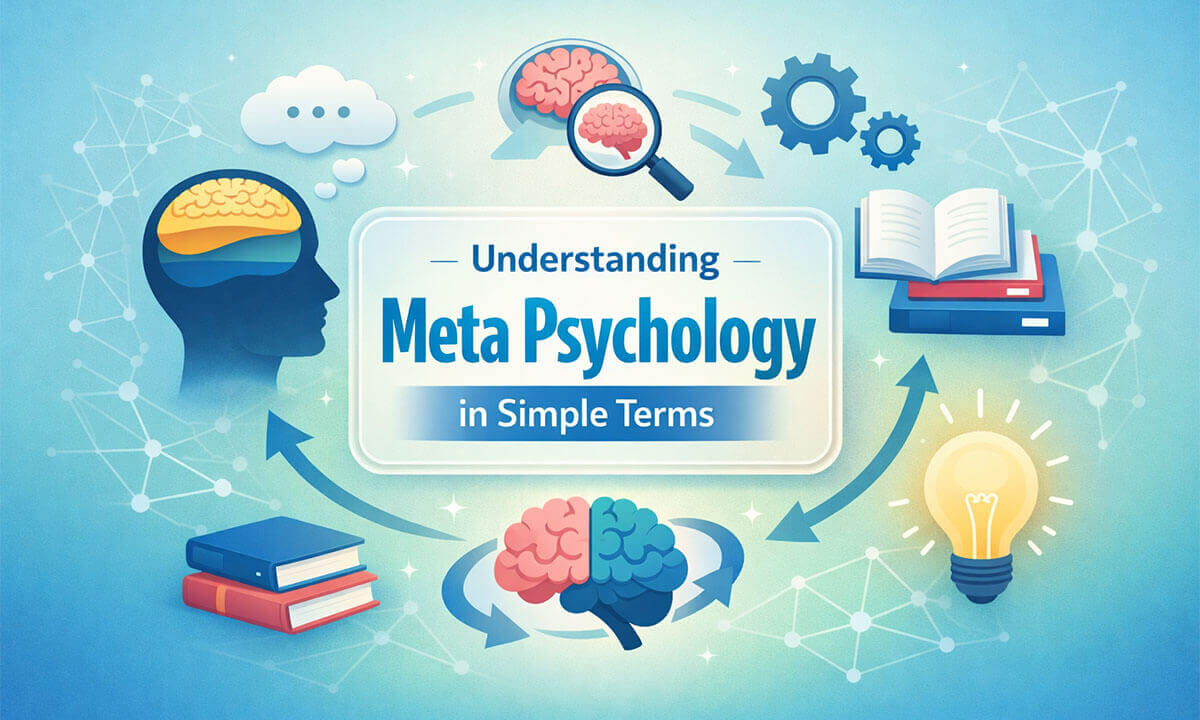
Understanding Meta Psychology in Simple Terms:
Meta Psychology is a higher level branch of psychology that studies how psychological knowledge is formed, structured, and understood. Instead of focusing only on behavior, thoughts, or emotions, it focuses on the theories, assumptions, and methods behind psychology itself. In other words, if psychology studies the mind, Meta Psychology studies how psychologists understand the mind. This makes Meta Psychology an essential foundation for students, researchers, and educators who want a deeper understanding of psychological science. In the rest of this article, we are going to explore the basic understanding Meta Psychology in simple terms.
What Is Meta Psychology?
Meta Psychology is a specialized and higher-order area within psychology that focuses on the foundational structure, assumptions, and theoretical frameworks of psychological knowledge. Instead of studying human behavior, cognition, or emotions directly, Meta Psychology examines how these topics are conceptualized, explained, and scientifically constructed within psychology.
In simple terms, Meta Psychology does not ask, “How does memory work?” or “Why do people behave in certain ways?” Instead, it asks, “How do psychologists define memory?” and “What assumptions are being used to explain human behavior?”
This makes Meta Psychology a reflective and critical discipline, because it steps back from direct psychological study and analyzes the logic behind psychological theories themselves.
Historical Definition and Origin: The concept of Meta Psychology was first introduced by Sigmund Freud, who used it to describe the theoretical framework underlying psychoanalysis. Freud viewed Meta Psychology as the deepest level of psychological explanation, where mental life is interpreted through abstract theoretical models such as unconscious processes, psychic energy, and internal conflicts (Freud, 1915/1963).
For Freud, Meta Psychology was not just observation but a theoretical construction of the mind, aimed at explaining psychological phenomena beyond surface behavior.
Modern Definition of Meta Psychology: In contemporary psychology, the meaning of Meta Psychology has expanded significantly. It is no longer limited to psychoanalysis but now refers to a broader intellectual approach that includes:
- The analysis of psychological theories and models
- The examination of assumptions underlying psychological research
- The study of how psychological knowledge is developed and validated
- The integration of different psychological perspectives into unified frameworks
According to Henriques (2011), modern Meta Psychology aims to create a coherent framework that connects fragmented areas of psychology, allowing the discipline to function as a more unified science.
Core Meaning of Meta Psychology: At its core, Meta Psychology can be understood as the “psychology of psychology” or the study of psychological thinking itself. It investigates three essential dimensions:
1. Conceptual Meaning: It explores how psychological concepts such as intelligence, personality, emotion, and consciousness are defined and used in scientific discourse.
2. Theoretical Meaning: It evaluates the structure and validity of psychological theories, asking whether they are logically consistent and scientifically grounded.
3. Epistemological Meaning: It studies how psychological knowledge is produced, asking questions like:
- How do we know what we know about the mind?
- What methods are considered scientifically valid in psychology?
- Are psychological truths objective or influenced by culture and interpretation?
These dimensions make Meta Psychology both a philosophical and scientific field of reflection.
Why Meta Psychology Is Important: Meta Psychology is essential because psychology itself is a diverse and sometimes fragmented discipline. Different schools of thought (such as behaviorism, cognitive psychology, psychoanalysis, and humanistic psychology) often explain the same behavior in different ways.
Meta Psychology helps by:
- Clarifying differences between psychological theories
- Identifying hidden assumptions in research
- Improving scientific consistency in psychology
- Encouraging integration across psychological approaches
Without Meta Psychology, psychology risks becoming a collection of disconnected theories rather than a unified science.
In simple: Meta Psychology is best understood as the critical and reflective study of psychology itself. It does not focus on behavior directly but instead focuses on how psychological knowledge is created, structured, and interpreted. It serves as a bridge between psychology and philosophy, ensuring that psychological science remains coherent, self-aware, and scientifically grounded.
Key Areas of Meta Psychology:
Meta Psychology is not a single method or theory; rather, it is a multi-dimensional field of reflection that examines how psychological knowledge is constructed, organized, and justified. Its key areas help explain how psychology functions as a science and how different theories, methods, and assumptions interact with one another. Below are the major key areas of Meta Psychology.
1. Theoretical Foundations of Psychology: One of the most important areas of Meta Psychology is the examination of theoretical foundations. This involves analyzing how psychological theories are built and what assumptions they rely on about human nature.
Every psychological theory (whether it is behaviorism, cognitive psychology, psychoanalysis, or humanistic psychology) rests on certain basic beliefs, such as:
- What is the nature of the human mind?
- Are humans driven by unconscious forces, learned behaviors, or conscious choices?
- Can mental processes be fully measured scientifically?
Meta Psychology critically evaluates these assumptions to determine whether they are logically consistent and scientifically meaningful.
For example:
- Behaviorism assumes behavior is shaped only by environmental conditioning
- Cognitive psychology assumes mental processes can be studied like information systems
- Psychoanalysis assumes unconscious forces strongly influence behavior
Meta Psychology compares and evaluates these assumptions to understand how each theory constructs its explanation of human behavior.
2. Epistemology of Psychological Knowledge: Epistemology is the study of how knowledge is acquired and validated, and it is a central part of meta-psychology.
In psychology, epistemology asks:
- What counts as valid psychological knowledge?
- Can human experience be measured objectively?
- Are psychological truths universal or culturally influenced?
Different psychological traditions answer these questions differently:
- Positivist approaches emphasize measurable, objective data
- Constructivist approaches emphasize subjective experience and meaning
- Critical approaches focus on power, culture, and context in knowledge production
Meta Psychology examines these perspectives to understand how psychological knowledge is shaped, limited, or expanded by different epistemological positions (Kuhn, 1962).
3. Methodological Evaluation in Psychology: Another key area of Meta Psychology is the analysis of research methods used in psychology.
Psychological research uses a variety of methods, including:
- Experimental studies
- Surveys and questionnaires
- Clinical case studies
- Observational research
- Qualitative interviews
- Neuroimaging and biological measurements
Meta Psychology evaluates these methods by asking:
- Do these methods accurately capture human psychological reality?
- What are the limitations of each method?
- Are some methods biased or incomplete?
For example, experimental methods provide strong control but may lack real-world complexity, while qualitative methods offer depth but may lack generalizability.
Meta Psychology helps researchers understand these strengths and limitations, leading to more balanced and reliable scientific inquiry.
4. Integration of Psychological Perspectives: Psychology is not a single unified discipline; it consists of multiple schools of thought that often differ in explanation and approach. Meta-psychology plays a key role in integrating these diverse perspectives.
Major psychological approaches include:
- Biological psychology (brain and neurochemistry)
- Cognitive psychology (thinking and information processing)
- Behavioral psychology (learning and conditioning)
- Psychoanalytic psychology (unconscious processes)
- Humanistic psychology (self-growth and meaning)
Each approach explains human behavior from a different angle. Meta Psychology works to:
- Identify connections between these approaches
- Reduce contradictions between theories
- Build a more unified understanding of human behavior
According to Henriques (2011), psychology often suffers from fragmentation, and Meta Psychological integration is essential for creating a coherent scientific discipline.
5. Conceptual Analysis of Psychological Terms: Meta Psychology also focuses on the meaning and use of psychological concepts.
Many Psychological terms are widely used but not always clearly defined. Examples include:
- Intelligence
- Personality
- Emotion
- Consciousness
- Motivation
Meta Psychology examines:
- How these concepts are defined in different theories
- Whether definitions are consistent or conflicting
- How cultural and theoretical contexts shape meaning
For instance, “intelligence” in psychometrics is measured as IQ, while in cognitive psychology it may include problem-solving, memory, and adaptability. Meta-psychology highlights these differences to prevent confusion and oversimplification.
6. Philosophical Reflection on Psychology: Meta psychology is deeply connected to philosophy, especially the philosophy of mind and science.
- What is the relationship between mind and brain?
- Is psychology a natural science or a social science?
- Can human behavior be fully explained through scientific laws?
These philosophical reflections help psychologists understand the deeper implications of their work and ensure that psychological science remains intellectually grounded.
The key areas of Meta Psychology (ranging from theoretical analysis and epistemology to methodological evaluation and conceptual clarification) form a comprehensive framework for understanding psychology itself. By studying these areas, psychologists and students gain a deeper awareness of how psychological knowledge is created, tested, and interpreted. Eventually, Meta Psychology strengthens psychology as a discipline by promoting clarity, integration, and critical thinking across all levels of psychological science.
How Meta Psychology Is Developed:
Meta Psychology does not emerge as a single discovery or fixed theory. Instead, it develops gradually through the interaction of philosophy, scientific progress, theoretical debate, and practical application in psychology. It grows as psychologists and scholars continuously reflect on how psychological knowledge is created, tested, and interpreted. Below are the major processes through which Meta Psychology develops.
1. Development from Philosophical Foundations: The roots of Meta Psychology lie deeply in philosophy, especially in the philosophy of mind and epistemology. Long before psychology became a formal science, philosophers were already asking questions about human consciousness, perception, and knowledge.
Key philosophical contributions include:
- René Descartes, who emphasized the distinction between mind and body
- John Locke, who proposed that knowledge comes from experience
- Immanuel Kant, who argued that human perception is shaped by mental structures
These philosophical ideas influenced early psychological thinking by shaping fundamental questions such as:
- What is the nature of the mind?
- How do humans acquire knowledge?
- Can mental processes be studied scientifically?
Meta Psychology develops from these philosophical roots by continuously revisiting and refining these foundational questions (Robinson, 1995).
2. Evolution of Competing Psychological Schools: A major driver of Meta Psychology is the existence of multiple competing schools of thought in psychology. As psychology developed into a scientific discipline, different approaches emerged, each offering a different explanation of human behavior.
Some major schools include:
- Behaviorism: Focus on observable behavior and conditioning
- Psychoanalysis: Focus on unconscious motives and internal conflict
- Cognitive psychology: Focus on mental processes like thinking and memory
- Humanistic psychology: Focus on personal growth and self-actualization
- Biological psychology: Focus on brain and neural mechanisms
These schools often disagree with each other, not only in findings but also in basic assumptions about human nature.
Meta Psychology develops as a response to this diversity by:
- Comparing different theoretical frameworks
- Identifying contradictions and overlaps
- Analyzing underlying assumptions
- Searching for integrative explanations
In this way, Meta Psychology acts as a bridge between competing psychological perspectives.
3. Influence of Scientific and Technological Progress: Meta Psychology also develops through advances in science and technology, especially in areas such as neuroscience, cognitive science, and artificial intelligence.
Modern developments contribute by:
- Providing biological evidence for psychological processes
- Introducing brain imaging techniques (e.g., fMRI, EEG)
- Enhancing data collection and statistical analysis
- Supporting computational models of cognition
These advancements often challenge older psychological theories. For example, findings in neuroscience may question purely behavioral explanations of learning or memory.
As a result, Meta Psychology evolves by continuously re-evaluating psychological theories in light of new scientific evidence.
4. Interdisciplinary Integration: Another important factor in the development of Meta Psychology is its connection with other disciplines. Psychology does not exist in isolation; it overlaps with several fields, including:
- Sociology (social behavior and group dynamics)
- Anthropology (culture and human evolution)
- Linguistics (language and communication)
- Biology (brain and genetics)
- Computer science (artificial intelligence and modeling)
Through interdisciplinary interaction, Meta Psychology develops by:
- Expanding its explanatory frameworks
- Incorporating new concepts and methods
- Understanding human behavior in broader contexts
This integration helps psychology move beyond narrow explanations and toward a more holistic understanding of human behavior and mental processes (Gergen, 2001).
5. Critical Reflection on Psychological Practice: Meta Psychology also develops from real-world psychological practice, especially in clinical and educational settings. Psychologists working in applied environments often notice differences between theoretical models and actual human behavior.
For example:
- A therapy model may not work equally for all clients
- Cultural differences may affect psychological interpretation
- Human behavior may be more complex than theories suggest
These practical experiences lead to:
- Re-evaluation of existing theories
- Development of new therapeutic approaches
- Refinement of psychological models
Thus, Meta Psychology grows through continuous feedback between theory and practice.
6. Academic Debate and Theoretical Criticism: Scientific progress in psychology is driven by debate, criticism, and revision.
- Are psychological theories accurate?
- Do they apply universally or only in specific contexts?
- Are research methods reliable and valid?
Through academic discussion, peer review, and theoretical criticism, psychology evolves over time.
Meta Psychology develops by:
- Analyzing scientific disagreements
- Evaluating competing explanations
- Encouraging refinement of theories
- Promoting intellectual self-awareness in psychology
This critical process ensures that psychology remains a self-correcting and evolving science.
Meta Psychology develops through a continuous and dynamic process involving philosophy, scientific advancement, theoretical diversity, interdisciplinary influence, and practical experience. It does not remain fixed but evolves as psychology itself grows and changes. By reflecting on how psychological knowledge is created and refined, meta-psychology ensures that psychology remains intellectually strong, scientifically grounded, and capable of integrating diverse perspectives into a more unified understanding of human behavior.
Importance of Meta Psychology in Modern Education:
Meta Psychology plays a crucial role in modern education, especially in the teaching and learning of psychology as a scientific and academic discipline. It goes beyond memorizing theories and encourages learners to understand how psychological knowledge is created, structured, and critically evaluated. In today’s rapidly changing academic environment, meta-psychology helps students and educators develop deeper intellectual clarity and analytical thinking. Below are the key reasons why Meta Psychology is highly important in modern education.
1. Develops Critical Thinking Skills: One of the most important contributions of Meta Psychology in education is the development of critical thinking. Instead of accepting psychological theories at face value, students learn to question them by asking:
- What assumptions does this theory rely on?
- Is the evidence scientifically valid?
- Are there alternative explanations?
This process encourages learners to move beyond surface-level understanding and engage in deeper analytical reasoning. As a result, students become more independent thinkers who can evaluate psychological claims logically and scientifically.
2. Enhances Understanding of Psychological Theories: Psychology includes many different schools of thought, such as behaviorism, cognitive psychology, psychoanalysis, and humanistic psychology. These theories often differ in their explanations of human behavior.
Meta Psychology helps students:
- Compare different psychological approaches
- Understand the strengths and limitations of each theory
- Recognize how theories are developed and modified over time
This deeper understanding prevents confusion and helps students see psychology as an interconnected system rather than isolated concepts.
3. Strengthens Research Awareness and Scientific Literacy: In modern education, research plays a central role in psychology. Meta Psychology helps students understand the logic behind psychological research methods, including:
- Experimental designs
- Surveys and questionnaires
- Qualitative studies
- Statistical analysis
It also teaches students to evaluate:
- Whether research methods are reliable
- How data is interpreted
- What limitations exist in scientific findings
This improves scientific literacy and prepares students to engage in high-quality academic research.
4. Bridges Theory and Real-Life Application: A common challenge in psychology education is the gap between theoretical knowledge and real-life application. Meta psychology helps bridge this gap by encouraging students to reflect on how theories apply in real-world situations.
For example:
- Psychological theories in classroom learning
- Clinical applications in mental health treatment
- Workplace behavior and organizational psychology
- Social and cultural influences on behavior
By understanding the deeper structure of psychological knowledge, students can apply it more effectively in practical contexts.
5. Encourages Intellectual Flexibility and Open-Mindedness: Modern education emphasizes adaptability and open-minded thinking. Meta Psychology contributes to this by exposing students to multiple perspectives in psychology.
Instead of promoting a single “correct” view, it teaches that:
- Human behavior can be explained in different ways
- No single theory fully explains all psychological phenomena
- Scientific understanding evolves over time
This helps students develop intellectual flexibility and respect for diverse viewpoints, which is essential in both academic and professional settings.
6. Supports Curriculum Development in Psychology Education: Meta Psychology also plays an important role in designing psychology curricula.
- Organize psychological concepts in a logical structure
- Ensure balance between theory, research, and application
- Integrate different psychological perspectives into teaching materials
According to Henriques (2011), psychology education benefits greatly from integrative frameworks that reduce fragmentation and promote coherence across different subfields.
7. Promotes Self-Reflection and Personal Development: Meta Psychology is not only academic but also reflective.
- How they understand their own thinking processes
- How personal beliefs influence interpretation of psychological concepts
- How knowledge is shaped by experience and context
This reflective practice supports personal development, self-awareness, and emotional intelligence, which are valuable in both academic and everyday life.
Meta Psychology is highly significant in modern education because it transforms psychology from a memorization-based subject into a critical, reflective, and integrative discipline. It strengthens critical thinking, improves research understanding, bridges theory with practice, and promotes intellectual flexibility. By including Meta Psychology in psychology education, institutions can produce learners who are not only knowledgeable but also capable of thinking deeply, analyzing critically, and applying psychological knowledge effectively in real-world contexts.
Applications of Meta Psychology:
Meta psychology is not only a theoretical branch of psychology; it also has wide and meaningful applications across academic, clinical, social, and technological domains. Because it focuses on the foundations, assumptions, and structures of psychological knowledge, it helps improve how psychology is studied, applied, and understood in real-life contexts. Here are the major applications of Meta psychology.
1. Application in Academic Research and Psychological Science: One of the most significant applications of Meta Psychology is in academic research and scientific inquiry. It helps researchers critically evaluate how psychological studies are designed and interpreted.
Meta Psychology is applied in research to:
- Assess the validity of psychological theories
- Identify hidden assumptions in research designs
- Improve methodological accuracy
- Compare competing psychological models
For example, when researchers study memory or intelligence, meta-psychology encourages them to question how these concepts are defined and measured across different studies.
This leads to more rigorous, transparent, and reliable scientific research, reducing bias and improving overall quality in psychological science.
2. Application in Clinical Psychology and Mental Health Practice: Meta Psychology plays an important role in clinical psychology, where therapists and mental health professionals work with diverse human experiences.
In clinical settings, it helps professionals:
- Understand the theoretical basis of different therapy models
- Compare approaches such as Cognitive Behavioral Therapy (CBT), psychoanalysis, and humanistic therapy
- Reflect on the limitations of psychological diagnoses
- Adapt treatment methods to individual and cultural differences
For example, a therapist may recognize that a single theoretical model cannot explain all aspects of a client’s mental health condition. Meta Psychology encourages flexible and reflective practice, improving therapeutic effectiveness.
It also helps clinicians avoid over-reliance on rigid diagnostic categories by promoting a more holistic understanding of human behavior and mental distress.
3. Application in Educational Psychology: In education, Meta Psychology is used to improve both teaching and learning processes. It helps educators understand how psychological principles are constructed and how they can be applied in classrooms.
Applications include:
- Designing effective learning strategies
- Understanding student motivation and cognition
- Evaluating teaching methods critically
- Integrating multiple psychological learning theories
For example, behaviorist approaches may focus on reinforcement, while cognitive approaches focus on mental processing. Meta psychology helps educators combine these perspectives for better learning outcomes.
It also encourages teachers to reflect on how educational theories influence classroom practices and student behavior.
4. Application in Social Psychology and Cultural Studies: Meta psychology is also important in understanding how psychological knowledge interacts with society and culture.
It helps in:
- Analyzing how cultural values shape psychological theories
- Understanding social influences on behavior interpretation
- Examining bias in psychological research across cultures
- Promoting culturally sensitive psychological models
For instance, concepts like personality or intelligence may differ across cultural contexts. Meta Psychology highlights these differences and prevents universal assumptions that may not apply globally.
This makes psychology more inclusive and socially relevant.
5. Application in Artificial Intelligence and Cognitive Science: Modern applications of Meta Psychology extend into artificial intelligence (AI) and cognitive science, where researchers attempt to model human thinking and behavior.
Meta Psychology contributes by:
- Clarifying how mental processes are conceptually defined
- Helping design cognitive models of thinking and decision-making
- Evaluating whether AI systems truly reflect human cognition
- Improving human–machine interaction theories
For example, when designing AI systems that simulate human learning, meta-psychology helps define what “learning” and “intelligence” actually mean in psychological terms.
This ensures that technological models are grounded in accurate psychological theory.
6. Application in Psychological Assessment and Testing: Psychological assessments such as IQ tests, personality inventories, and diagnostic tools also benefit from Meta Psychology.
It helps in:
- Evaluating whether tests measure what they claim to measure
- Identifying cultural or methodological bias in testing
- Improving reliability and validity of assessment tools
- Redefining psychological constructs used in testing
For example, Meta psychology may question whether IQ tests fully capture the complexity of human intelligence or whether alternative models are needed.
This leads to more fair and scientifically accurate assessment systems.
7. Application in Policy Making and Social Development: Meta Psychology also has indirect applications in public policy and social development. Governments and organizations use psychological research to design programs related to:
- Mental health awareness
- Education systems
- Workplace productivity
- Social behavior and community development
Meta Psychology ensures that these policies are based on well-evaluated and critically examined psychological theories, rather than simplified assumptions about human behavior.
This improves the effectiveness and ethical quality of social policies.
The applications of Meta Psychology are broad and impactful, extending across research, clinical practice, education, technology, and public policy. By encouraging critical reflection on how psychological knowledge is created and applied, Meta Psychology strengthens the scientific foundation of psychology and improves its real-world effectiveness. Ultimately, Meta Psychology ensures that psychology remains not only a study of human behavior but also a self-aware and continuously improving discipline.
Challenges in Meta Psychology:
Meta Psychology plays a crucial role in understanding how psychological knowledge is created and structured, but it is also a highly complex and evolving field. Because it operates at a “higher level” of reflection, it faces several theoretical, methodological, and practical challenges that limit its development and application. Below are the major challenges in Meta Psychology.
1. High Level of Abstractness and Complexity: One of the prime challenges in Meta Psychology is its highly abstract nature. Unlike applied psychology, which deals with observable behavior, Meta Psychology focuses on:
- Theories about theories
- Assumptions behind concepts
- Philosophical foundations of knowledge
This makes it difficult for students and even researchers to fully understand and apply.
For example, concepts like epistemology, theoretical integration, and conceptual analysis require advanced philosophical and scientific reasoning. As a result, Meta Psychology is often perceived as complex and less accessible compared to other branches of psychology.
2. Lack of Universal Agreement Among Scholars: Another main challenge is the absence of a single, universally accepted framework in Meta Psychology.
Different scholars and psychological traditions interpret Meta Psychology in different ways:
- Freud emphasized unconscious structures and theoretical models
- Modern integrative psychologists focus on unifying frameworks
- Philosophical approaches emphasize knowledge and epistemology
Because of these differences, there is no single definition or structure that all psychologists agree upon. This leads to fragmentation and theoretical inconsistency within the field.
3. Fragmentation of Psychological Theories: Psychology itself is highly diverse, and this creates a direct challenge for Meta Psychology. The discipline includes multiple schools of thought, such as:
- Behaviorism
- Cognitive psychology
- Psychoanalysis
- Humanistic psychology
- Biological psychology
Each of these approaches has its own assumptions, methods, and explanations of human behavior.
Meta Psychology attempts to integrate these perspectives, but achieving full integration is difficult because:
- Theories often contradict each other
- Methods differ significantly across approaches
- Each school has its own philosophical foundation
This fragmentation makes it challenging to build a unified Meta Psychological system.
4. Difficulty in Practical Application: While Meta Psychology is valuable theoretically, applying it in real-world settings is often difficult. Unlike clinical or educational psychology, meta-psychology does not directly provide:
- Treatment methods
- Diagnostic tools
- Behavioral interventions
Instead, it works at a conceptual and analytical level.
This creates a gap between theory and practice, where practitioners may find it difficult to use Meta Psychological insights in everyday professional work. As a result, its practical relevance is sometimes underestimated.
5. Overlap with Philosophy of Science: Meta Psychology often overlaps with the philosophy of science, especially in areas such as:
- Epistemology (how knowledge is formed)
- Ontology (nature of reality and mind)
- Scientific methodology
Because of this overlap, there is sometimes confusion about whether Meta Psychology is:
- A part of psychology
- A branch of philosophy
- Or an interdisciplinary field
This lack of clear disciplinary boundaries can create conceptual uncertainty and reduce its academic clarity.
6. Limited Empirical Verification: Another challenge is that many Meta Psychological ideas are not directly testable through empirical methods.
For example:
- Theoretical integration models
- Conceptual frameworks of psychological knowledge
- Philosophical assumptions about mind and behavior
These cannot always be measured or tested using experiments or statistical analysis.
Because psychology increasingly values empirical evidence, this creates tension between:
- Empirical psychology (data-driven)
- Meta Psychology (theory-driven and reflective)
This limits the acceptance of Meta Psychological work in strictly experimental research environments.
7. Educational and Curriculum Limitations: In many academic institutions, Meta Psychology is not taught as a separate or core subject. Instead, it is often:
- Briefly included in advanced theory courses
- Overlooked in undergraduate psychology programs
- Considered too theoretical for practical training
As a result, many students are not fully exposed to Meta Psychological thinking. This limits awareness and slows the development of deeper critical understanding in psychology education.
Meta Psychology faces several important challenges, including its abstract nature, lack of consensus, fragmentation of psychological theories, limited practical application, and overlap with philosophy. Despite these difficulties, these challenges also highlight its importance as a reflective and foundational field. By addressing these issues, Meta Psychology can become more structured, accessible, and integrated into mainstream psychological science, ultimately strengthening the discipline as a whole.
In conclusion, Meta Psychology is a powerful and essential part of psychological science. It helps us understand not only the human mind but also how psychological knowledge itself is created and structured. By studying Meta Psychology, students and researchers gain deeper insight into the foundations of psychology, making them more analytical, reflective, and scientifically aware. At Meta Psychological Education, meta-psychology serves as a core concept for developing advanced psychological understanding and academic excellence.
Frequently Asked Questions (FAQs):
How is Meta Psychology different from psychology?
Psychology studies human behavior, thoughts, and emotions directly. Meta psychology, on the other hand, studies:
- How psychological theories are formed
- What assumptions psychologists use
- How psychological knowledge is validated
In short, psychology studies the mind, while Meta Psychology studies how we study the mind.
Is Meta Psychology a separate branch of psychology?
Meta Psychology is not always treated as a separate branch. It is better understood as a higher-level theoretical and philosophical perspective within psychology that overlaps with philosophy of science and theory development.
How is Meta Psychology used in education?
In education, Meta Psychology helps students and teachers:
- Understand psychological theories deeply
- Develop critical thinking skills
- Analyze research methods
- Connect theory with real-life applications
- Improve learning and teaching strategies
Is Meta Psychology useful in real life?
Yes, Meta Psychology is useful in:
- Clinical psychology and therapy
- Education and teaching
- Research and academic writing
- Artificial intelligence and cognitive science
- Social and cultural analysis
It improves how psychological knowledge is applied in real-world situations.
Can Meta Psychology improve modern psychology?
Yes, Meta Psychology helps modern psychology become more unified, reflective, and scientifically strong by encouraging critical evaluation of theories, methods, and assumptions.
References:
- Freud, S. (1963). The unconscious. In J. Strachey (Ed. & Trans.), The standard edition of the complete psychological works of Sigmund Freud (Vol. 14). Hogarth Press. (Original work published 1915)
- Gergen, K. J. (2001). Social Construction in Context. London: Sage Publications.
- Henriques, G. (2011). A new unified theory of psychology. Springer Science + Business Media. https://doi.org/10.1007/978-1-4614-0058-5
- Kuhn, T. S. (1962). The structure of scientific revolutions. University of Chicago Press: Chicago.
- Robinson, D. N. (1995). An intellectual history of psychology (3rd ed.). University of Wisconsin Press.

Meta Psychological Education focuses on the foundational, higher-order skills (meta-skills) that allow individuals to “learn how to learn,” manage their own cognitive processes, and adapt to new situations, often termed meta-learning. It bridges psychological research with practical application in learning and development.