Freud’s Stages of Human Development:
The theory of psychosexual development proposed by Sigmund Freud remains one of the most influential (and debated) frameworks in psychology. Freud argued that human personality develops through a series of stages in which instinctual energy, or libido, is focused on different erogenous zones of the body. Each stage presents a psychological conflict that must be resolved for healthy personality development. Failure to successfully navigate these stages may result in fixation, which can influence behavior and personality traits later in life (Lantz & Ray, 2022; Silverman, 2017). Freud’s model not only attempted to explain childhood development but also sought to connect early experiences with adult psychological functioning, including emotional patterns, interpersonal relationships, and even mental health conditions (Mistry et al., 2024). In the rest of this article, we will explore Freud’s stages of human development.
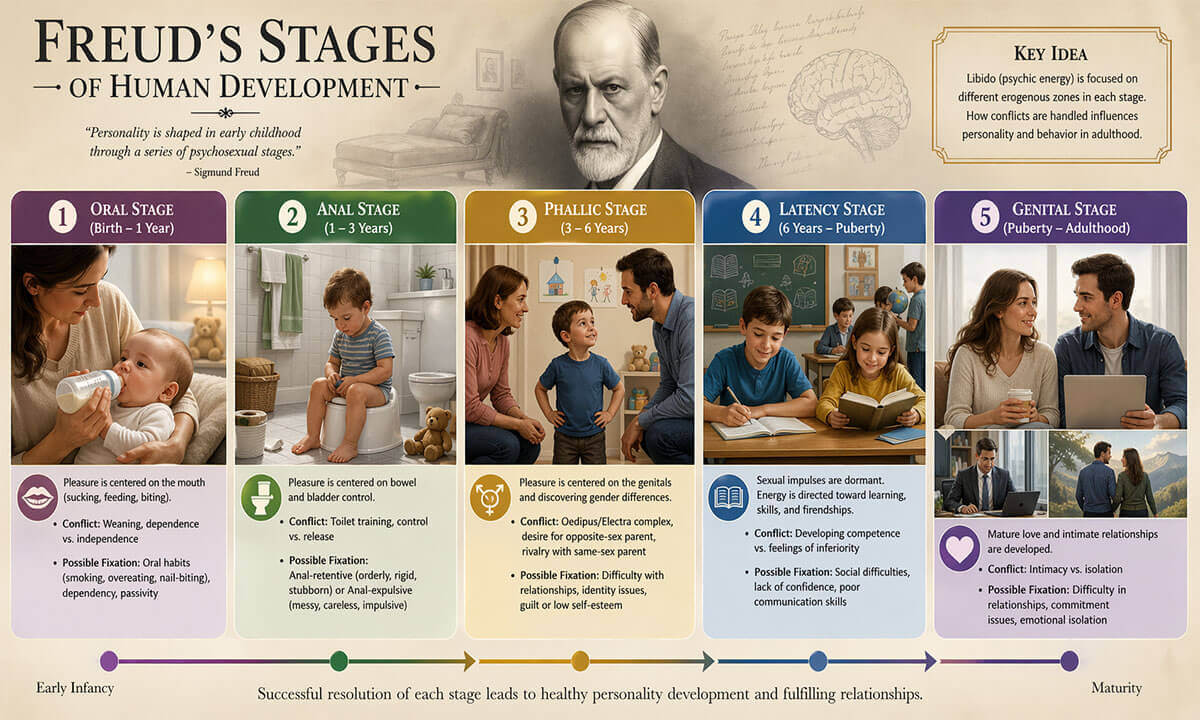
1. Oral Stage (Birth to 1 year): The oral stage is the earliest phase in the psychosexual development theory proposed by Sigmund Freud. During this stage, an infant’s primary source of pleasure and interaction with the world is through the mouth. Activities such as sucking, breastfeeding, bottle-feeding, and even mouthing objects are not merely biological necessities. They are deeply tied to emotional satisfaction and psychological development.
Freud emphasized that the infant is entirely dependent on caregivers, especially the mother or primary nurturer, for nourishment and comfort. This dependency plays a crucial role in shaping the child’s sense of trust, security, and attachment. When caregivers respond consistently and sensitively to the infant’s needs, the child develops a basic sense of safety and confidence in the environment. However, inconsistent or neglectful caregiving may lead to feelings of insecurity and anxiety that can persist into later life (Lantz & Ray, 2022).
A central conflict in this stage involves the process of weaning, transitioning the infant from breast or bottle feeding to other forms of nourishment. Freud believed that how this transition is managed has lasting psychological implications. If weaning occurs too early or too abruptly, the child may experience frustration and deprivation. Conversely, prolonged indulgence may lead to overdependence.
Fixation at the oral stage can manifest in adulthood through behaviors that symbolically relate to oral gratification. These may include habits such as smoking, overeating, nail-biting, or excessive talking. Personality traits associated with oral fixation may include dependency, passivity, or, in some cases, aggression expressed verbally (Silverman, 2017). Thus, the oral stage lays the groundwork for later emotional regulation and interpersonal relationships.
2. Anal Stage (1 to 3 years): The anal stage marks the second phase of development, typically occurring between the ages of one and three years. In this stage, the child’s focus shifts from oral activities to the control of bowel and bladder movements. According to Freud, this period is crucial for the development of self-control, autonomy, and the ability to conform to social expectations.
The central developmental task of this stage is toilet training. This process introduces the child to societal rules and norms, requiring them to regulate their natural bodily impulses. Freud viewed toilet training as the first major conflict between the child’s instinctual desires and external demands. The way caregivers approach this task significantly influences the child’s emerging personality.
If parents adopt a strict or punitive approach, the child may become overly concerned with control and order. This can lead to what Freud described as an “anal-retentive” personality, characterized by traits such as rigidity, perfectionism, stubbornness, and excessive neatness. On the other hand, if parents are overly lenient or inconsistent, the child may develop an “anal-expulsive” personality, associated with disorganization, carelessness, and impulsivity (Haslam, 2016).
Beyond personality traits, the anal stage is also important for fostering a sense of independence. Successfully navigating this stage helps children gain confidence in their abilities and develop a sense of autonomy. However, unresolved conflicts may lead to difficulties in managing control, authority, and responsibility later in life.
In essence, the anal stage highlights how early experiences with discipline and control can shape enduring patterns of behavior and attitudes toward structure, responsibility, and self-regulation.
3. Phallic Stage (3 to 6 years): The phallic stage represents one of the most complex and controversial phases in the theory of Sigmund Freud. Occurring roughly between the ages of three and six, this stage is characterized by a child’s growing awareness of their own body and the differences between males and females. Unlike earlier stages, where pleasure is linked to basic biological functions, this phase involves deeper psychological and emotional dynamics related to identity and relationships.
A central concept in this stage is the Oedipus complex. Freud proposed that boys develop an unconscious attraction toward their mothers and perceive their fathers as rivals for maternal affection. This creates internal conflict, as the child simultaneously fears punishment (often conceptualized as castration anxiety) and desires closeness with the mother. To resolve this tension, the child eventually identifies with the father, adopting his behaviors, values, and gender role.
Although Freud placed less emphasis on girls, later theorists introduced the idea of the Electra complex, in which girls develop attachment toward the father and rivalry with the mother. Regardless of gender, successful resolution of this stage leads to the development of a stable gender identity and the internalization of societal norms and moral values (Boothe, 2017).
However, unresolved conflicts during the phallic stage may result in difficulties with authority, relationships, or self-identity in adulthood. Critics argue that Freud’s explanations are heavily influenced by cultural norms and patriarchal assumptions, and may not universally apply across different societies (Gupta et al., 2023). Despite these criticisms, the stage remains important for understanding how early family dynamics can influence personality formation.
4. Latency Stage (6 years to Puberty): The latency stage is a period of relative calm compared to the earlier, more conflict-driven stages. Spanning from approximately age six until the onset of puberty, this phase is marked by a temporary suppression or dormancy of sexual impulses. Freud believed that the energy previously directed toward erogenous zones is redirected into socially and culturally acceptable activities.
During this time, children focus on developing cognitive abilities, academic skills, and social relationships. School becomes a central environment for growth, where children learn discipline, cooperation, and problem-solving. Friendships (often with peers of the same gender) play a crucial role in shaping social identity and interpersonal skills.
This stage is essential for building confidence and competence. Children begin to compare themselves with others, striving for achievement and recognition. Success in school and peer interactions fosters a sense of industry and self-worth, while repeated failure may lead to feelings of inferiority.
Although Freud described this stage as sexually inactive, modern interpretations suggest that it is more accurate to view it as a time when developmental energy is channeled into learning, creativity, and socialization (Lantz & Ray, 2022). The latency stage thus serves as a bridge between early childhood conflicts and the more mature relationships of adolescence.
5. Genital Stage (Puberty to Adulthood): The genital stage is the final phase of psychosexual development, beginning at puberty and continuing into adulthood. In this stage, sexual impulses re-emerge with greater intensity, but unlike earlier stages, they are directed toward others in a mature and socially appropriate manner. The focus shifts from self-centered gratification to mutual relationships, intimacy, and emotional connection.
According to Sigmund Freud, individuals who have successfully resolved conflicts in earlier stages are able to form healthy romantic and social relationships. They demonstrate emotional balance, responsibility, and the capacity for both love and productive work. This stage reflects psychological maturity, where personal desires are integrated with societal expectations.
However, if earlier conflicts remain unresolved, they may resurface during this stage, affecting relationships and behavior. For example, unresolved oral or anal fixations might manifest in dependency, control issues, or difficulty maintaining stable relationships.
The genital stage also highlights the broader goal of development in Freud’s theory: achieving a well-balanced personality capable of meaningful engagement with the world. While Freud’s emphasis on sexuality has been widely debated, his recognition of the importance of early experiences in shaping adult life continues to influence modern psychological thought (Silverman, 2017).
In conclusion, Freud’s stages of human development provide a foundational perspective on how early experiences shape personality and behavior. By outlining the oral, anal, phallic, latency, and genital stages, Freud offered a structured way to understand the complex interplay between biological drives and social expectations. While contemporary psychology has moved beyond many of Freud’s original claims, his theory remains historically significant and intellectually stimulating. It continues to inspire discussion, critique, and further research into the nature of human development, reminding us that childhood experiences play a crucial role in shaping who we become as adults.
Frequently Asked Questions (FAQs):
Does Freud’s theory hold up today?
The theory developed by Sigmund Freud is still widely discussed, but it is considered controversial in modern psychology. When Freud first introduced his ideas in the late 19th and early 20th centuries, they were bold and groundbreaking. Today, however, psychologists evaluate his work more critically.
Several major criticisms have emerged. First, the theory focuses heavily on male development, with relatively limited attention to female psychological experiences. Second, many of Freud’s concepts (such as the libido or unconscious drives) are difficult to measure scientifically, making the theory hard to test through empirical research. As a result, much modern research has challenged or failed to support his claims.
Another concern is that Freud based much of his theory on case studies of adult patients rather than systematic observation of children. This raises questions about reliability and generalizability. Additionally, critics argue that linking adult behavior directly to early childhood experiences is problematic because the time gap is so large that clear cause-and-effect relationships are difficult to establish.
Despite these criticisms, Freud’s ideas have not been entirely discarded. Contemporary psychoanalytic theories have expanded on his work, especially by emphasizing internalized relationships, emotional development, and the complex ways individuals construct their sense of self. In this sense, Freud’s theory still provides a foundation, even if it is no longer accepted in its original form.
Does Freud’s theory include LGBTQ+ development?
One important limitation of Freud’s psychosexual theory is that it largely excludes LGBTQ+ development. His framework primarily assumes heterosexual development as the standard outcome, with other sexual orientations described as deviations from this path.
Freud’s own views on homosexuality were somewhat complex and, in some ways, progressive for his time. While his theory suggested that non-heterosexual orientations resulted from variations or interruptions in psychosexual development, he did not classify homosexuality as a disease. In fact, he argued against attempts to “cure” individuals of their sexual orientation, recognizing that such efforts were ineffective and potentially harmful.
In a well-known 1935 letter, Freud explicitly stated that homosexuality “cannot be classified as an illness” and should not be considered something shameful. This position distinguished him from many of his contemporaries, who viewed homosexuality as pathological.
However, modern psychology has moved beyond Freud’s developmental explanations. Today, researchers generally understand sexual orientation as influenced by a combination of biological, genetic, and environmental factors rather than as a deviation from a single “normal” developmental path. Consequently, Freud’s framework is considered limited in its ability to explain the diversity of human sexuality.
What is the influence of Freud’s theory on psychology today?
Even though few psychologists fully support Freud’s psychosexual stages today, his contributions have had a lasting impact on the field of psychology. One of his most significant insights was the idea that unconscious processes play a powerful role in shaping human behavior. This concept continues to influence modern therapeutic approaches, including psychoanalysis and psychodynamic therapy.
Freud also emphasized the importance of early childhood experiences in personality development. While contemporary researchers debate the extent of this influence, there is broad agreement that early life events (such as attachment, caregiving, and social environment) have long-term effects on emotional and psychological development.
Moreover, Freud’s work opened the door for deeper exploration of personality, motivation, and mental health. His theories encouraged psychologists to look beyond observable behavior and consider internal mental processes, laying the groundwork for many later developments in psychology.
What is meant by “fixation” in Freud’s theory?
In the theory proposed by Sigmund Freud, fixation refers to a situation in which an individual becomes psychologically “stuck” at a particular stage of development. This typically occurs when conflicts in that stage are either unresolved or overindulged.
For example, difficulties during the oral stage may lead to habits like smoking or overeating, while issues in the anal stage may result in excessive neatness or disorganization. Fixation suggests that early childhood experiences continue to influence adult personality and behavior in subtle but persistent ways. Although modern psychology does not fully support this idea, it remains a useful concept for understanding how early patterns can shape later tendencies.
Why did Freud emphasize sexuality so much in development?
Freud used the term “sexuality” in a broader sense than it is commonly understood today. For him, it referred to the pursuit of pleasure and the release of psychological tension, not just adult sexual behavior.
He believed that from infancy onward, humans seek pleasure through different parts of the body (erogenous zones), and this drive plays a central role in development. While this emphasis was revolutionary at the time, it has also been one of the most criticized aspects of his theory. Many modern psychologists argue that Freud overemphasized sexuality while underestimating social, cultural, and cognitive influences on development.
How does Freud’s theory compare to modern developmental theories?
Freud’s theory differs significantly from modern approaches in psychology. While Freud focused on unconscious drives and early childhood experiences, contemporary theories (such as cognitive, behavioral, and social development theories) emphasize observable behavior, learning processes, and environmental influences.
For instance, modern developmental psychologists often rely on empirical research and longitudinal studies, which provide measurable and testable evidence. In contrast, Freud’s ideas are more interpretive and based on clinical observations. However, both perspectives share a recognition that early life experiences play an important role in shaping personality.
What role do parents play in Freud’s stages of development?
Parents and caregivers are central to Freud’s theory. According to Sigmund Freud, the way parents respond to a child’s needs during each stage significantly influences psychological development.
For example, sensitive caregiving during the oral stage fosters trust, while balanced discipline during the anal stage promotes autonomy and self-control. In the phallic stage, the child’s relationship with parents helps shape identity and moral development. Freud believed that both excessive strictness and excessive leniency could lead to developmental problems, highlighting the importance of balanced parenting.
Is Freud’s theory still used in education or counseling?
While Freud’s exact stages are not widely used in modern educational practice, his ideas still influence counseling and psychotherapy, particularly in psychodynamic approaches. Therapists may explore early childhood experiences, unconscious motivations, and unresolved conflicts; concepts rooted in Freud’s work.
In education, his theory indirectly contributes to understanding emotional development and the importance of early childhood environments. Teachers and counselors may not explicitly apply psychosexual stages, but they often recognize that early experiences affect learning, behavior, and social interaction.
Can Freud’s stages explain personality differences?
Freud believed that personality differences arise largely from how individuals resolve conflicts at each stage of development. For example, someone who experienced strict discipline during the anal stage might develop a highly organized and perfectionistic personality, while another person might become more relaxed or disorganized.
Although modern psychology explains personality through a combination of genetics, environment, and cognitive processes, Freud’s theory offers an early framework for understanding how personality may develop over time. It highlights the idea that individual differences are not random but rooted in developmental experiences.
What is the biggest contribution of Freud’s developmental theory?
Perhaps the most enduring contribution of Sigmund Freud is the idea that unconscious processes influence human behavior. Before Freud, much of psychology focused only on observable actions.
Freud introduced the notion that hidden thoughts, desires, and early experiences shape how people think, feel, and behave. He also emphasized that childhood is a critical period for personality development. Even though many of his specific claims are debated today, these broader insights continue to influence psychology, psychotherapy, and even fields like education and literature.
References:
- Boothe, B. (2017). Oedipus complex. In V. Zeigler-Hill & T. K. Shackelford (Eds.), Encyclopedia of Personality and Individual Differences (pp. 1–5). Springer International Publishing. https://doi.org/10.1007/978-3-319-28099-8_1405-2
- de Kuyper, E. (1993). The Freudian Construction of Sexuality: The Gay Foundations of Heterosexuality and Straight Homophobia. Journal of Homosexuality, 24(3–4), 137–144. https://doi.org/10.1300/J082v24n03_10
- Gupta, M., Madabushi, J. S., & Gupta, N. (2023). Critical overview of patriarchy, its interferences with psychological development, and risks for mental health. Cureus, 15(6), e40216. https://doi.org/10.7759/cureus.40216
- Haslam, N. (2016). Anal expulsive/anal retentive personality. In V. Zeigler-Hill & T. K. Shackelford (Eds.), Encyclopedia of Personality and Individual Differences (pp. 1–2). Springer International Publishing. https://doi.org/10.1007/978-3-319-28099-8_1357-1
- Lantz, S. E., & Ray, S. (2022). Freud’s developmental theory. In StatPearls. StatPearls Publishing.
- Mistry, L. N., Neelkanthan, S., Deshpande, S. S., Jawdekar, A. M., Shah, P. P., & Khachane, N. A. (2024). Matters of the mind: A look into the life of Sigmund Freud. Cureus, 16(10), e71562. https://doi.org/10.7759/cureus.71562
- Silverman, D. K. (2017). Psychosexual stages of development (Freud). In V. Zeigler-Hill & T. K. Shackelford (Eds.), Encyclopedia of Personality and Individual Differences (pp. 1–5). Springer International Publishing. https://doi.org/10.1007/978-3-319-28099-8_1417-1

Meta Psychological Education focuses on the foundational, higher-order skills (meta-skills) that allow individuals to “learn how to learn,” manage their own cognitive processes, and adapt to new situations, often termed meta-learning. It bridges psychological research with practical application in learning and development.