Information Processing Theory in Psychology:
Information Processing Theory (IPT) is one of the most influential frameworks in modern cognitive psychology. Emerging during the cognitive revolution of the mid-20th century, it conceptualizes the human mind as a system that receives, processes, stores, and retrieves information; much like a computer. Early pioneers such as George A. Miller helped establish the foundations of this theory by examining the limits and structure of human memory. Over time, IPT has expanded through interdisciplinary contributions from neuroscience, artificial intelligence, and experimental psychology, offering a comprehensive model for understanding cognition, learning, and behavior. In the rest of this article, we will explore Information Processing Theory in psychology.

1. The Core Concept of Information Processing: Information Processing Theory begins with a simple but powerful idea: the human mind works in a structured, step-by-step way to handle information from the environment. Instead of viewing people as passive responders to stimuli, this theory presents individuals as active processors who interpret, organize, and transform incoming data into meaningful knowledge.
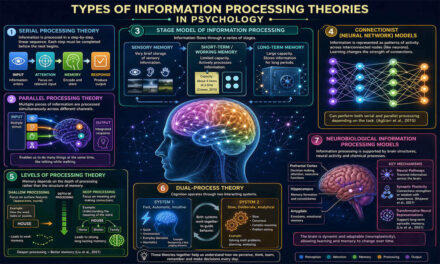
The process typically involves four key stages: input, processing, storage, and output. When a person encounters a stimulus (such as reading a sentence or hearing a sound); it first enters the cognitive system as raw data. The brain then interprets this information by connecting it with prior knowledge, organizing it into meaningful patterns, and deciding how to respond. Finally, the processed information may be stored for future use or expressed through behavior.
What makes this model particularly compelling is its similarity to how computers operate. However, unlike machines, human cognition is flexible, adaptive, and influenced by experience. For example, two individuals may interpret the same information differently based on their background knowledge or expectations. This highlights that information processing is not purely mechanical; it is shaped by learning, context, and cognitive strategies.
2. Sensory Memory and Attention: The first stage of processing begins with sensory memory, a system that briefly holds information exactly as it is received from the environment. This stage acts as a temporary buffer, allowing the brain to capture a snapshot of sensory input before deciding what to do with it. Visual information (iconic memory) may last less than a second, while auditory information (echoic memory) can persist slightly longer.
However, the human brain is constantly bombarded with more information than it can handle. This is where attention plays a crucial role. Attention functions as a selective filter, determining which pieces of information move forward for deeper processing and which are discarded. Without this filtering mechanism, cognitive overload would make meaningful thinking nearly impossible.
Importantly, attention is not a fixed or uniform process. Research suggests that the brain can process information both sequentially and simultaneously. For instance, some tasks require focused, step-by-step attention, while others allow multiple stimuli to be processed at once. Neurobiological evidence supports this flexibility, showing that attention can shift between serial and parallel processing depending on task demands (Li et al., 2020).
This adaptability demonstrates that attention is not just a gatekeeper but an intelligent system that prioritizes information based on relevance, goals, and environmental demands.
3. Working Memory and the “Magical Number”: Once information passes through the attentional filter, it enters working memory; a limited-capacity system responsible for holding and manipulating information for short periods. Working memory is essential for everyday cognitive tasks such as problem-solving, reasoning, and comprehension. For example, when solving a math problem mentally, you rely on working memory to hold intermediate steps while calculating the final answer.
One of the most influential ideas in this area comes from George A. Miller, who proposed that the average person can hold about seven units of information (plus or minus two) in immediate memory. This concept, often referred to as the “magical number,” became a foundational principle in cognitive psychology.
However, later research has challenged and refined this estimate. Cowan (2015) argued that when rehearsal and chunking are controlled, the true capacity of working memory is closer to four meaningful units. This suggests that earlier estimates may have been inflated due to the use of strategies that group information into larger, more manageable chunks.
Despite its limitations, working memory is highly dynamic. It not only stores information temporarily but also interacts with long-term memory to retrieve relevant knowledge. This interaction allows individuals to make sense of new information by linking it with what they already know.
4. Long-Term Memory and Encoding: Long-term memory represents the final and most enduring stage of the information processing system. Unlike working memory, it has an almost unlimited capacity and can store information for extended periods, ranging from minutes to an entire lifetime. This system includes different types of memory, such as episodic memory (personal experiences), semantic memory (facts and knowledge), and procedural memory (skills and actions).
The transition from working memory to long-term memory depends on encoding; the process of transforming information into a form that can be stored and later retrieved. Encoding is most effective when the information is meaningful, organized, and connected to existing knowledge. Techniques such as elaboration, visualization, and repetition can significantly enhance this process.
Recent advances in neuroscience provide deeper insight into how long-term memory works. Rather than being stored in a single location, memories are distributed across networks of neurons in the brain. These networks are continuously reshaped through experience, making memory a dynamic and reconstructive process rather than a static one. Research indicates that transformative neural representations play a key role in stabilizing and retrieving episodic memories (Liu et al., 2021).
This understanding shifts the view of memory from a simple storage system to a complex, evolving process that is influenced by both biological mechanisms and cognitive activity.
5. Neurobiological Foundations of Memory: While Information Processing Theory was originally developed as a cognitive model, modern research has firmly grounded it in neurobiology. Memory and information processing are not abstract processes alone; they are supported by complex brain structures and neural mechanisms. Key regions such as the hippocampus, prefrontal cortex, and amygdala play essential roles in encoding, storing, and retrieving information.
At the cellular level, memory formation depends on synaptic plasticity, which refers to the brain’s ability to strengthen or weaken connections between neurons based on experience. This process allows learning to occur and ensures that frequently used pathways become more efficient over time. Neurotransmitters such as glutamate and dopamine also contribute to memory consolidation and retrieval.
Mujawar et al. (2021) emphasize that memory involves coordinated activity across neural circuits rather than isolated brain regions. This interconnected system supports different types of memory, from short-term working memory to long-term storage. Understanding these biological mechanisms strengthens Information Processing Theory by linking cognitive functions with physical processes in the brain, making the theory more comprehensive and scientifically grounded.
6. Serial vs. Parallel Processing: One of the most important developments in Information Processing Theory is the recognition that the brain does not rely on a single mode of processing. Early models assumed that information was handled in a strictly sequential manner, known as serial processing, where one step must be completed before the next begins. This approach works well for tasks that require careful, step-by-step reasoning, such as solving complex mathematical problems.
However, real-world cognition often involves parallel processing, where multiple streams of information are handled simultaneously. For example, when driving a car, a person can monitor traffic, adjust speed, and listen to music all at the same time. This ability demonstrates the brain’s remarkable efficiency and flexibility.
Contemporary research shows that both serial and parallel processing coexist within the cognitive system. Neural network studies reveal that hierarchical brain structures can switch between these modes depending on task complexity (Agliari et al., 2015). Similarly, neurobiological evidence indicates that attention mechanisms adapt dynamically, enabling either focused or distributed processing (Li et al., 2020).
This dual-processing capacity suggests that human cognition is far more sophisticated than early linear models proposed, allowing individuals to respond effectively to diverse and complex environments.
7. Applications of Information Processing Theory: Information Processing Theory is not limited to academic research; it has significant practical applications across various fields. In education, the theory has transformed teaching methods by emphasizing how students encode, store, and retrieve information. Techniques such as chunking, rehearsal, and meaningful learning are directly derived from this framework and are widely used to improve learning outcomes.
In the field of artificial intelligence, Information Processing Theory has inspired the development of computational models that simulate human thinking. Many machine learning systems are designed based on principles of data input, processing, storage, and output, reflecting the same structure proposed in cognitive psychology.
Clinical psychology also benefits from this theory, particularly in understanding cognitive impairments and memory disorders. By identifying where processing breakdowns occur (whether in attention, encoding, or retrieval), professionals can design targeted interventions.
Additionally, the theory plays a crucial role in human-computer interaction, guiding the design of user interfaces that align with human cognitive limitations. For instance, reducing cognitive load and presenting information in manageable chunks can significantly enhance user experience. These applications demonstrate how Information Processing Theory bridges the gap between theoretical knowledge and real-world practice.
8. Limitations of the Theory: Despite its widespread influence, Information Processing Theory is not without limitations. One of the main criticisms is its reliance on the computer metaphor, which can oversimplify the richness of human cognition. Unlike computers, humans are influenced by emotions, motivations, and social contexts, factors that are not fully captured in traditional processing models.
Another limitation is that early versions of the theory were too linear, suggesting a fixed sequence of stages. Modern research, however, shows that cognitive processes are highly interactive and often occur simultaneously. This complexity is better explained by updated models that incorporate parallel processing and neural network dynamics.
Furthermore, the theory tends to focus heavily on conscious, deliberate processing while giving less attention to unconscious or automatic processes. Many everyday actions, such as habits and intuitive decisions, occur without active awareness, indicating that cognition is not always as structured as the theory suggests.
Nevertheless, these limitations have led to the refinement rather than the rejection of the theory. By integrating insights from neuroscience and other disciplines, Information Processing Theory continues to evolve, maintaining its relevance in contemporary psychological research.
In conclusion, Information Processing Theory remains a cornerstone of cognitive psychology, offering a structured and scientifically grounded framework for understanding how humans think, learn, and remember. From Miller’s early insights into memory capacity to contemporary neurobiological research, the theory has evolved significantly while retaining its core principles. By integrating cognitive, computational, and neural perspectives, IPT provides a powerful lens through which to examine human behavior. Although it is not without limitations, its adaptability and empirical support ensure its continued relevance in psychological research and practical applications.
Frequently Asked Questions (FAQs):
What is Information Processing Theory in simple terms?
Information Processing Theory explains how the human mind takes in information, processes it, stores it, and later retrieves it when needed. It compares the brain to a system that works step by step, similar to how a computer handles data, but with much more flexibility and adaptability.
Who introduced Information Processing Theory?
The theory developed during the cognitive revolution and was influenced by several psychologists and researchers. One of the most important contributors was George A. Miller, who studied the limits of human memory and helped shape early understanding of cognitive processing.
What are the main stages of Information Processing Theory?
The theory generally includes four main stages:
- Input: Receiving information through the senses
- Processing: Interpreting and organizing the information
- Storage: Saving information in memory
- Output: Responding or using the information
These stages work together to help individuals understand and interact with their environment.
What is the difference between working memory and long-term memory?
Working memory is a temporary system that holds and manipulates information for short periods, such as when solving a problem or reading a sentence. In contrast, long-term memory stores information for extended periods, sometimes for a lifetime, and includes knowledge, experiences, and skills.
What is the “magical number” in memory?
The “magical number” refers to the idea that people can hold about 7 (plus or minus 2) pieces of information in their immediate memory. This concept was proposed by George A. Miller, although later research suggests the actual number may be closer to four when measured more precisely (Cowan, 2015).
What is attention and why is it important?
Attention is the process that selects which information from the environment will be processed further. It is important because the brain cannot handle all incoming information at once. Attention helps focus on what is relevant and ignore what is not, preventing cognitive overload.
What is the difference between serial and parallel processing?
Serial processing means handling one piece of information at a time in a step-by-step manner, while parallel processing involves handling multiple pieces of information simultaneously. Research shows that the brain can use both methods depending on the situation (Li et al., 2020).
How is Information Processing Theory used in education?
In education, the theory helps teachers design lessons that improve learning. Strategies such as repetition, chunking, and connecting new information to prior knowledge are based on this theory and help students better understand and remember material.
What are the limitations of Information Processing Theory?
The theory can oversimplify human thinking by comparing it to a computer. It may not fully consider emotions, social influences, or unconscious processes. Additionally, early models were too linear and did not capture the complexity of real cognitive processes.
Why is Information Processing Theory still important today?
Despite its limitations, the theory remains important because it provides a clear and structured way to understand how people think and learn. It continues to evolve with new research in neuroscience and psychology, making it relevant in fields like education, artificial intelligence, and clinical psychology.
References:
- Agliari, E., Barra, A., Galluzzi, A., Guerra, F., Tantari, D., & Tavani, F. (2015). Hierarchical neural networks perform both serial and parallel processing. Neural Networks, 66, 22–35. https://doi.org/10.1016/j.neunet.2015.02.010
- Association for Psychological Science. (2012). Remembering the father of cognitive psychology. Retrieved From: https://www.psychologicalscience.org/observer/remembering-the-father-of-cognitive-psychology
- Cowan, N. (2015). George Miller’s magical number of immediate memory in retrospect: Observations on the faltering progression of science. Psychological Review, 122(3), 536–541. https://doi.org/10.1037/a0039035
- Li, K., Kadohisa, M., Kusunoki, M., Duncan, J., Bundesen, C., & Ditlevsen, S. (2020). Distinguishing between parallel and serial processing in visual attention from neurobiological data. Royal Society Open Science, 7(1), 191553. https://doi.org/10.1098/rsos.191553
- Liu, J., Zhang, H., Yu, T., et al. (2021). Transformative neural representations support long-term episodic memory. Science Advances, 7(41), eabg9715. https://doi.org/10.1126/sciadv.abg9715
- Mujawar, S., Patil, J., Chaudhari, B., & Saldanha, D. (2021). Memory: Neurobiological mechanisms and assessment. Industrial Psychiatry Journal, 30(Suppl 1), S311–S314. https://doi.org/10.4103/0972-6748.328839
- Miller, G. A. (1956). The magical number seven, plus or minus two: Some limits on our capacity for processing information. Psychological Review, 63(2), 81–97. https://doi.org/10.1037/h0043158

Meta Psychological Education focuses on the foundational, higher-order skills (meta-skills) that allow individuals to “learn how to learn,” manage their own cognitive processes, and adapt to new situations, often termed meta-learning. It bridges psychological research with practical application in learning and development.