Understanding STEM Student Academic Help-Seeking Through Psychological Needs Theory:
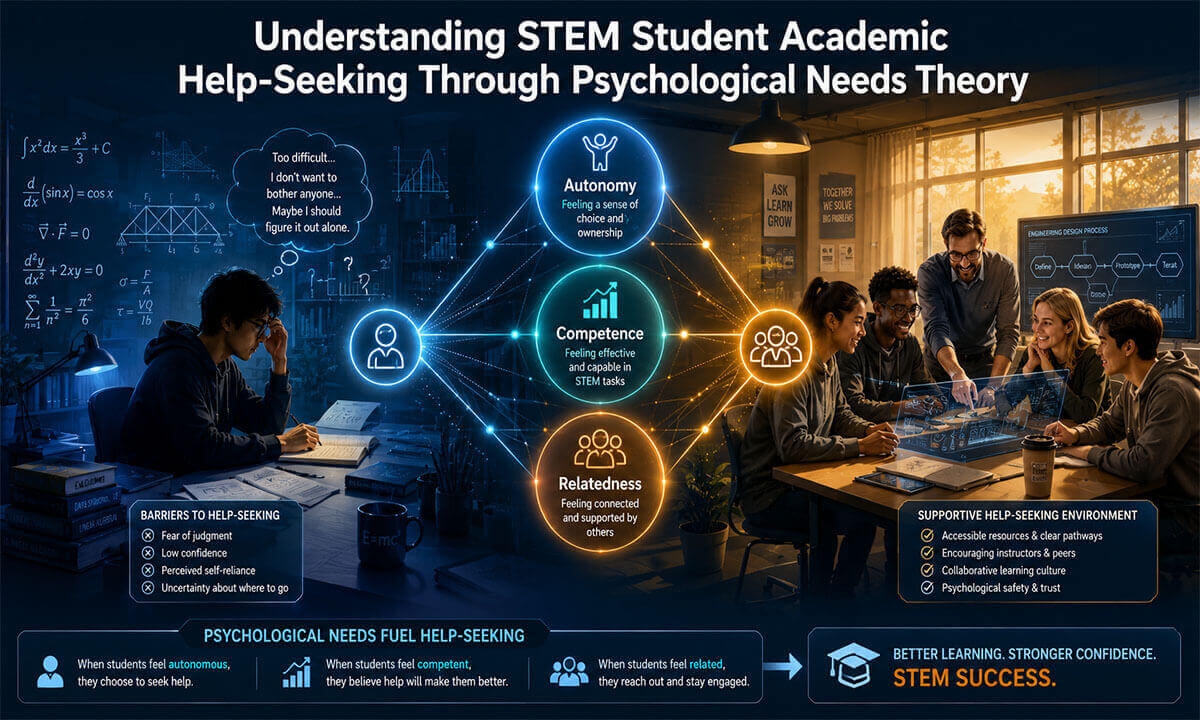
When a student struggles in a difficult college class, the logical solution seems simple: ask for help. Professors hold office hours, universities build tutoring centers, and teaching assistants host review sessions. Yet, in Science, Technology, Engineering, and Math (STEM) fields, thousands of undergraduates choose to suffer in silence rather than raise a hand. This silence isn’t due to laziness or a lack of resources. It is rooted in human psychology. To understand why STEM students frequently avoid asking for help and how we can encourage them to seek it; we have to look through the lens of Basic Psychological Needs Theory (BPNT). In the rest of this article, we will explore the basic understanding STEM student Academic Help-Seeking through psychological needs theory.
Academic Help Seeking:
Students unavoidably experience difficulties and confusion in their assignment and need academic help. From having academic difficulties to actual help seeking, this process functions as a goal-directed activity. According to help seeking process models (Aleven et al., 2006; Nelson-Le Gall, 1981; Newman, 1998a, 1998b), seeking help generally consists of six phases:
- Awareness of the need for help
- A decision to seek help
- A decision about a target person to seek help from (i.e., source)
- A decision about the type of help to seek
- Implementation of help-seeking strategies
- A reaction to help-seeking episode.
Researchers have focused most attention on the types and sources of academic help.
The Three Types of Academic Help-Seeking:
When students run into a difficult problem, they usually fall into one of three distinct categories based on how and why they ask for help:
1. Adaptive Help-Seeking (Asking to Learn): Adaptive help-seekers don’t want you to do the work for them; they want clues, hints, or explanations so they can solve the problem on their own.
- Academic Performance & Emotions: Across all grade levels (from elementary school to college); these students achieve the highest grades. They experience more positive emotions, feel less anxiety, and actively use deep learning strategies like outlining material (organization), connecting new ideas to old ones (elaboration), and checking their own understanding (metacognition).
- Motivation & Goals: They possess a mastery goal orientation, meaning they truly care about understanding the material and improving their skills. They do not worry much about how others judge their intelligence (they have low performance-approach and performance-avoidance goals).
- Psychological Needs & Environment:
- Competence: They feel capable and confident in their ability to learn.
- Relatedness: They feel connected to their teachers and supported both academically and emotionally.
- Classroom Setup: They thrive when teachers emphasize understanding and effort rather than just grades.
2. Expedient Help-Seeking (Asking for the Answer): Expedient help-seekers just want to get the assignment done as fast as possible. They ask for direct answers or let someone else complete the work for them rather than trying to understand the process.
- Academic Performance & Emotions: These students tend to get lower grades than adaptive help-seekers. In college, while they might use basic organization or metacognition, they skip deep learning strategies like elaboration. They often report high levels of anxiety.
- Motivation & Goals: They focus heavily on performance-avoidance; they want to avoid looking incompetent or failing, rather than actually mastering the topic.
- Psychological Needs & Environment:
- Competence: Elementary students in this group feel less competent than adaptive help-seekers, but more competent than those who avoid asking altogether.
- Relatedness: They feel lower support from teachers and peers compared to adaptive help-seekers.
- Classroom Setup: They are more common in classrooms where teachers emphasize test scores and competition (performance goals) over emotional support.
3. Help-Seeking Avoidance (Suffering in Silence): Avoidant help-seekers know they need help, but they refuse to ask for it.
- Academic Performance & Emotions: Their achievement levels are significantly lower than adaptive help-seekers, matching the low performance of expedient help-seekers. They report low self-regulation, low positive emotions, and very high anxiety. While college avoiders might memorize material (rehearsal), they rarely try to connect concepts deeply (elaboration).
- Motivation & Goals: They have low mastery goals and high performance goals. They are terrified that asking a question will expose them as “unsmart” (feeling that help-seeking threatens their self-esteem).
- Psychological Needs & Environment:
- Need Satisfaction: They have the lowest satisfaction across all three basic psychological needs (competence, autonomy, and relatedness). Low competence is the biggest predictor of help-seeking avoidance.
- Classroom Setup: Avoidance is highest when students feel their teachers don’t care about mastery and instead create high-pressure environments focused strictly on performance.
Side-by-Side Comparison:
| Feature | Adaptive Help-Seeking | Expedient Help-Seeking | Help-Seeking Avoidance |
| Primary Goal | Understand the material and solve it independently | Finish the work quickly with minimal effort | Avoid looking incompetent |
| Request Type | Hints, clues, or explanations | Direct answers or completed solutions | No request (silent struggling) |
| Academic Achievement | Highest | Lower | Lower |
| Anxiety Level | Low | High | High |
| Key Learning Strategies | Organization, Elaboration, Metacognition | Basic Organization, Metacognition | Rehearsal, Basic Organization |
| Main Goal Orientation | High Mastery | High Performance-Avoidance | High Performance (Approach & Avoid) |
The Core Sources of Academic Help:
When students get stuck on course materials, their two primary human sources of help are teachers and peers.
Whether a student chooses to ask a teacher or a classmate depends on several factors:
- Helper Personality: Is the person perceived as approachable, patient, or friendly?
- Relationships: Do they feel a personal connection with the helper?
- Perceived Role & Duty: Is it explicitly the person’s job to help? (e.g., “The professor is paid to answer my questions”).
Research shows clear preferences among undergraduates:
- Preference for Peers: Driven by strong, positive social relationships with classmates.
- Preference for Instructors: Driven by how much the student values school, academic rigor, and course outcomes.
The Four Dimensions of Help-Seeking Sources:
To better understand how students choose help, researchers Makara and Karabenick (2013a) created a framework that categorizes help-seeking sources across four key dimensions:
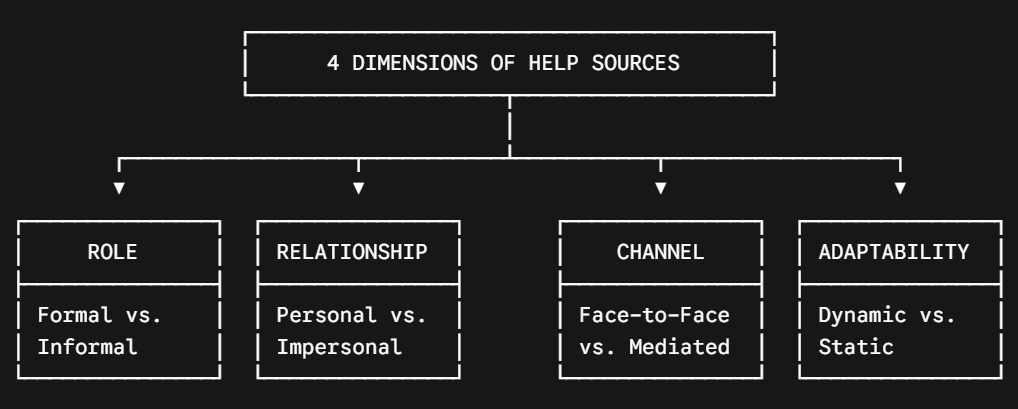
- Role (Formal vs. Informal): Is the person officially designated to help? (e.g., a professor/TA is formal; a study buddy is informal).
- Relationship (Personal vs. Impersonal): Does the student feel close to the helper? (e.g., a close peer is personal; an unfamiliar professor is impersonal).
- Channel (Face-to-Face vs. Mediated): Is the interaction in person or through technology? (e.g., Office hours vs. email/LMS messaging).
- Adaptability (Dynamic vs. Static): Can the response adjust dynamically to the student’s specific confusion? (e.g., a live conversation is dynamic; reading a pre-written FAQ is static).
Examples in Practice:
- In-Person Instructor: Formal, personal, face-to-face, and dynamic.
- Email to Instructor: Formal, personal or impersonal (depending on rapport), technology-mediated, and dynamic.
How Technology Alters Student Preferences:
The widespread adoption of online communication tools (email, messaging apps, learning management systems) has significantly changed how students seek help. Importantly, students treat the same helper differently depending on the medium used.
- In-Person Preference: College students generally prefer asking peers over instructors when talking face-to-face.
- Online Preference: When using technology-mediated tools (e.g., email or online portals), college students prefer reaching out to instructors over peers.
- Overall Preference: When given the absolute choice, students still lean toward asking for help in person rather than online for both instructors and peers.
Why this matters: Measurement tools in academic research must explicitly separate in-person interactions from tech-mediated interactions. Treating “asking a professor” as a single behavior ignores these clear medium-based differences.
Matching Help Sources to Help Types:
The type of help a student needs {adaptive (asking for hints to learn) vs. expedient (asking for direct answers)} also influences who they ask.
- College Students (Karabenick, 2003): While undergraduates generally like asking peers for general guidance, those who want adaptive help (deeply understanding the material) specifically choose instructors over peers.
- High School Students (Pajares et al., 2004): In contrast, high school students in a computer science study didn’t seem to separate teachers from peers when deciding what type of help to ask for. For example, a student looking for a quick, expedient answer was equally likely to ask either a teacher or a peer.
Research Method Controversy & Proposed Solution:
Why did the college study find a clear distinction between teachers and peers, while the high school study did not? There are two main possibilities:
- Age/Grade-Level Differences: College students may have a more mature understanding of academic roles than high schoolers, knowing that professors are better suited for deep mastery while peers are fine for quick checks.
- Methodological Differences: The high school study used Exploratory Factor Analysis (EFA) (a simpler statistical method) which might not have been precise enough to separate teacher-directed behaviors from peer-directed behaviors.
Associations of Academic Help-Seeking with Gender and Grade Level:
1. Gender Differences in Academic Help-Seeking: Research consistently shows that male and female students tend to handle academic challenges differently.
- Female Students: Across elementary, middle, and high school, female students are consistently more likely to practice adaptive help-seeking (asking for guidance to truly learn the material). They are less likely to ask for direct answers just to get the work done quickly, and they are less likely to avoid asking for help entirely.
- Male Students: Male students in K–12 settings are more prone to expedient help-seeking (asking for direct answers) and help-seeking avoidance (refusing to ask for help even when they need it).
2. Grade Level and Developmental Changes: As students grow older and progress through school, their help-seeking behaviors undergo significant shifts—and surprisingly, college students reverse a negative trend seen in younger grades.
The Decline in K–12 (Elementary through High School): As students move from late elementary school into middle and high school, their willingness to seek productive help generally declines:
- Adaptive help-seeking goes down: Adolescents become increasingly reluctant to ask for hints or explanations.
- Expedient help-seeking goes up: Older K–12 students rely more on getting quick answers to finish assignments without mastering the material.
Why this happens: During adolescence, social pressure and self-consciousness peak. Older K–12 students often worry that asking for help will make them look incompetent in front of their peers or teachers.
The College Reversal: Interestingly, higher education breaks this negative trend:
- A study by Won et al. (2019) found that among undergraduate students, advancing to higher grade levels (e.g., seniors vs. freshmen) is positively linked to adaptive help-seeking.
- The Key Factor (Self-Efficacy): As college students mature, they develop greater confidence in managing their own learning (self-efficacy for self-regulated learning). This boost in learning confidence serves as a bridge; it empowers upper-level university students to actively ask for meaningful guidance rather than avoiding help or looking for shortcuts.
Key Takeaways:
- In K–12, girls seek help more productively than boys: Female students favor asking for understanding (adaptive), while male students are more likely to ask for direct answers (expedient) or suffer in silence (avoidant).
- Help-seeking gets worse in K–12, but recovers in college: While teenagers in middle and high school rely less on productive help-seeking, college students reverse this trend as they gain independence and confidence in managing their own learning.
What is Basic Psychological Needs Theory?
Developed by psychologists Edward Deci and Richard Ryan as part of Self-Determination Theory, BPNT suggests that all human beings need three fundamental “psychological nutrients” to stay motivated, mentally healthy, and productive:
- Competence: The feeling that you are capable, effective, and growing in your abilities.
- Autonomy: The feeling that you have control over your choices and ownership of your actions.
- Relatedness: The feeling that you belong, are supported, and matter to a community.
When these three needs are met, students thrive. When they are threatened, students experience anxiety, disengagement, and self-doubt.
The STEM Paradox: Why Seeking Help Feels Like Threatening Your Own Needs:
In an ideal learning environment, seeking help is a healthy, problem-solving behavior. But traditional STEM culture often inadvertently turns asking for help into a psychological risk.
|
The Psychological Barrier |
|
| Psychological Need | How Traditional STEM Environments Create Friction |
| Competence | If I ask for help, it proves I’m not smart enough. |
| Autonomy | Relying on others means losing control of my work. |
| Relatedness | If I show weakness, I won’t fit into this culture. |
- The Threat to Competence: STEM majors are notoriously rigorous, often carrying a culture where intelligence is viewed as an innate trait rather than a developed skill. Students frequently believe that if they were “cut out” for engineering or chemistry, they would figure it out on their own. Admitting they are stuck feels like admitting a lack of basic ability, directly threatening their need for competence.
- The Threat to Autonomy: Undergraduate STEM programs are heavily structured around rigid prerequisites, tight exam schedules, and high-stakes grading curves. Students already struggle with feeling a lack of autonomy. When they feel forced to rely on external help or worry that asking a tutor will mean losing control over their own learning process; they tend to push back by trying to “fix it alone” to maintain independence.
- The Threat to Relatedness: In large lecture halls packed with hundreds of peers, developing genuine social connections is difficult. If a student feels like an outsider (a common issue among underrepresented minorities and women in STEM) asking a question can feel like exposing oneself to judgment. A weak sense of relatedness turns a simple question into a social vulnerability.
Adaptive vs. Maladaptive Help-Seeking:
Psychologists divide student help-seeking into two main styles:
- Adaptive Help-Seeking: The student asks questions to genuinely understand the concept so they can solve future problems independently.
- Maladaptive Help-Seeking: The student either avoids asking for help entirely (suffering in silence) or asks solely for the final answer without trying to learn the underlying material.
Research consistently shows that when a student’s basic psychological needs are met, they lean toward adaptive help-seeking. When those needs are threatened, they slip into maladaptive behaviors.
Self-Determination Theory (SDT):
1. The Core Principles of Self-Determination Theory (SDT): At the heart of Self-Determination Theory is Basic Psychological Needs Theory (BPNT). It states that human beings require three “psychological nutrients” to stay intrinsically motivated—meaning they do tasks out of natural interest and pleasure rather than external pressure.
3 Basic Psychological Needs (SDT):
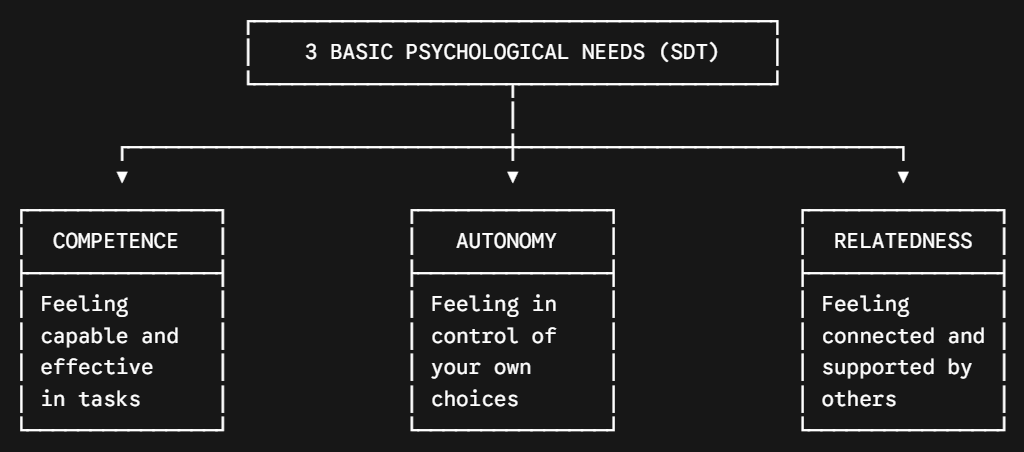
- Competence: Understanding how to achieve desired outcomes and feeling confident in your ability to carry out the required actions.
- Autonomy: Feeling like the author and regulator of your own life and choices (self-initiating).
- Relatedness: Developing secure, satisfying, and meaningful connections with people in your social environment.
BPNT vs. Traditional Drive Theory: Unlike early psychological theories (such as Hull’s Drive Theory, which argued that humans only act to relieve physiological drives like hunger), BPNT argues that people don’t actively go around “chasing” these psychological needs. Instead, when an environment naturally satisfies these three needs, intrinsic motivation, enjoyment, and academic performance automatically rise.
2. Need Satisfaction vs. Need Frustration: A crucial distinction in recent motivation research is that a low level of need satisfaction is NOT the same thing as need frustration.
|
Satisfaction vs. Frustration |
|
| Low Satisfaction (Passive) | Need Frustration (Active) |
| I don’t feel particularly close to my classmates. | My environment actively undermines or blocks me. |
- Need Dissatisfaction (Low Satisfaction): A passive absence of support (e.g., feeling neutral or disconnected).
- Need Frustration (Thwarting): An active, oppressive obstruction of a need by the environment (e.g., a professor actively belittling a student’s intelligence or strictly controlling every step of an assignment).
Why the Distinction Matters:
- Structural Difference: Statistical research shows a 6-factor structure best explains human experience (Satisfaction and Frustration measured separately for Competence, Autonomy, and Relatedness).
- Different Outcomes: Low need satisfaction leads to apathy, but need frustration directly drives exhaustion, negative emotions, and class disengagement.
- The College Gap: While need frustration has been studied in sports, workplace settings, and K-12 classrooms, researchers have rarely examined how need frustration affects college undergraduates, nor how it influences their decisions to seek or avoid academic help.
3. How Psychological Needs Interact with Each Other: Most studies look at the three needs in isolation (main effects). However, in real life, the impact of one need often depends on the level of another need (interaction effects).
Lessons from Organizational Psychology (Dysvik et al., 2013): Research in workplace settings highlights how these needs depend on one another:
- Autonomy acts as a gateway: Competence and relatedness boost intrinsic motivation only when autonomy satisfaction is high. If a person feels no freedom, feeling capable or connected isn’t enough to make them enjoy the work.
- Relatedness buffers low competence: When relatedness is high, intrinsic motivation remains strong even if competence is low. However, if relatedness is low, competence becomes vital for maintaining motivation.
4. Sources of Relatedness: Instructors vs. Peers: Many SDT studies lump “relatedness” into a single score. However, who a student feels connected to (instructors or peers) changes academic outcomes in distinct ways.
The Structural Shift in College Relationships: As students transition from elementary school to university, their access to instructors changes dramatically:
- Elementary School: High contact hours with a single homeroom teacher; easy to build deep relational connections.
- High School: Shorter periods with multiple subject teachers; less individual contact time.
- College/University: Massive lecture halls, brief semester timelines, and fewer contact hours make relationships with professors feel depersonalized and task-specific.
Why College Relatedness Still Matters: Despite the structural barriers at large universities:
- Instructor Connection: When undergraduates perceive instructors as approachable and respectful, their academic motivation and achievement increase significantly.
- Peer Connection: Undergraduates who feel connected to peers are far more likely to form study groups, whereas a lack of peer support leads to lower grades and poor university adjustment.
Key Takeaways:
- Satisfaction and Frustration are Different: Simply lacking support is distinct from having your needs actively blocked. Frustration leads directly to burnout and disengagement.
- Needs Work as a System: Competence and relatedness require a foundation of autonomy to truly unlock intrinsic motivation.
- Source Matters: Connection to professors drives learning focus, while connection to peers buffers stress and enables collaborative study.
How Universities Can Fulfill Psychological Needs:
To help STEM students succeed, universities must shift from simply offering support services to creating environments that make seeking help feel safe and empowering.
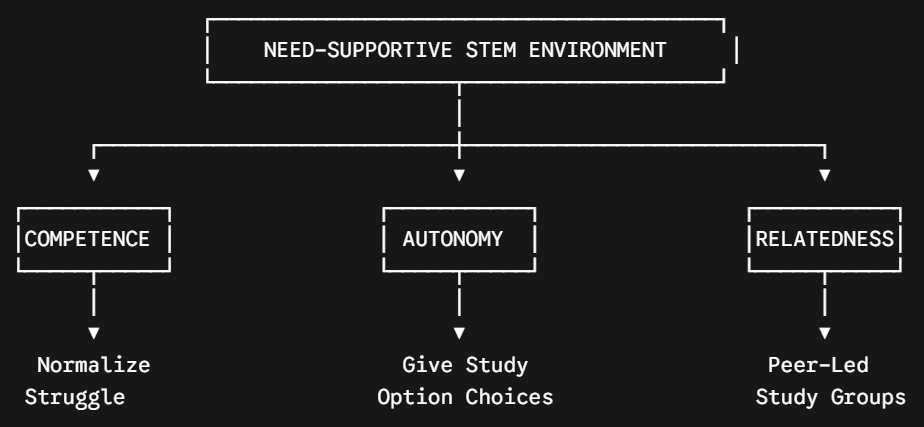
- Frame Struggle as Normal (Nurturing Competence): Professors can actively protect a student’s sense of competence by framing academic challenges as a standard part of scientific growth. When instructors share their own past academic hurdles or design assignments that encourage iterative revision, asking for help becomes a tool for growth rather than a sign of failure.
- Offer Choice and Agency (Nurturing Autonomy): Students need choices in how they access help. Providing a variety of avenues (anonymous discussion boards (like Piazza), peer tutoring, flexible office hours, or self-guided review modules) allows students to choose the support structure that best fits their comfort level and schedule.
- Build Support Communities (Nurturing Relatedness): Building strong relationships with professors and peers is the single most powerful driver of adaptive help-seeking. Incorporating structured peer-led study groups, active learning workshops, and approachable faculty interactions creates a culture where asking questions feels like a normal conversation among teammates rather than an interrogation.
In conclusion, academic help-seeking isn’t just an administrative checklist item; it is a deeply psychological act. When undergraduate STEM students choose not to seek help, they aren’t failing to recognize their academic needs; they are often protecting their psychological ones. By designing learning environments that respect and fulfill the human needs for competence, autonomy, and relatedness, universities can transform STEM education from a solitary survival test into a collaborative, supportive journey. When students feel capable, autonomous, and connected, asking for help stops being a source of shame and becomes what it was always meant to be: the smartest step toward mastery.
References:
- Aleven, V., McLaren, B. M., & Koedinger, K. R. (2006). Toward computer-based tutoring of help-seeking skills. In S. A. Karabenick & R. S. Newman (Eds.), Help seeking in academic settings: Goals, groups, and contexts (pp. 255–291). Lawrence Erlbaum Associates.
- Ames, C. (1992). Classrooms: Goals, structures, and student motivation. Journal of Educational Psychology, 84(3), 261–271. https://doi.org/10.1037/0022-0663.84.3.261
- Bartholomew, K. J., Ntoumanis, N., Ryan, R. M., Bosch, J. A., & Thøgersen-Ntoumani, C. (2011). Self-determination theory and diminished functioning: The role of interpersonal control and psychological need thwarting. Personality and Social Psychology Bulletin, 37(11), 1459–1473. https://doi.org/10.1177/0146167211413125
- Butler, R., & Neuman, O. (1995). Effects of task and ego achievement goals on help-seeking behaviors and attitudes. Journal of Educational Psychology, 87(2), 261–271. https://doi.org/10.1037/0022-0663.87.2.261
- Chen, B., Vansteenkiste, M., Beyers, W., Boone, L., Deci, E. L., Kaap-Deeder, J., Duriez, B., Lens, W., Matos, L., Mouratidis, A., Ryan, R. M., Sheldon, K. M., Soenens, B., Van Petegem, S., & Verstuyf, J. (2015). Basic psychological need satisfaction, need frustration, and need strength across four cultures. Motivation and Emotion, 39(2), 216–236. https://doi.org/10.1007/s11031-014-9450-1
- Ciani, K. D., Sheldon, K. M., Hilpert, J. C., & Easter, M. A. (2011). Antecedents and trajectories of achievement goals: A self-determination theory perspective. British Journal of Educational Psychology, 81(2), 223–243. https://doi.org/10.1348/000709910X517399
- Costa, S., Ntoumanis, N., & Bartholomew, K. J. (2015). Predicting the brighter and darker sides of interpersonal relationships: Does psychological need thwarting matter? Motivation and Emotion, 39(1), 11–24. https://doi.org/10.1007/s11031-014-9427-0
- Deci, E. L., & Ryan, R. M. (1985). The General Causality Orientations Scale: Self-determination in personality. Journal of Research in Personality, 19(2), 109–134. https://doi.org/10.1016/0092-6566(85)90023-6
- Deci, E. L., & Ryan, R. M. (2000). The “what” and “why” of goal pursuits: Human needs and the self-determination of behavior. Psychological Inquiry, 11(4), 227–268. https://doi.org/10.1207/S15327965PLI1104_01
- Earl, S. R., Taylor, I. M., Meijen, C., & Passfield, L. (2017). Autonomy and competence frustration in young adolescent classrooms: Different associations with active and passive disengagement. Learning and Instruction, 49, 32–40. https://doi.org/10.1016/j.learninstruc.2016.12.001
- Freeman, T. M., Anderman, L. H., & Jensen, J. M. (2007). Sense of belonging in college freshmen at the classroom and campus levels. The Journal of Experimental Education, 75(3), 203–220. https://doi.org/10.3200/JEXE.75.3.203-220
- Froiland, J. M., & Worrell, F. C. (2016). Intrinsic motivation, learning goals, engagement, and achievement in a diverse high school. Psychology in the Schools, 53(3), 321–336. https://doi.org/10.1002/pits.21901
- Froiland, J. M., Worrell, F. C., & Oh, H. (2019). Teacher-student relationships, psychological need satisfaction, and happiness among diverse students. Psychology in the Schools, 56(5), 856–870. https://doi.org/10.1002/pits.22245
- Furrer, C., & Skinner, E. (2003). Sense of relatedness as a factor in children’s academic engagement and performance. Journal of Educational Psychology, 95(1), 148–162. https://doi.org/10.1037/0022-0663.95.1.148
- Gonida, E. N., Karabenick, S. A., Makara, K. A., & Hatzikyriakou, G. A. (2014). Perceived parent goals and student goal orientations as predictors of seeking or not seeking help: Does age matter? Learning and Instruction, 33, 120–130. https://doi.org/10.1016/j.learninstruc.2014.04.007
- Jang, H., Reeve, J., Ryan, R. M., & Kim, A. (2009). Can self-determination theory explain what underlies the productive, satisfying learning experiences of collectivistically oriented Korean students? Journal of Educational Psychology, 101(3), 644–661. https://doi.org/10.1037/a0014241
- Karabenick, S. A., & Sharma, R. (1994). Perceived teacher support of student questioning in the college classroom: Its relation to student characteristics and role in the classroom questioning process. Journal of Educational Psychology, 86(1), 90–103. https://doi.org/10.1037/0022-0663.86.1.90
- Karimi, S., & Sotoodeh, B. (2019). The mediating role of intrinsic motivation in the relationship between basic psychological needs satisfaction and academic engagement in agriculture students. Teaching in Higher Education, 25(8), 961–975. https://doi.org/10.1080/13562517.2019.1623775
- Makara, K. A., & Karabenick, S. A. (2013a). Characterizing sources of academic help in the age of expanding educational technology: A new conceptual framework. In S. A. Karabenick & M. Puustinen (Eds.), Advances in help-seeking research and applications: The role of emerging technologies (pp. 37–72). Information Age Publishing.
- Makara, K. A., & Karabenick, S. A. (2013b, August). A plethora of personal and impersonal online and non-online academic help seeking sources in higher education [Paper presentation]. European Association for Research on Learning and Instruction (EARLI) Conference, Munich, Germany.
- Marchand, G., & Skinner, E. A. (2007). Motivational dynamics of children’s academic help-seeking and concealment. Journal of Educational Psychology, 99(1), 65–82. https://doi.org/10.1037/0022-0663.99.1.65
- Nelson-Le Gall, S. (1981). Help-seeking: An understudied problem-solving skill in children. Developmental Review, 1(3), 224–246. https://doi.org/10.1016/0273-2297(81)90019-8
- Newman, R. S. (1998a). Adaptive help seeking: A role of social interaction in self-regulated learning. In S. A. Karabenick (Ed.), Strategic help seeking: Implications for learning and teaching (pp. 13–37). Lawrence Erlbaum Associates.
- Newman, R. S. (1998b). Students’ help seeking during problem solving: Influences of personal and contextual achievement goals. Journal of Educational Psychology, 90(4), 644–658. https://doi.org/10.1037/0022-0663.90.4.644
- Rocchi, M., Pelletier, L., Cheung, S., Baxter, D., & Beaudry, S. (2017a). Assessing need-supportive and need-thwarting interpersonal behaviours: The Interpersonal Behaviours Questionnaire (IBQ). Personality and Individual Differences, 104, 423–433. https://doi.org/10.1016/j.paid.2016.08.034
- Rocchi, M., Pelletier, L., & Desmarais, P. (2017b). The validity of the Interpersonal Behaviors Questionnaire (IBQ) in sport. Measurement in Physical Education and Exercise Science, 21(1), 15–25. https://doi.org/10.1080/1091367X.2016.1242488
- Roussel, P., Elliot, A. J., & Feltman, R. (2011). The influence of achievement goals and social goals on help-seeking from peers in an academic context. Learning and Instruction, 21(3), 394–403. https://doi.org/10.1016/j.learninstruc.2010.05.003
- Ryan, R. M., & Deci, E. L. (2017). Self-determination theory: Basic psychological needs in motivation, development, and wellness. The Guilford Press. https://doi.org/10.1521/978.14625/28806
- Schenke, K., Lam, A. C., Conley, A. M., & Karabenick, S. A. (2015). Adolescents’ help seeking in mathematics classrooms: Relations between achievement and perceived classroom environmental influences over one school year. Contemporary Educational Psychology, 41, 133–146. https://doi.org/10.1016/j.cedpsych.2015.01.003
- Shim, S. S., Kiefer, S. M., & Wang, C. (2013). Help seeking among peers: The role of goal structure and peer climate. The Journal of Educational Research, 106(4), 290–300. https://doi.org/10.1080/00220671.2012.692733
- Song, J., Bong, M., Lee, K., & Kim, S. (2015). Longitudinal investigation into the role of perceived social support in adolescents’ academic motivation and achievement. Journal of Educational Psychology, 107(3), 821–841. https://doi.org/10.1037/edu0000016
- Tian, L., Chen, H., & Huebner, E. S. (2014). The longitudinal relationships between basic psychological needs satisfaction at school and school-related subjective well-being in adolescents. Social Indicators Research, 119(1), 353–372. https://doi.org/10.1007/s11205-013-0495-4
- Vansteenkiste, M., Ryan, R. M., & Soenens, B. (2020). Basic psychological need theory: Advancements, critical themes, and future directions. Motivation and Emotion, 44(1), 1–31. https://doi.org/10.1007/s11031-019-09818-1
- Vasconcellos, D., Parker, P. D., Hilland, T., Cinelli, R., Owen, K. B., Kapsal, N., Lee, J., Antczak, D., Ntoumanis, N., Ryan, R. M., & Lonsdale, C. (2020). Self-determination theory applied to physical education: A systematic review and meta-analysis. Journal of Educational Psychology, 112(7), 1444–1469. https://doi.org/10.1037/edu0000420
- Wang, Y., Tian, L., & Huebner, E. S. (2019). Basic psychological needs satisfaction at school, behavioral school engagement, and academic achievement: Longitudinal reciprocal relations among elementary school students. Contemporary Educational Psychology, 56, 130–139. https://doi.org/10.1016/j.cedpsych.2019.01.003
- Won, S., Hensley, L. C., & Wolters, C. A. (2021). Brief research report: Sense of belonging and academic help-seeking as self-regulated learning. The Journal of Experimental Education, 89(2), 412–424. https://doi.org/10.1080/00220973.2019.1703095
- Won, S., Wolters, C. A., & Mueller, S. A. (2018). Sense of belonging and self-regulated learning: Testing achievement goals as mediators. The Journal of Experimental Education, 86(3), 402–418. https://doi.org/10.1080/00220973.2016.1277337
- Yuan, K. H., & Hayashi, K. (2006). Standard errors in covariance structure models: Asymptotics versus bootstrap. British Journal of Mathematical and Statistical Psychology, 59(2), 397–417. https://doi.org/10.1348/000711005X85896
Meta Psychological Education focuses on the foundational, higher-order skills (meta-skills) that allow individuals to “learn how to learn,” manage their own cognitive processes, and adapt to new situations, often termed meta-learning. It bridges psychological research with practical application in learning and development.